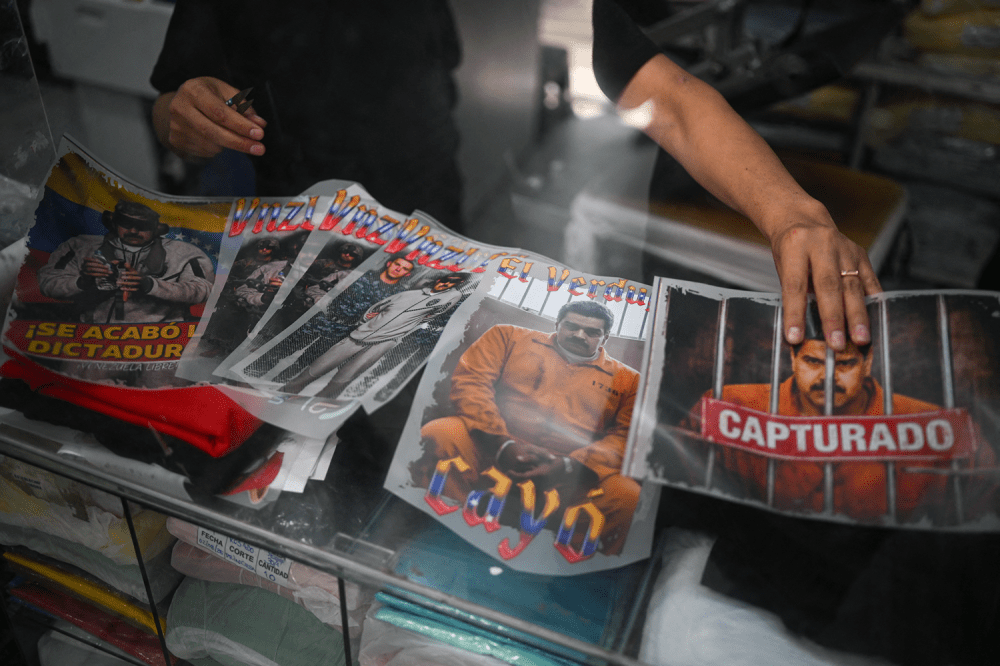
The U.S. attack on Venezuela on Jan. 3, while shocking, followed a familiar U.S. government playbook developed post-9/11. Successive presidents expanded executive power by declaring the existence of a war against terrorists; denying privileges or obligations to their opponents in this war; and diversifying targets while claiming self-defense against all. There is a straight line from the post-9/11 national security framework to the capture of Venezuelan President Nicolás Maduro.
Operation Southern Spear encapsulates the legal chaos generated by executives seeking to maximize power since 2001. Under the law of war, the White House (without congressional consultation or approval) actually initiated an armed conflict with Venezuela through an act of aggression that could constitute an international crime.
The U.S. attack on Venezuela on Jan. 3, while shocking, followed a familiar U.S. government playbook developed post-9/11. Successive presidents expanded executive power by declaring the existence of a war against terrorists; denying privileges or obligations to their opponents in this war; and diversifying targets while claiming self-defense against all. There is a straight line from the post-9/11 national security framework to the capture of Venezuelan President Nicolás Maduro.
Operation Southern Spear encapsulates the legal chaos generated by executives seeking to maximize power since 2001. Under the law of war, the White House (without congressional consultation or approval) actually initiated an armed conflict with Venezuela through an act of aggression that could constitute an international crime.
Now displaying breathtaking opportunism to escape censure for acting without Congress, the Trump administration claims that the Maduro snatch was just a “law enforcement operation” conducted by the military. To complete the legal turmoil, upon presentation in court, Maduro said he was a prisoner of war and entitled to all attendant rights and privileges.
The declaration of war for political purposes after the unprecedented 9/11 attacks anticipated the legal confusion over Maduro’s capture today. Terrorism and war are traditionally governed by very different legal regimes. There is no internationally recognized definition for terrorism because, as the old adage goes, “one man’s terrorist is another man’s freedom fighter.”
Instead, states prohibit acts of terrorism under domestic criminal law. That’s very different from the established law of war. The law of war is contained primarily in the 1949 Geneva Conventions and their protocols, which codified rules of engagement that most of the international community had recognized for hundreds of years and included explicit safeguards for detainees and civilians following the brutality of World War II. The law of war legalizes targeting and killing enemy combatants (traditionally, the opposing military or militias) and allows for proportionate civilian collateral damage when necessary to attain a military goal. Yet combatants in war also have special privileges in detention, including immunity from prosecution for lawful killing, protection from mistreatment, and access to the International Committee of the Red Cross. States have traditionally been loath to grant such privileges and immunities to those they consider to be terrorists, so terrorists were never considered to be combatants in a war before 9/11.
Additionally, the law of war does not allow for a nonstate actor such as al Qaeda to unilaterally declare war against a state; states alone have the power to start wars by declaration or armed attack. Armed groups do engage in violence against state forces, of course, and the state may respond in self-defense, but there are legal tests for determining when such violence qualifies as “war.” Most experts on the law of war agree that an isolated attack such as 9/11 (even combined with previous acts by al Qaeda such as the 1998 U.S. Embassy bombings in East Africa and the USS Cole bombing) could not constitute a war and certainly not one started by al Qaeda. The 9/11 perpetrators were therefore criminals, to be tried under U.S. domestic criminal law, as the United States had tried many previous terrorist suspects before 2001.
The problem was that Bush administration wanted to exercise those broad powers of war, without the obligation to grant any privileges to the people they detained. The White House solved that problem by simply announcing that detainees would be considered unprivileged, entitled to no POW rights—but that at the same time they could be targeted freely on the “battlefield,” which could be anywhere in the “global war on terrorism.”
In this legal twilight, the Bush White House avoided most of the constraints that would be placed on U.S. forces in a war, such as justification for strikes that disproportionately affect civilians or (beyond a few exceptions) legal consequences for military members and CIA officers who committed the crimes of torture and illegal detention within the fictitious war. The remaining 15 men captured during the initial war on terrorism languish at Guantánamo today, their health ravaged by torture and two decades of harsh imprisonment without family visits or adequate medical care, both Geneva Convention privileges. One of the architects of Bush’s strategy to withhold privileges later acknowledged that it was a “mistake.”
George W. Bush, and later Barack Obama, then diversified the targets. In its authorization for use of military force (AUMF) post-9/11, Congress granted the executive branch power to take action against the perpetrators of the attacks. However, shortly after 9/11, Bush pivoted to an old foe—Iraq—and received another AUMF for that operation. A scandalous invention of evidence for Saddam Hussein’s weapons of mass destruction underpinned Bush’s war of “preemptive self-defense.”
The United States continued to refuse Geneva Convention privileges and immunities to Iraqi detainees. Photographs from U.S. detention facilities and subsequent reports of detainee treatment revealed horrific abuses by U.S. forces that went largely unprosecuted. As a result, U.S. allies refused to share intelligence or conduct joint operations that could aid or abet U.S. war crimes, which weakened counterterrorism functions. The Islamic State emerged later in Iraq, using detainee abuse at Guantánamo as a recruitment tool.
Obama further broadened targeting under the original 2001 AUMF, launching drone strikes against groups and individuals in Pakistan and Yemen whom the White House claimed to be associated, even tenuously, with al Qaeda. Obama also refused to formally remedy civilian casualties, which international investigations estimated were far higher than his administration claimed. The implication was that those killed in drone strikes were guilty of acts of war against the United States, which the families of many victims and officials in targeted areas hotly contested. Former U.S. military drone operators characterized the program as a “driving force” for “terrorism and destabilization around the world.”
Within the United States, the ever more amorphous war was used to justify the enforced disappearance of José Padilla and other U.S. citizens under Bush; the unconstitutional surveillance of electronic data under Obama; and the deployment of troops against protesters under the first Trump administration. Just as the context of war provided cover for the expansion of executive power over foreign military action and suspension of human rights and humanitarian principles abroad, the same context of war led to the contraction of civil rights at home.
Donald Trump entered his second term ready to cry “war” in order to end most immigration into the United States. The drumbeat began immediately. One of his first executive orders, titled “Protecting the American People Against Invasion,” cited national security as justification for his race-based mass deportation policy. In another executive order issued the same day, Trump designated foreign drug cartels—particularly the Venezuelan gang Tren de Aragua—as “terrorist organizations.”
We already knew from Bush’s conflation of terrorists with combatants in a war that this was the first step toward claiming a “war” of self-defense against the cartels. Trump, predictably, went further, conflating criminal drug smugglers (who operate for economic gain) with terrorists (who operate on ideological grounds), and argued that the smugglers started the war. In fact, he described Tren de Aragua as a “hybrid criminal state” seeking to invade the United States and compared it to the Islamic State, whose members seek territorial control that Tren de Aragua does not. U.S. intelligence assessments confirm that Tren de Aragua is not supported by the Venezuelan government.
The Trump administration’s invocation of the 1798 Alien Enemies Act was intended to further bolster the “war” narrative. The act was last used by President Franklin D. Roosevelt in a deeply racist and xenophobic manner to detain Japanese, Italian, and German families during World War II and became the basis for the Trump administration to deport hundreds of Venezuelans. Some were first sent to Guantánamo (in a horrifying moment for longtime Guantánamo detainee counsel) and later to the Centro de Confinamiento del Terrorismo (CECOT) in El Salvador. Trump stated that the deportees were not entitled to due process and has not addressed the illegal renditions to torture at CECOT.
Finally, the high-profile drone murders of Venezuelan small-boat operators in the Caribbean echoed the immediate post-9/11 controversy of criminals vs. combatants, with the Trump administration characterizing the strikes as “self-defense” against the cartel-waged war. There is no public evidence that the boat occupants were even criminals, much less that they were engaged in combat in association with either a nonstate actor or by Maduro’s government.
Maduro was the de facto sitting head of state in Venezuela when abducted, regardless of U.S. recognition of his position. Although U.S. courts have ruled that they can exercise jurisdiction over people captured illegally, Maduro’s position makes him immune from prosecution in another country’s court (although the International Criminal Court may exercise jurisdiction over sitting heads of state, should Trump wish to repair relations with that court). The next steps for his defense will depend in part on whether the current Venezuelan authorities waive his immunity, as Panama did for Manuel Noriega regarding his U.S. prosecution in 1989.
Maduro is correct that he is a prisoner of war because a war existed when he was abducted—but not a war of “self-defense.” The law of war is clear on this issue. The U.S. armed attack began an international armed conflict (a traditional war) between the two states. Anyone captured during the war, even if the war lasted only for that day’s attack, is a prisoner of war. If Noriega’s case serves as precedent, the Southern District of New York should recognize that designation as his prosecution inevitably moves forward.
It is encouraging that U.S. allies have criticized the illegal abduction of Maduro and his wife, just as many of them criticized the detention facilities at Guantánamo Bay, the CIA torture program, and the drone killings. But the fundamental problem is internal: Congress, the courts, and any future administration must recognize that executive power has expanded far beyond constitutional bounds and the definition of “war” with it. Both international law and U.S. credibility and security have suffered grievously as a result.
The author’s writing does not reflect the opinion of the U.S. Defense Department.