
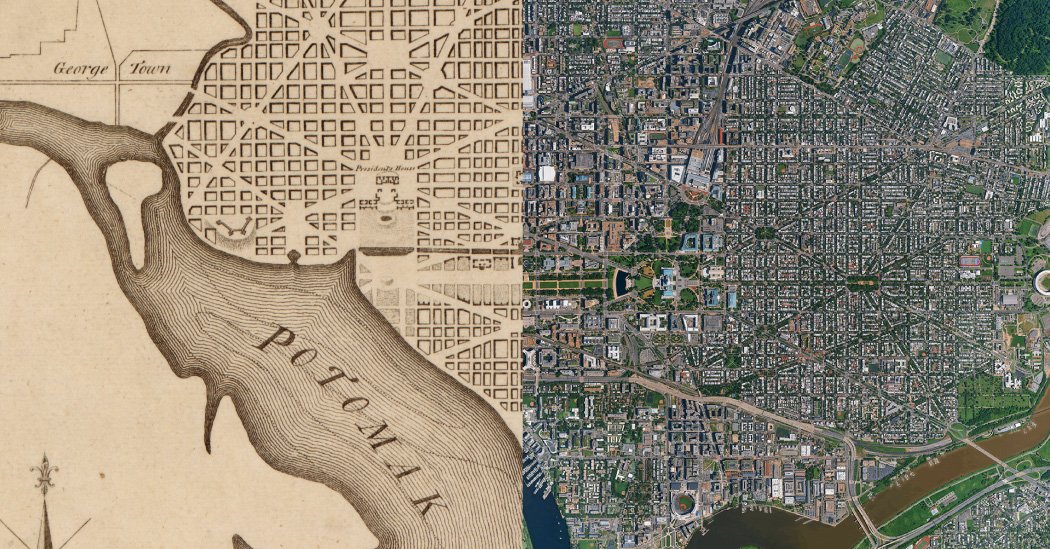
Pierre Charles L’Enfant, the French-born engineer hired by George Washington to lay out the new American capital, proposed an ambitious idea: the whole city as a work of civic art. His vision, visible in the city today, included sweeping sightlines to the Capitol and subtle nods to the new democracy encoded in the street network.
And for much of the city’s history, that idea has been deliberately tended — a new monument here, an expanded park there, a solemn vista aligned just so. Washington is unlike any other city in America for this accumulation of carefully arranged details, many quietly referencing one another.
President Trump returned in his second term eager to leave his own mark on the capital at the nation’s 250th anniversary. In this often slow-moving city, his proposals have been urgent, including a ballroom, a triumphal arch, a garden of heroes, a championship golf course, a renovated Kennedy Center and more.
“He might be equated with Jefferson before he’s done in the impact that he had on the city,” said Rodney Mims Cook Jr., the president’s appointed chair of the Commission of Fine Arts charged with reviewing many of these plans (Jefferson looked over L’Enfant’s shoulder and steered design competitions for the Capitol and White House). Mr. Trump, he said, could help complete L’Enfant’s plan.
His arch would be the most prominent monument added to the capital in 80 years, his ballroom the greatest change to the White House grounds in at least as long. And his imprint could extend beyond any single construction site, altering faraway views and the framing of iconic sites.
Many historians, architects and planners fear that a president so confident in his own taste could disrupt in months what has been assembled here over two centuries. It’s not that Washington shouldn’t change, they say — rather, that change should be guided with a particular care that no other American city demands.
1791: The L’Enfant Plan
L’Enfant envisioned a city far more extensive than what the new federal government needed in 1791. Even then, he was thinking about how the capital would tell the story of the nation.
Thackara & Vallance engraving of the L’Enfant plan (1792), Library of Congress, Geography and Map Division
L’Enfant sparred with the city’s commissioners and was fired before finishing the job. But the capital that rose here largely followed his plan, and the ideas he embedded in it give Washington its distinctive feel today. Manhattan’s street grid, laid out two decades later, was divided into uniform blocks that could be easily developed by private citizens. Washington’s shape, by contrast, is defined by what’s public: the key civic buildings, the wide avenues and squares, the central Mall.
“There’s a fundamental idea that the city conveys about public value being first and foremost over private interest,” said Thomas Luebke, the longtime secretary of the Commission of Fine Arts, which was created by Congress in 1910 to help shepherd the city’s evolution. “That idea that we come first as a group is somehow conveyed in the scale and design of the city.”
L’Enfant’s grand pedestrian mall, the centerpiece of his plan, became a jumble of buildings and disconnected gardens in the 19th century. The agriculture department ran experimental crop fields there. A railroad terminal was built on the Mall in the 1870s, its train tracks bisecting the green.
A monument to Washington was at last completed in 1884, although in slightly the wrong spot, off-center to L’Enfant’s axes (where the land could better support a giant obelisk).
By the turn of the 20th century, as the city was celebrating the centennial of the federal government’s relocation here, Washington’s core hardly resembled how Americans know it today. That transformation would happen thanks to the second great plan for the city.
1901: The McMillan Plan
The Senate Park Commission, proposed by Senator James McMillan of Michigan, was tasked in 1901 with unifying a new network of outlying parks and restoring L’Enfant’s idea of the capital as a coherent whole.
The commission, including the architect Daniel Burnham and the landscape designer Frederick Law Olmsted Jr., claimed to study every part of the city. And in unveiling their proposal for its future, they warned, “No such undertaking should be allowed to invade, to mutilate or to mar the symmetry, simplicity and dignity of the one great composition” of the District of Columbia.
To dramatize its Mall plan, the commission exhibited this rendering in pencil, ink and watercolor wash. It’s more than nine feet wide.
To appreciate its details, let’s turn it on its side and look closer:
At the center of this kite shape, the commission proposed a circular pool and garden, which were never built. But much of the rest of the plan was: Union Station, the Lincoln Memorial, the Arlington Memorial Bridge, the Jefferson Memorial, the decluttered Mall framed by American elm trees and grand civic buildings.
Those changes would take decades. As late as the 1930s, the Mall still looked like this, with temporary World War I-era buildings and even a power plant:
Elsewhere in the city, parts of the McMillan plan and L’Enfant’s street grid were disrupted by urban renewal and highway construction. But the “monumental core” evolved into a place that is remarkably faithful to these two documents.
The tilted Mall is the kind of conscientious detail that now appears throughout the area. The monuments directly speak to one another. They each defer to the Washington Monument. The spaces left open are a part of the effect.
The more recent museums added to the Mall hardly match one another in architectural style or material. But they are unified in how they open onto a shared front lawn, and in how their similar heights convey that no one institution looms greater than the others.
“Even in the most extreme of their differences, they’re tipping their hat to the context,” said Elizabeth K. Meyer, a professor of landscape architecture at the University of Virginia and a member of the Commission of Fine Arts from 2012 to 2020.
In the resulting collection, much of the American story is right there on the Mall: art, war, ingenuity, protest, space exploration, the founding fathers, the great outdoors, the democratic ideal. The Mall has made space for parts of the story L’Enfant and McMillan didn’t anticipate (or celebrate), like Native American history. It has allowed new stories layered on top of earlier ones, like the way the Lincoln Memorial has become a civil rights symbol.
“It’s really unparalleled where you have a single idea that lies dormant for the most part for a century,” said Richard Longstreth, an architectural historian, of the L’Enfant plan. “Then in revised form — and aggrandized form — it slowly and with great effort takes shape as the McMillan plan, which is still the guidepost for our thinking. Until now.”
2026: The Trump era
President Trump returned to Washington with a distinctly different perspective from the architects, planners and preservationists who have shaped the capital. The president is a developer — and he describes his projects in the builder’s logic of underutilized land and maximized value. In West Potomac Park, his chosen spot for his garden of heroes, he sees a “totally BARREN field of Prime Waterfront Real Estate.”
And he believes he has found many such spaces in D.C.
Critics argue that these projects are in tension with the history around them, rather than at one with the “great composition” of the capital. And they say there hasn’t been much time or willingness to resolve that tension (a process that previously controversial projects still went through).
“The dilemma we have is we have a developer-in-chief who is object-oriented,” said Charles A. Birnbaum, who leads The Cultural Landscape Foundation, which has sued over the reflecting pool and the Kennedy Center. That means the president is attuned to paint colors and column styles, he said, not symbolic axes and century-old city plans.
Mr. Trump’s supporters, in response, stake a claim to history, too. Presidents have talked about wanting a ballroom for 150 years, administration officials say. And the 1924 Arlington Memorial Bridge Commission, they note, originally called for a pair of 166-foot-tall columns in the park at the bridge’s western end. The arch’s 166-foot height (below the gilded statues that bring it to 250 feet) is meant to nod to that proposal.
“The president is not talking about steamrolling D.C. and putting up high-rises, he’s talking about additions with a history,” said Will Scharf, the White House staff secretary and the chair of the National Capital Planning Commission, which also reviews these proposals. “The ballroom, the arch, putting a monument in Memorial Circle — these are old ideas.”
Being a developer, he added, means Mr. Trump can finally bring those ideas to life “not at the speed of government.”
Mr. Cook, the chair of the Commission of Fine Arts, says L’Enfant always intended for the capital to include something like grand arches (Mr. Cook has for years been proposing where to put them). They’re not explicit on L’Enfant’s drawings. But Mr. Cook believes it would have been heresy for him not to complete his plan with such gateways to the city.
“Then let’s have a conversation,” said Rebecca Miller, the executive director of the DC Preservation League (they’re suing over the golf course, the Kennedy Center and Trump’s plans to paint the granite exterior of the Eisenhower building white).
Let historians debate Mr. Cook’s claim, and include the public, she said. Would L’Enfant’s arches have been 250 feet tall? Is “triumphal” the right tone for the entrance to Arlington National Cemetery? Is an arch the best way to commemorate the nation’s 250th anniversary?
That is the kind of raucous, public, potentially years-long process that has preceded other major additions to the capital. But just months after it was introduced, the arch has already been approved by the arts commission. The ballroom is already under construction. The president has his own deadlines — the 250th anniversary this summer, and then the end of his term.
Before Mr. Cook’s commission approved the arch in May, the panel asked the architect Nicolas Leo Charbonneau to consider removing the gilded statues on top and to add more openings to make it a less imposing mass.
The president, Mr. Charbonneau explained, elected not to adopt those revisions.



