
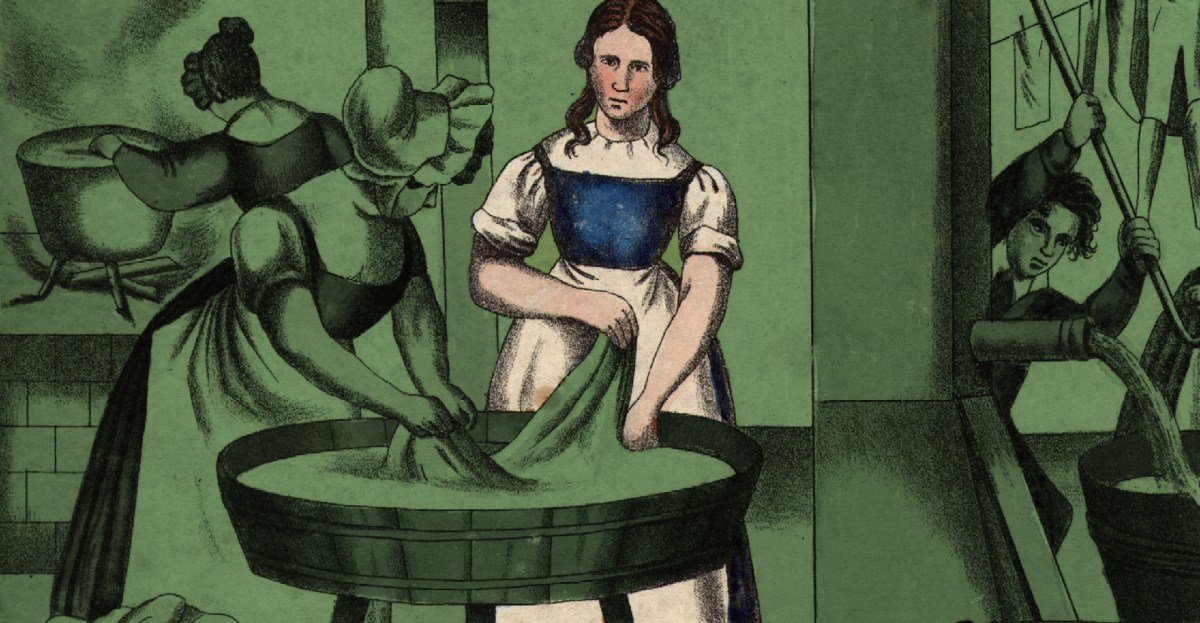
Yesteryear, the buzzy new debut novel by Caro Claire Burke, has the kind of premise it’s hard to look away from: a tradwife influencer named Natalie — a Harvard dropout who married rich at 20 — wakes up in 1855. Gone are her tastefully discrete appliances, her prized collection of luxury sweaters, her team of nannies and farm workers. In their place: an outhouse, stained homespun prairie dresses, and hours of back-breaking labor spent washing a single load of laundry with homemade lye soap.
Natalie, confronted with this brave old world, does a lot of crying. Things get especially rough for her after she tries to escape, stumbles into a bear trap, badly injures her leg, and then has to cope with 19th-century pioneer medicine. The medicinal ointment “smells like bacon grease,” and there’s no anesthetic for the stitches, so that, Natalie tells us, “it feels like my body has depleted a month’s worth of energy from the mere translation of so many nerve signals screaming EMERGENCY to my brain.”
There’s a sort of satisfaction to witnessing Natalie’s distress. You find yourself wanting to say, “How’s all that trad working for you now?” and then maybe sneer a little.
At long last, one of those perniciously appealing traditional housewife influencers — the type who’s always posting videos of herself baking bread in a sun-drenched kitchen while her adorable children romp next to her — has been forced to put her money where her mouth is. Surely now, you think, she’ll have to admit that the modern era has some things going for it.
Yesteryear is a book animated by this kind of rage, by a palpable fury at the archetype of the tradwife. That’s what makes the premise so irresistible — irresistible enough to have garnered breathless review coverage, for Anne Hathaway to sign on to produce and star in the movie after a vicious four-studio bidding war. I myself read Yesteryear in one long rush, unable to put it down.
But where the book begins to falter is when it tries to suggest that tradwives are just as angry with themselves as feminists are.
In Yesteryear, Natalie knows her content is rage bait. She refers to her followers as “the Angry Women,” noting smugly that “self-proclaimed progressive women” are “chemically addicted to hating women like me.” When, on a trip to Target, she encounters Vanessa, a high school friend who has since renounced her devout upbringing, Natalie lingers with almost erotic pleasure on how much the person must envy and despise her. “Go ahead,” she thinks gleefully. “Give yourself a migraine thinking about me.”
Natalie isn’t wrong that a lot of the attention tradwives receive ranges from critical to furious. “Is tradwife content dangerous, or just stupid?” asked a viral Cut essay in 2023. Another essay in 2020 described the sexism at its core as “the gateway to white supremacy.” In a 2024 profile of Hannah Neeleman, the influencer known as “Ballerina Farm,” who is the most prominent of the tradwives, the New York Times summarized the discourse: “Is she, as her fans would have it, a woman who has made the commendable decision to stay home, raise the kids and support the family farm? Or is she, as her detractors would argue, someone who uses social media to push for a return to traditional gender roles while glossing over the privileges that allowed her to have such a lifestyle in the first place?”
To people who consider themselves progressive, who are by and large the presumed audience for Yesteryear, tradwives aren’t women who “choose their choice”; they threaten the gains of 20th-century feminism. They try to sell women on the lie that they would be happier without birth control or educations or careers, tending endless beautiful children in a spotless, beautiful kitchen. And it’s true that a large swath of their followers are there both for the pleasure of their gorgeous pastoral lives and to be furious at them for their political propaganda.
Natalie describes the appeal of her content by analogizing it to the rancid, craveable flavor of black truffles. “People aren’t so different from pigs, apparently,” she says. “Once they learn a rotten thing can be eaten, they will eat it, and they will become addicted to it.” She believes there is a “rot” of unhappiness on her farm that comes through in her content — her own exhaustion at the drudgery of her chores, the palpable fakery of her artificial paradise — “and everyone rushed towards me with their forks.”
For most critics of tradwife content, the “rot” Natalie is describing here is the anti-feminist proselytizing, the romanticization of a bleak way of life that left many women trapped. The rot Burke is portraying in Yesteryear, however, is just straightforward influencer hypocrisy.
Influencing at its most basic form is sales, and like any overworked saleswoman, Natalie lies about her product: herself, and her allegedly pure lifestyle. She secretly douses the family’s “organic” farm in pesticides, because she knows they’ll never turn a profit otherwise. Her pastoral-chic line of Dutch ovens is made in Taiwan and drop-shipped. She has nothing but contempt for Vanessa, whom she greets warmly while internally calling her a “pick me” and a “cunt” for having named her daughter Zoe.
But Natalie’s hypocrisy goes deeper than that. We learn that she despises her dimwitted husband Caleb, whom she felt pressured to marry young and begin having kids with as soon as the wedding was over, thanks to the culture of her unnamed evangelical sect; he cannot achieve a full erection during sex, leaving her to impregnate herself with a sauce baster. Being alone with her children triggers panic attacks. Early followers tell her that her smile looks too strained, so now she compulsively practices fake smiling at all times, and has trouble dropping it when the occasion calls for solemnity.
Still, she tells herself that all the wives and mothers she knows are happier than the career women she sees bemoaning their inability to have it all. Once she has her first child and finds herself bored and miserable, she decides the stay-at-home moms she knows must be lying about their happiness. With no work history or job prospects and an ever-mounting brood of children to provide for, she can find no outlet for her intellect and creativity outside of the project of turning her life into online content.
Natalie has an intimate understanding of why her followers love to resent her, because she loves to resent modern women. She tracks her liberal college roommate Reena on social media for the sheer pleasure of hating her and her life choices, an act that mirrors career women hate-following tradwives. “She looked like a stereotype of a modern woman,” Natalie gloats over a video of Reena announcing she’s been laid off from her consulting gig, “poreless and lip-lined and shrill.”
Throughout the novel, characters create an imaginary woman out of scraps of social media content, just so that they can get mad at her. Natalie does it with Reena, and Natalie’s followers do it to her. In Burke’s telling, we do this because we are all unhappy with our own lives and want to lash out. Which is a little strange, because what is the novel Yesteryear if not the process of creating an imaginary woman out of scraps of social media content, just so that we can get mad at her?
Yesteryear has a gripping, thriller-like pacing, which it owes mostly to the delicious mystery of what exactly happened to Natalie to send her to 1855.
Did she time-travel, à la Outlander? Is she on some sort of hidden camera reality TV show? Is she being tested by God (Natalie’s favorite option)? At one point, she finds a secret cabin in the past with a sign out front that says “The Manosphere,” and I got giddy with delight over the idea that Burke was positing a world where all those podcasters decided to start building virtual realities to send uppity women for reprogramming, like an updated Stepford Wives.
Along the way, Natalie is punished by the world of 1855. There’s the bear trap, of course, and the fact that one of the first things Caleb does when we meet him in the past is slap his wife across the face so hard she blacks out. Also, the food “looks, frankly, like shit,” made with such sparse, stingy ingredients that even Natalie’s famous sourdough loaves don’t turn out right. (“The worst possible thing to happen,” she fumes.)
The real reason for Natalie’s time travel, when it comes, is deflating. Without spoiling too much, Burke’s conclusion suggests that the sadistic anger that pulses through Yesteryear — the desire to see Natalie brought down a peg, humiliated, forced to admit that what she says she wants is not what anyone who had the choice would actually want — is a feeling that Natalie shares. She wants to see herself punished as much as the reader does. She punishes herself enough to furnish the whole plot of the book.
There’s an easy smugness to this conclusion that, in retrospect, makes the project of Yesteryear less satisfying than it at first promised to be. It relies on the seductive but unlikely idea that if tradwives were really honest with themselves, they’d admit that they agree with feminists on what the problems with their lives are. It posits that Natalie, too, wants to ask, “How’s all that trad working out for you now?”
I don’t think we have to pretend that being Ballerina Farm really is as idyllic as it looks on Instagram in order for us to grant tradwives the courtesy of taking them at their word about their fundamental beliefs. Their lives might not be all that happy, but it strikes me as unlikely that tradwives secretly believe that this is because the message they are preaching is false and will make other people’s lives worse. Nor do I believe tradwives really think that they are doing something wrong, something rotten, by making the content that they do.
Even Natalie, for all her silent rage, never imagines that the liberal women she hates don’t genuinely believe in equality. It’s as though the strongest comeuppance Burke can imagine for this woman who makes us so angry is to deny that she believes the things she appears, through all her words and actions, to sincerely believe. Yesteryear punishes the tradwife by making her into someone less than substantial — and so in the end, this bingeable, buzzy novel fails to entirely satisfy.
There is something fundamentally dishonest in building an imaginary woman in order to hate her, and not even letting her hold her own principles. I suppose it’s fun to imagine a world in which a tradwife turns out to secretly love cursing and pills, where social media is not just exaggerated but an out-and-out lie, and where she punishes herself to save all the rest of us the trouble. But that’s no less of a fantasy than a bucolic farm where the bread is always perfect and the children never cry.



