
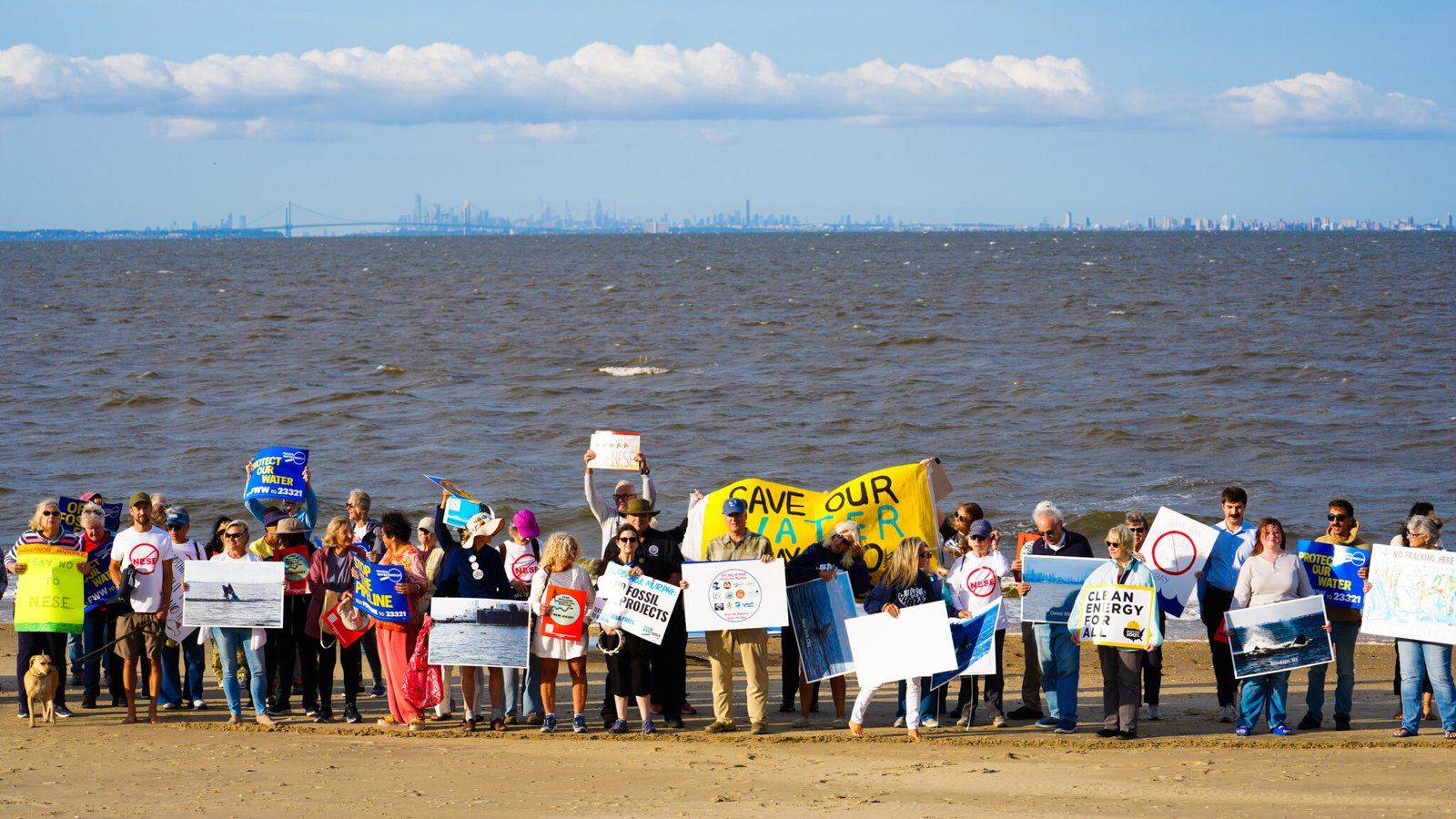
A state environmental panel on Wednesday approved the final license an energy developer needs to build a controversial $1 billion underwater natural gas pipeline project between New Jersey and New York, over the objections of dozens of environmentalists, public health experts, elected officials, residents, boaters, fishing enthusiasts, and others.
Critics have dubbed energy developer Williams’ proposed 37-mile Northeast Supply Enhancement pipeline the “zombie pipeline” because previous permit denials in 2018, 2019, and 2020 killed the project. But the company reapplied to the Federal Energy Regulatory Commission in May 2025, the commission approved the project in August, and state regulators in New Jersey and New York green-lighted it in November.
Wednesday, seven members of the Tidelands Resource Council unanimously approved a utility license Williams needs to construct the pipeline, which company officials say will expand capacity for the national grid. (The 12-member council has one vacancy and four members were absent.)
The approval came at the end of a nearly five-hour virtual public hearing, where only two people besides Williams officials spoke in support of the plan. More than 50 others blasted it, shouting “shame!” after the council approved it and calling council members “maggots,” “criminal,” and “disgusting” in the meeting’s chat thread.
The license was the last regulatory hurdle Williams had to clear for construction of the pipeline, which will deliver gas from Pennsylvania to Long Island via Old Bridge, Sayreville, South Amboy, and under the Raritan Bay in the New York-New Jersey Harbor. It would be part of a larger interstate network known as the Transcontinental pipeline, or Transco.
Despite the license approval, the project’s fate remains uncertain because its opponents have challenged it in state and federal courts in New Jersey and New York. Oral arguments are set for June 18 in federal court in New York, while briefs are still being filed in New Jersey’s federal fight, said attorney Dan Greenhouse of Eastern Environmental Law Center, which represents several environmental groups.
“It is a very real possibility that the meritorious challenges brought in these federal courts may result in significant changes to or reversal of the current permits that are required for the project,” Greenhouse said during the meeting. “So the council ought to hold its decision at least until the court cases have been finally decided.”
Environmentalists seek court review of NJ’s approval of $1B interstate pipeline
Council members, though, forged ahead after an hourlong closed door session where they discussed their “authority to act,” as well as the pending litigation, with Nicholas Seminoff, a deputy attorney general for New Jersey.
When they returned to the public meeting, they asked Williams’ representatives about issues that had particularly piqued critics, including the pipeline’s path across an underwater Superfund site and the company’s plans to discharge into the bay chemical-treated water that will be used to test the new pipeline.
They then approved the license but limited it to seven years instead of the 24-year approval Williams sought, ordered officials to submit updated drawings as the project gets built, and required the company to leave land in the pipeline’s path the way they found it, in case they ultimately abandon the project.
Earlier, critics had warned council members that the project risked environmental catastrophe, pointing to past violations and accidents involving Williams’ pipelines as well as the lead, arsenic, and other contaminants buried at the Superfund site the proposed pipeline would cross.
“I don’t know how this council could consider approving anything that goes through a Superfund site. It just defies common sense,” said Don Greenberg, a Bradley Beach resident and at-large chair of the Surfrider Foundation-Jersey Shore chapter. “We shouldn’t destroy this bay for a profit grab by a multinational company.”
Critics said New Jersey should be focusing on expanding solar and wind energy sources, with the U.S. lagging far behind China in renewable energy. They regarded the pipeline’s revival as proof of President Donald Trump’s meddling.
“During the 2024 election cycle, the oil and gas industry, including the Williams pipeline company, spent $450 million to impact the election results. As soon as President Trump took office, he embarked on a systematic payback plan for the industry, including successfully bullying New York’s Governor (Kathy) Hochul into approving the NESE pipeline,” said Anshul Gupta, policy and research director at New Yorkers for Clean Power.
The project’s foes also reminded the council that such projects required a showing of public necessity — and the pipeline would not serve New Jerseyans, delivering gas instead to people in Brooklyn, Queens, and Long Island.
“Approving unnecessary projects is the absolute worst decision that TRC can make,” said Ken Dolsky, vice president of New Jersey Forest Watch.
Williams’ representatives said the project is necessary.
“As determined by a number of federal and state agencies, the project has been determined to be in the public interest,” said attorney Richard Scott, who represented the company at the hearing.
Williams did have two people pipe up to support the pipeline project.
Dennis Hart, executive director of the Chemistry Council of New Jersey, said manufacturers here pay 55% more for electricity than the rest of the country, and the pipeline expansion could help alleviate that.
“We are not looking at an energy crisis in the future. We’re facing an energy crisis and energy shortage right now,” Hart said.
Ray Cantor of the New Jersey Business and Industry Association dismissed complaints that New Jersey residents would not benefit.
“We are not concerned that most of the gas will be going to near our state. We recognize that we are a nation of individual states. One state should not be in a position to deny energy resources to another state. That is why we have FERC overlooking the entire project,” Cantor said. “If we were to accept that proposition, then New Jersey would be at the whim of other states merely deciding to deny us our energy resources.”
Williams officials have said construction would start this fall, with the pipeline expected to be completed by the end of next year, barring further denials or delays.
GET THE MORNING HEADLINES.



