
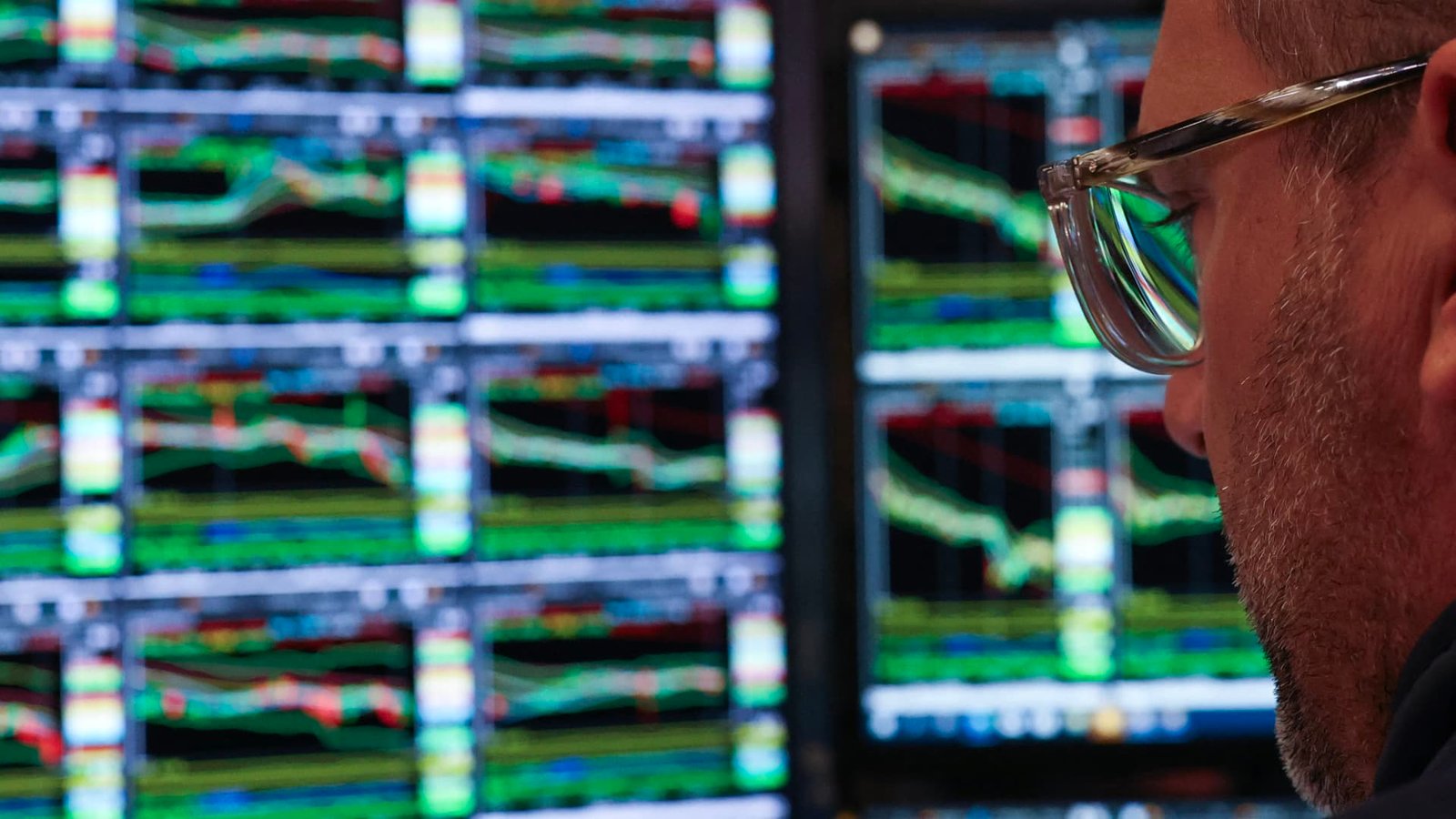
A trader works on the floor of the New York Stock Exchange (NYSE) at the opening bell in New York City, on April 7, 2025.
Timothy A. Clary | Afp | Getty Images
Investors ran for cover this week as fears surrounding artificial intelligence spending and higher oil prices both hit stocks, driving the yield on the 10-year U.S. Treasury note below 5%.
The benchmark yield remained just under 5% on Friday, after falling beneath that level Thursday for the first time in a month, as investors continued to express misgivings over the massive debt tech companies are taking on to finance their build-out of AI networks.
The magnitude of Thursday’s drop in 10-year yields clouds the near-term outlook, leaving bond investors “dazed and confused,” said Chris Rupkey, chief economist at Fwdbonds. The only consistent storyline Friday was crude oil futures moving higher and closing above $100 per barrel, he said.
“This means more or less that more inflation is on the way, so bond yields are adjusting higher to account for this energy price surge,” Rupkey said.
On Friday, the yield on the 10-year U.S. Treasury — used as a benchmark for borrowing costs ranging from mortgages to credit cards — rose 5 basis points to 4.999%.
The yield on the 2-year Treasury note, which more closely tracks short-term Federal Reserve policy, also increased 5 basis points, to 4.686%. Yields on longer-dated 30-year U.S. Treasurys climbed 4 basis points, to 5.312%.
One basis point equals 0.01%, or 1/100th of 1%, and yields and prices move inversely to one another.
This week’s rebound in Treasury prices comes just weeks after 10- and 30-year yields jumped to their highest levels in more than 20 years.
Since then, concerns have grown about the hundreds of billions of dollars being spent by tech companies. Stocks sank, bond yields on outstanding tech debt rose and spreads on credit default swaps widened in a host of AI companies.
CoreWeave has led the rout. The yield on its 9.75% bond due in 2031 stands at 15.637%, while the spread on its five-year credit default swaps is 1,129. Any reading above 1,000 is generally considered distressed.
The question remains whether the trend of lower Treasury yields will continue, said Byron Anderson, head of fixed income at Laffer Tengler Investments.
“With a Federal Reserve that is focused on inflation and largely out of the bond market as a buyer, it is hard to see a sustained rally without the market narrative flipping to recession,” he said. “We are far from the recession narrative, with two Fed rate hikes still built into expectations and a good economic backdrop.”
The Federal Reserve meets next week and the market isn’t expecting any change in official rates from the current level of 3.75% to 4.00%. However, it is pricing in a roughly 71% probability of a quarter percentage point hike in December, according to the CME Group FedWatch tool.
Rupkey expects Fed Chairman Kevin Warsh’s press briefing Wednesday will “likely leave bond investors in the dark.”
“We don’t expect Warsh to green light a December meeting rate hike that a Powell Fed might have done in the good old days,” he said.
Consumer sentiment changed little in October from historically low levels as inflation weighed on the economic outlook, according to a University of Michigan survey released Friday.
The survey showed the headline consumer sentiment index at 48 this month, off just 0.1 point from September and better than the Dow Jones consensus for 46.3. Compared with a year ago, the gauge tumbled 10.4%.
On inflation, the one-year outlook rose to 4.7%, while the five-year expectation accelerated to 3.5%, both 0.1 percentage point higher than September.
Also on Friday, the S&P Global Purchasing Managers Index for manufacturing came in hotter than expected, at 56 versus a 55.3 estimate, the highest reading in 53 months.
Meanwhile, rising energy costs continue to weigh on the inflation outlook.
West Texas Intermediate futures for December delivery gained 3.8% to close at $103.27 per barrel on Friday. Brent crude, the international oil benchmark, rose 3.1% to settle at $116.72 a barrel, the highest settlement for Brent since April 29.
Firmer energy prices come as fresh attacks by Iran-backed Houthi militants against Saudi Arabian oil installations drove new fears over an oil supply squeeze. President Donald Trump said Wednesday the U.S. was not negotiating with Iran and promised something would happen “fairly soon.” Those remarks came after New York Times reports earlier this week that the U.S. and Israel could resume strikes against Iran following the midterm elections on Nov. 3.
— CNBC’s Jeff Cox and Spencer Kimball contributed reporting.



