
The Pinellas County Sheriff’s Office arrested two of its own deputies on felony charges Wednesday after investigations found they abused official databases — in one case, automatic license plate reader data — to look up people they were romantically interested in, Sheriff Bob Gualtieri said.
In the first case, 33-year-old Deputy Travis Stanton used agency and state databases to research a 17-year-old girl he met at the restaurant where she worked, Gualtieri said at a news conference. Stanton’s case did not involve abuse of the automatic license plate reader database, Gualtieri said.
In the second case, Deputy Karl Gwynne, 57, queried the agency’s automatic license plate reader database some 300 times to track the car of a woman he wanted to date, according to the sheriff.
Stanton’s defense attorney, Kym B. Rivellini, released a statement to the Tampa Bay Times.
“Mindful of how the Sheriff’s Office operates after almost a decade of service, Travis decided it was the best course of action to resign from his law enforcement position,” the statement said. “We stand behind his history as a good person, a good husband and a proud former law enforcement officer. With his wife and family, we will now navigate this process as they begin a new chapter in their lives.”
A defense attorney for Gwynne was not listed in court records Wednesday, and he could not immediately be reached for comment.
Automatic license plate readers have generated an uncommonly universal wave of outrage from Americans concerned about the government following their private lives when they’ve done nothing wrong. At the same time, defenders say, these readers can offer key pieces of evidence in criminal cases.
But worries of how authorities access and use vast troves of surveillance data have compounded as stories of misuse pile up.
The investigation into Stanton began when the teen complained to the sheriff’s office, saying the deputy was coming into the fast-food restaurant where she worked and making her uncomfortable, Gualtieri said.
Investigators learned the girl told Stanton on July 28 that she drove a Nissan Altima and that she was 17. A few minutes after leaving the restaurant, Stanton used the computer in his patrol car to run the license plate on the girl’s car through the Florida Crime Information Center, commonly known as FCIC. The database is highly controlled and for official use only, Gualtieri said.
“Stanton was well aware of the legal requirements to access this database and the consequences for misuse,” Gualtieri said. “Running the plate of a 17-year-old girl who you are interested in is clearly inappropriate and clearly unlawful.”
Trying to identify the girl, Stanton learned through the query that the car was registered to her mother, and he found the family’s home address, Gualtieri said. Stanton learned that the girl has a twin sister, and he accessed the sister’s driver license photo.
Stanton visited the girl at the restaurant at least four times between July 31 and Aug. 18. On Aug. 19, Stanton entered the parking lot at Seminole High School, where the girl and her sister are students, and ran a tag on a car similar to the girl’s Nissan, but it was the wrong car, Gualtieri said. He then ran driver’s license checks on the girl and her sister five times while still in the school parking lot.
To justify the searches, Gualtieri said, Stanton entered a code to indicate that he was “verifying an identity.”
“Now he’s verifying an identity, all right, but it was not for official reasons,” the sheriff said.
Also while at the school, Stanton queried the girl’s name in the sheriff’s office’s records management system and the girl’s mother driver’s license information and photo. He took a photo of the girl’s driver license photo using his agency cellphone.
Stanton returned to the restaurant on Aug. 25 and again photographed the girl’s license photo in his car. He then went into the restaurant and inadvertently recorded a 17-minute conversation with the girl. He asked her if she wanted to see a dead body he’d photographed five days earlier at the scene of a motorcycle crash, Gualtieri said. She said no.
“Stanton can be heard telling the girl during the conversation that he knows that she’s a minor and clearly knows that she is only 17 years old,” Gualtieri said.
He told the girl that he’d received a “hit” on her car in the agency’s system that said her driver’s license was suspended for truancy. That wasn’t true, Gualtieri said.
“He knew her license was suspended because of his unlawful snooping in the system and accessing her personal information, including her photograph,“ Gualtieri said.
Stanton again returned to the restaurant on Sept. 4, 11 and 17, staying for about 20 minutes each time.
During phone calls that day, including with another deputy, Stanton referred to the girl as “my queen,” Gualtieri said. The other deputy said Stanton clearly had a romantic interest, the sheriff said.
When supervisors asked Stanton about accessing the girl’s information, he said “curiosity got the better of him,” Gualtieri said.
Stanton, who was hired in 2017, was placed on administrative leave while the investigation continued, and he resigned Friday. He faces charges of unlawfully accessing the computer network and official misconduct.
Court records show he posted bond totaling $10,000.
The investigation into Gwynne began with a “media inquiry” about a large number of searches in the agency’s license plate readers database, Gualtieri said. A subsequent agency audit showed Gwynne had queried the database 300 times for the plate of a 35-year-old woman he’d arrested in 2010.
Supervisors questioned Gwynne on Sept. 11, and he initially said he did the searches for official reasons “but then admitted he wanted a relationship with the woman but that she had rebuffed his advances,” Gualtieri said.
Gwynne resigned that day. He was hired by the agency in 2005.
Further investigation found that Gwynne queried the woman’s information 81 times in other databases, including the Florida Crime Information Center, the statewide law enforcement records management system and his own agency’s records management system, according to the sheriff.
Of the 381 queries, Gwynne made 207 while off duty. He faces four counts of unlawfully accessing a computer system and one count of official misconduct. Records show he was released after posting bond totaling $25,000.
Gualtieri did not provide more details about the media inquiry. TCPalm reported Wednesday that it had asked the sheriff’s office as part of an investigation with USA Today about license plate data search anomalies in a publicly accessible log of such searches.
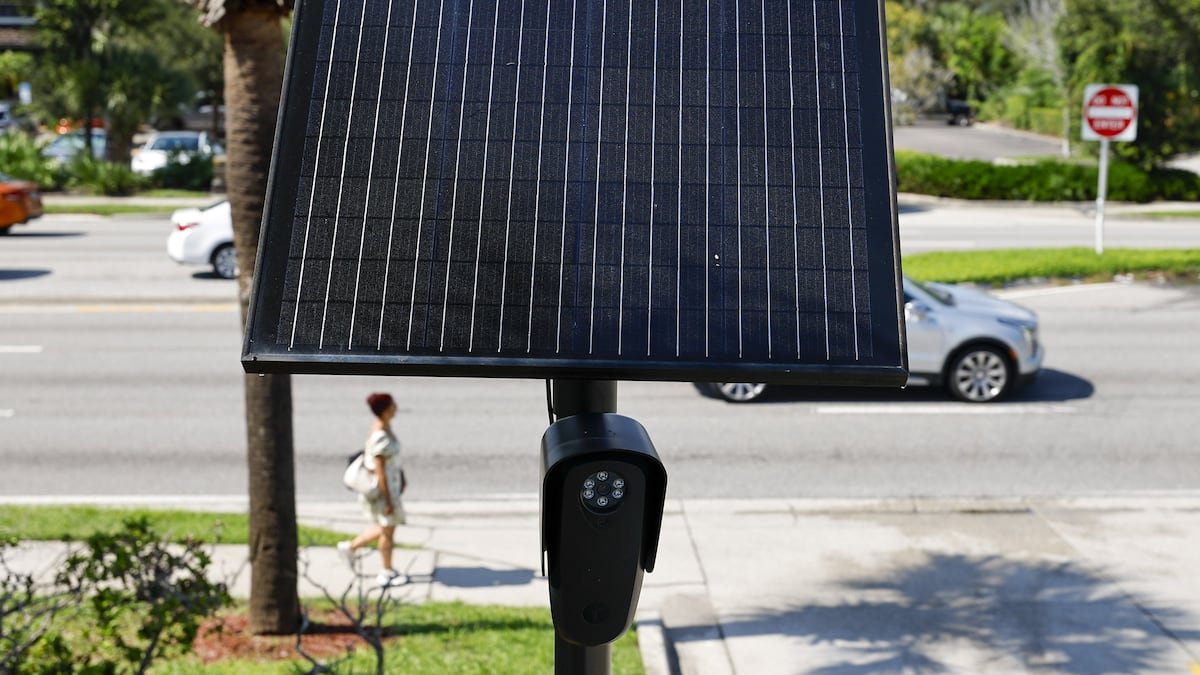
License plate reader cameras take a snapshot of passing cars, and artificial intelligence helps categorize vehicles based on make, model, color and license plate. The images flow to a searchable database.
The readers are commonly referred to as Flock cameras, though other companies like Axon provide similar products.
Reports of abuse of the data that license plate readers capture have contributed to a wave of backlash across the country, in Florida and in the Tampa Bay region.
The Washington Post reported last month that at least 50 law enforcement officers had been charged with or accused of misusing it and other systems. A TCPalm-USA TODAY investigation has resulted in law enforcement officers in Florida and four other states being fired, arrested or placed on leave.
On Aug. 31, the Florida’s Department of Transportation revoked approvals for cameras that read drivers’ license plates on state roadways. Agency leaders directed local police departments to take them down within 30 days, or Sept. 30. A memo obtained by the Times/Herald cited “recent exponential increase in deployments along our roadways, coupled with concerning reports of misuse, data privacy concerns, and surveillance schemes.”
Local governments in other states have canceled contracts, citing privacy and safety concerns.
Law enforcement leaders including Gualtieri have said the systems are a vital tool in fighting crime and finding missing people.
For a Times story that published in early August, Gualtieri said his agency uses Flock, Axon and a company called Vigilant for cameras. All deputies have access to license plate readers, and the technology doesn’t require much training, he said.
“What we should focus on is making sure that we’ve got the right safeguards in place to make sure it’s used properly, and if it is used improperly, that there are significant consequences,” Gualtieri said in August.
At Wednesday’s news conference, a sometimes visibly frustrated Gualtieri said abuse cases like Gwynne’s show the need for his agency to have stricter internal controls on the systems, which he said are in the works. But he said the technology “solves homicides and rapes and returns people with dementia and Alzheimer’s to their family and to their loved ones,” and that the value of the tool outweighs the inevitable abuses.
“There’s no perfect in this world, and cops aren’t perfect, either,“ he said. ”But when they mess up, we’re going to hold them accountable.”



