
That the Filipino bureaucratic system is among the most unnecessarily complicated in the world, to the point of becoming almost impossible to navigate, is a concept that has been repeatedly presented in local cinema, with some of the works of Brillante Mendoza being among the first that come to mind. Director Ma-an L. Asuncion-Dagñalan and screenwriter Abet Pagdagdagan Raz highlight this fact with their latest collaboration, “2 Valid IDs”, which is based on a local bureaucratic concept that has people being asked to show two valid IDs in order to get another ID.
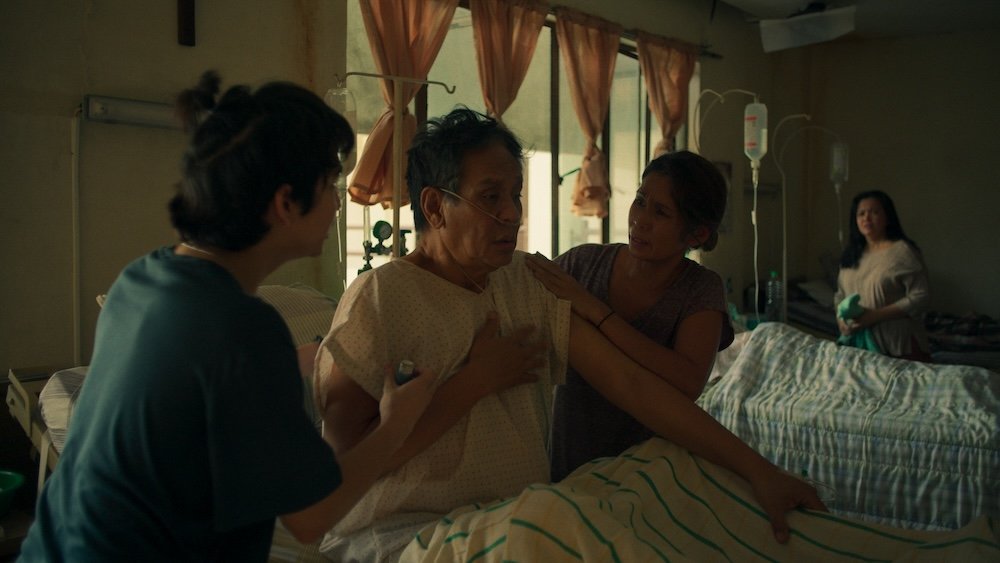
Sylvia, a poor farmer who has spent her whole life in the provinces with her husband, Ramon, is asked to provide two valid IDs to claim money sent by a relative at a remittance center for his medical treatment. Ramon suffers from severe Chronic Obstructive Pulmonary Disease (COPD), but there is a problem: Sylvia does not have a single ID. It is a requirement that looks simple but proves impossible for someone like her. Against her will, she resorts to a “fixer” to help her secure two valid IDs.
Weighed down by exhaustion, hunger and endless lines of bureaucracy, the little money sent to her is nearly drained by their daily expenses. As the days pass, her husband’s condition declines and Sylvia’s hope begins to fade. Meanwhile, a young man in the hospital room, Denver, is taking care of his bedridden grandfather while helping the rest of the patients as much as he can.
The director and screenwriter use the aforementioned concept of the two IDs to criticize the local system, not just regarding this particular issue, but essentially as a whole. The health system in Metro Manila, which actually differs depending on the LGU, also gets its share of scrutiny. Manila, Makati, Quezon City, Pasig and Taguig, among others, are separate LGUs, and locally provided healthcare can differ substantially because Philippine healthcare has historically been decentralized to local governments. The fact that Ramon’s treatment cannot proceed gets its share of criticism, as does the lack of caretakers in the hospital, which forces relatives and acquaintances to take care of the sick. Furthermore, although healthcare is nominally universal, households still pay a significant amount themselves, another aspect that comes under scrutiny.
As Sylvia tries to find a solution to the illogical bureaucracy, stumbling upon one obstacle after another, the sense that the whole situation is quite Kafkaesque also becomes evident. At the same time, paying a fixer emerges as the only visible way out, in another consequence of excessive of intense bureaucracy that actually applies globally. The fact that even public employees face issues because of the system also comes to the fore. The woman clerk states that if she gives out a remittance improperly, she gets fined, essentially adding to the bureaucracy through excessive caution and cementing the critique in the most thorough fashion.
At the same time, this is the story of a woman fighting against all odds and stumbling upon one obstacle after another, in a true odyssey that raises the question of whether she will crumble or erupt. Despite the relatively calm approach, this aspect creates a very appealing sense of tension while generating empathy for both wife and husband. The presence of the young man, which proves catalytic on a number of levels, moves in the same direction, in a comment that good intentions are not always enough and that youths should learn from their mistakes. Lastly, the differences between life in the provinces and life in the city get their own share of critique. The movie highlights two settings that are dog-eat-dog in different ways, further cementing its rather rich context.
Marietta Subong, aka Pokwang, gives a tremendous performance. The way Sylvia retains her calmness, partly in order to keep her husband calm, but gradually crumbles as she meets one obstacle after another is a true wonder to watch. The moments when she loses her composure are the highlights of an overall excellent effort. Meryll Soriano, as the noisy but helpful relative, is show-stealing at times, while Joey Marquez as Ramon and Zaijian Jaranilla as Denver also give competent performances. Both retain a sense of measure that is a testament to their acting and the direction here.
Neil Daza’s cinematography captures the hospital, the various public bureaus and the streets of Manila with realism and without any particular exaltation, allowing the story and the protagonist to shine. The close ups on Subong’s face work especially well, even more so because of the moments in which they are implemented. Vanessa Ubas-De Leon’s editing results in a mid to fast tempo that suits the narrative nicely, particularly considering the age of the main protagonists.
“2 Valid IDs” is an excellent social drama, an appealing story whose purpose of criticizing the system comes clearly across, and a movie that benefits the most from the acting, writing and direction.



