
The implementation of the 8th Pay Commission could lead to a significant increase in salaries and pensions for central government employees and pensioners. Still, the revision will also substantially increase the central government’s expenditure bill.
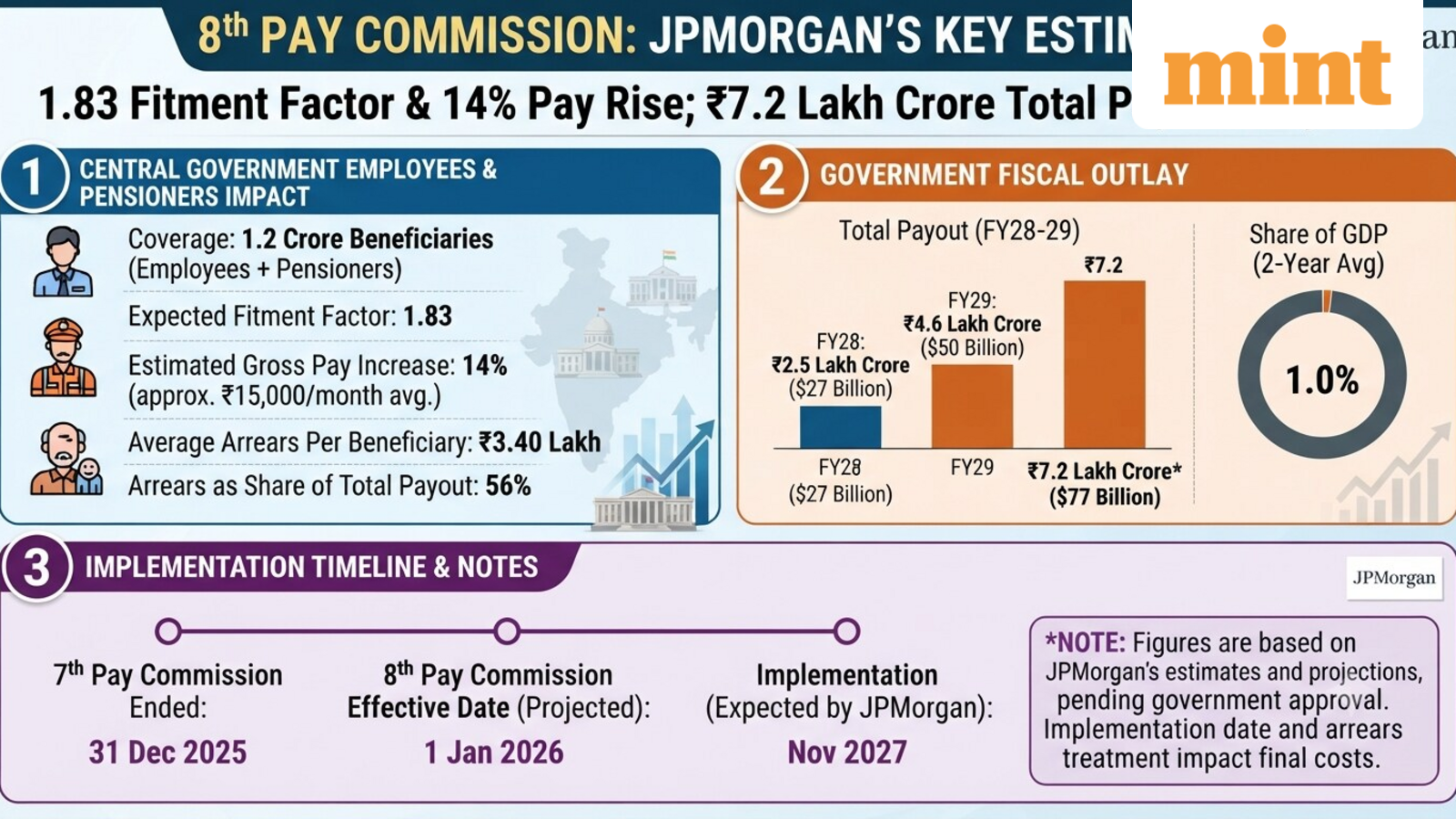
As per estimates from JPMorgan, the proposed pay revision could cost the government around ₹7.2 lakh crore, including nearly ₹4 lakh crore in arrears, depending on factors such as the implementation date and how arrears are treated.
Furthermore, it is essential to note that the estimates cover approximately 1.2 crore central government employees and pensioners. Keeping these fundamentals in view, let us discuss the key projections from the report and what they could mean for serving central government employees, pensioners, and associated stakeholders.
8th Pay Commission: What fitment factor and salary hike does JP Morgan expect?
JPMorgan expects a fitment factor multiplier of around 1.83. This will subsequently translate into an estimated 14-15% increase in gross pay. The figures are in line with and broadly comparable to the salary growth delivered by the 7th Pay Commission, whose term officially ended on 31 December 2025.
The calculations presented by JPMorgan factor in 60% dearness allowance (DA) and an assumed 14% increase in gross pay. The basic details of the same are as follows:
It is essential to keep in mind that the report’s fitment factor estimates are considerably lower than the factors of up to 4.38 sought by prominent employee unions such as the Indian Railways Technical Supervisors Association (IRTSA). Along with similar higher figures such as 4 and 3.833 proposed by Bharatiya Pratiraksha Mazdoor Sangh (BPMS) and National Council (Joint Consultative Machinery), or NC-JCM, respectively.
₹7.2 lakh crore cost: How much could the Centre spend?
JPMorgan estimates that the 8th Pay Commission could result in an additional payout of ₹7.2 lakh crore over FY28 and FY29.
The report by JPMorgan explains how arrears might end up accounting for a substantial part of this expenditure. Furthermore, if the revised pay structure is made effective starting from 1 January 2026, the estimated arrears might reach ₹4 lakh crore. Still, shifting the effective date to 1 January 2027 could bring this down to about ₹1.8 lakh crore.
JPMorgan expects the implementation of the 8th Pay Commission from November 2027, i.e., about 1 year from now. These are just projections; they are not confirmed government decisions. The actual revision of salaries, effective date of implementation and arrears are going to be dependent on the commission’s recommendations and the central government’s approval.
Disclaimer: The figures mentioned are projections based on JPMorgan’s estimates and should not be treated as confirmed government decisions. The actual salary revision, implementation date and arrears will depend on the 8th Pay Commission’s recommendations and the Centre’s approval.



