

After graduating from the University of Tokyo, Ryusuke Hamaguchi worked in the film industry for a few years before entering the graduate film programme at the Tokyo University of the Arts. His graduation film, “Passion”, screened at San Sebastian Film Festival in 2008. His 317-minute opus “Happy Hour” premiered at Locarno and went on to screen and win awards at numerous film festivals, while “Asako I & II” was selected for the competition at Cannes in 2018. By 2021, “Wheel of Fortune and Fantasy” had won the Silver Bear Grand Jury Prize in Berlin, while “Drive My Car” brought him unprecedented international recognition and eventually the Academy Award for Best International Feature Film.
Looking through his work chronologically, however, makes it clear that the success did not come suddenly. Hamaguchi does this very interesting thing that has his protagonists being very sincere and open with their feelings, which is the opposite of how Japanese usually are. He builds his narrative around this, a bit of surrealism, and very intelligent dialogue that usually works on more than one level. Furthermore, that his narratives have “unremarkable” people experiencing remarkable, somewhat surrealistic events is where his movies also wink at Haruki Murakami, with the overall style, with its almost total lack of action, also pointing the same way. His movies repeatedly revolve around people talking until something previously concealed is finally expressed, with conversation frequently becoming both the source of conflict and the path toward some form of understanding.
There are also clear influences from Eric Rohmer and Abbas Kiarostami, both of whom Hamaguchi has openly acknowledged. Regarding Kiarostami, he has mentioned watching “10 on Ten” and realizing that people talking in a car could actually make for an interesting movie. From Rohmer he drew inspiration regarding short-form narratives and the possibilities created by apparently casual encounters. At the same time, Hamaguchi gradually developed those influences into something increasingly recognizable as his own: prolonged conversations, emotional role-playing, characters unable to understand the people closest to them, coincidence operating almost as fate, and performances that slowly strip away the social masks people wear.
Moving into adult life is quite a transition, overshadowed by many obstacles, decisions and changes within yourself, which can often feel soul-crushing and confusing. In his second feature, produced as his thesis at Tokyo University of Arts, Hamaguchi’s “Passion” tells a story of a group of characters caught in the middle of that period of transition in their lives. A group of friends meets in Tokyo to celebrate the 29th birthday of Kaho, played by Aoba Kawai. There are other occasions which are also part of the celebration: Kaho’s engagement to Tomoya, played by Ryuta Okamoto, and Takeshi becoming a father. As the night goes on, the women depart, whereas Takeshi, Tomoya and Kenichiro decide to have a few more drinks and eventually visit Takako, played by Fusako Urabe, following the recent death of her pet. Their conversations quickly become personal, arriving at themes such as their goals in life, happiness and the freedom they experience.
As the group disbands in the early hours of the morning, a number of conflicts have come to the surface. While it has become evident Kenichiro is upset about Tomoya’s engagement to Kaho, there is also an obvious chemistry between him and Takako, which Takeshi has noticed. Freedom, determinism and the dichotomy of desire and obligation are the center of these encounters, with each character going through a similar process or realization about the nature of their friendship, their futures and, above all, themselves. There is a non-linear structure at the heart of “Passion” whose scenes seem to reflect the change these people go through as well as the consequences of the night they spend together. You have the feeling the narrative is moving towards something, an epiphany or moment of clarity, which climaxes in an emotionally painful confrontation at the finale. Already, honesty is both desirable and destructive, a contradiction Hamaguchi would explore repeatedly in the years to come.
Many reviewers and commentators have described parallels between Hamaguchi’s cinema and the works of John Cassavetes. There is something different about “Passion”, however, whose seemingly improvised nature distracts from a very thoughtful mise-en-scène. Each member of the cast gives a captivating performance as people realize the “dead end” they have reached in their lives and the inevitability of making drastic decisions, something reflected in the transitional spaces they inhabit, from restaurants to alleys. Their apartments follow a similar logic, emphasizing the emotional cage these people have built over time and how their relationships have also become elements in that prison. “Passion” not only highlights Hamaguchi’s gift of working with actors, but also his sense of place and time, resulting in a story which is both contemplative and captivating. The foundations of his later cinema are already very much present.
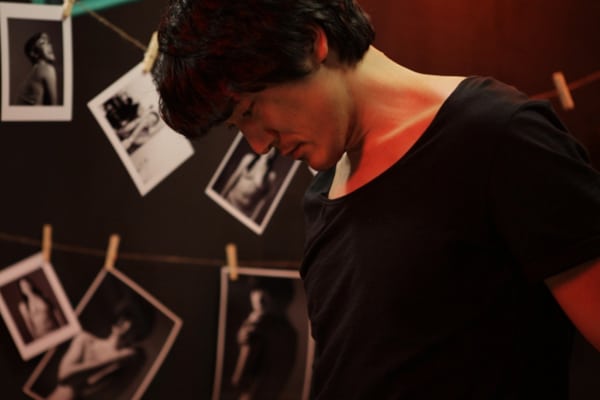
“The Depths” provides a particularly interesting chance to check the path that led Hamaguchi to the place he eventually came to inhabit in international cinema. Bae-hwan, played by Kim Min-jun, is a famous Korean fashion photographer visiting Japan at the request of his friend Gil-su to take pictures of his wedding. Things take a strange turn when the bride disappears and Bae-hwan ends up helping his friend in the photo studio he owns with his wife, where he is also associated with some rather shady men. In one such photoshoot, the two are introduced to Ryu, played by Hoshi Ishida, a successful male escort who has been brought in to take new promotional photographs. Bae-hwan is impressed by the unusual-looking young man and asks him to abandon prostitution in order to become a model, even suggesting taking him to Korea. Gil-su, played by Soji Arai, has objections that seem to involve something more complicated than fear of Ryu’s boss.
The first thing that becomes evident here, particularly for people who have seen Hamaguchi’s later works, is that at the time he did not yet have the command of the medium he exhibits now. The writing emerges as particularly faulty, especially in the characterization department, while a lack of tension makes the movie seem rather flat and lagging on occasion. Particularly the way the three men come together borders on the illogical, almost as if two different movies were brought together forcefully, with Hamaguchi seeming unsure of how to handle some of the homosexual aspects of the story. At the same time, the presentation of the darker aspects of photography, modelling and male prostitution is rather intriguing, while the movie definitely picks up as soon as the three men come together in an unusual love triangle where nobody is entirely sure of his orientation or feelings. The way these elements lead to sex, violence and eventually melodrama is captivating at times, while the comments about the pressures homosexuals feel to acknowledge their identity, first and foremost to themselves, are eloquently portrayed.
The bleakness of the cinematography, as presented by DP Gunyoung Kay Yang, fits the overall aesthetics of the movie to perfection, in a style somewhat reminiscent of the visuals Hamaguchi would employ later. The editing could be better, since the movie lags on many occasions, but in terms of pace it eventually works. Kim Min-jun is convincing as the rather cool, successful Bae-hwan, with the antithesis with the cowardice of Soji Arai’s Gil-su working quite well for the narrative, even if neither is particularly likeable. Hoshi Ishida plays the archetype of the “apple of discord” convincingly, although the way the character is presented does not completely justify the chaos he creates. “The Depths” is not among Hamaguchi’s strongest films, but his eye for composition was already evident. More importantly in retrospect, so were his interest in triangular relationships, unstable identities, desire that people cannot properly articulate, and conversations in which the spoken words only partially reveal what the characters actually feel.
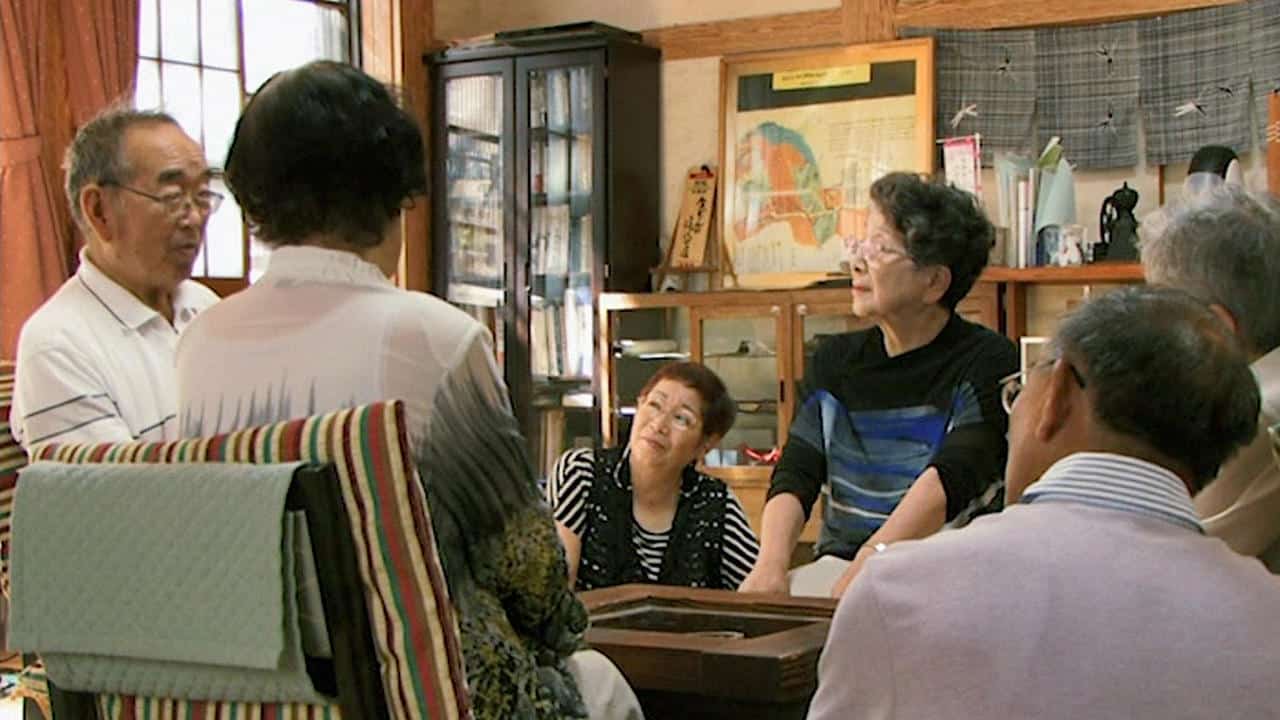
From 2011 to 2013, Hamaguchi and Ko Sakai conducted a series of interviews and conversations with residents of the northern region of Tohoku, an area heavily hit by both the earthquake and tsunami of March 2011. Their research resulted in three films that eventually became the Tohoku Trilogy: “The Sound of the Waves”, “Voices from the Waves” and “Storytellers”. The latter focuses on a number of elderly inhabitants of the area narrating banashi, folk tales of rural life often featuring talking animals. The folk storytellers are Masako Ito, Ken Sasaki and Reiko Sato, who, either in their homes or gathered at Kurikomayama in Miyagi Prefecture, talk to folklore scholar Kazuko Ono, founder of the Miyagi Folkgroup. A number of scenes inside cars feature Ono explaining the background of the folk tales and their occasional hidden meanings.
The documentary follows a certain motif, starting with a series of folktales before Ono dwells more on the personal lives of the narrators, particularly the hardships they faced in their youth, which also mirror her own. The stories include a monkey marrying the daughter of a farmer, groups of frogs, a shrimp and an eagle, a gambling god and, most amusingly, the talking bottom of a rich lady and the way a priest managed to wipe it. Beyond their entertainment value, however, the stories connect fantasy, memory and lived experience. “Storytellers” serves one of the most important purposes of the medium, as it records the voices of people who would not have been heard otherwise, while highlighting the connection between oral storytelling and reality in the best fashion. In retrospect, this preoccupation with storytelling as a way of making sense of life is particularly important within Hamaguchi’s oeuvre.
Ono is a great interviewer, being polite and responsive, while the fact that she is enjoying herself as much as the narrators becomes obvious and adds intensely to the entertainment the movie offers. Furthermore, the framing by DPs Yukiko Iioka, Yoshio Kitagawa and Yasuyuki Sasaki is occasionally impressive, particularly in the ways windows and the various embroidered walls in the houses of the interviewees are implemented. On the other hand, at 120 minutes, and particularly considering the talking-heads approach and the fact that the whole documentary comprises almost solely of narration, the movie overextends its welcome and can become difficult to follow after a point. Nevertheless, the experience of listening rather than directing people toward predetermined emotional outcomes would prove crucial. Hamaguchi’s later fiction repeatedly depends on exactly this kind of attention: allowing people to speak at length until apparently ordinary words begin revealing something much deeper.
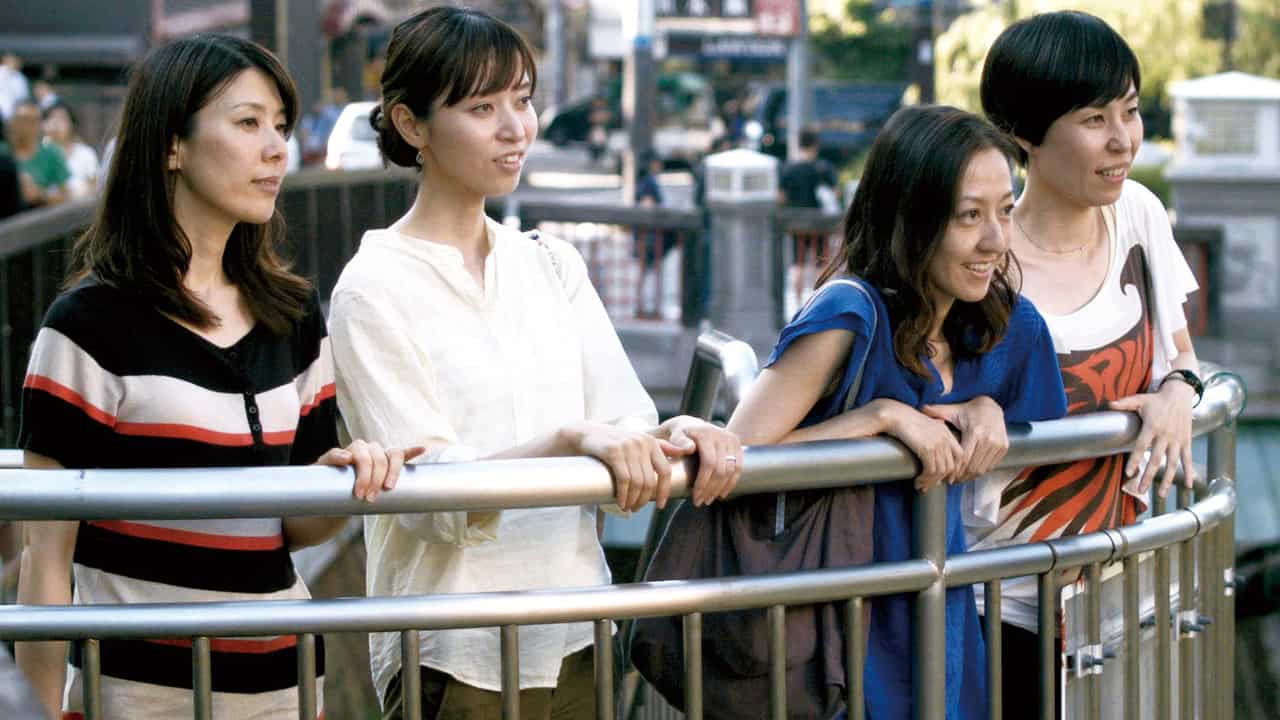
Development for “Happy Hour” began in 2013 during Hamaguchi’s time as an artist-in-residence at KIITO Design and Creative Center Kobe, where he hosted theater workshops. He got the project rolling through an improvisational acting workshop, and many of the participants ended up appearing in the film. Set in Kobe, the story follows four middle-class women named Akari, Sakurako, Fumi and Jun. All of them are in their thirties and embrace their friendship while dealing with their individual struggles. Characters suffer from depression and question their existence in the world. Feelings between romantic partners are blooming for some while deteriorating for others. Family members begin to go their separate ways, work-related stress takes a toll, and three of the leads are married although not all are stable marriages, with one woman going through a pending divorce involving a psychologically abusive husband. These emotional conflicts are played out through a meditative examination of human behavior.
“Happy Hour” is not a typical epic. The film is not necessarily big on scale but instead large on emotions. Patience is demanded as the movie is a slow burn, and more than one sitting may be required with so much to digest. A story like this could easily have come off as pretentious, self-indulgent and manipulative, but it is instead powerful, engaging, subtle and at times heartbreaking. With the melancholy, there is also hope as the cast slowly begins to rise above their setbacks, which only further warrants the audience continuing until the conclusion. Hamaguchi does not shy away from social commentary that tackles many issues, forcing the audience to confront the fact that reality can be harsh. Yet the narrative progression also demonstrates that life can still be beautiful and there is warmth in an imperfect world. More importantly, the long runtime gives conversations the space to evolve organically rather than simply functioning as devices for delivering information.
The heartwarming friendship between the four leads is the film’s strongest element. Sachie Tanaka, Hazuki Kikuchi, Maiko Mihara and Rira Kawamura are excellent and naturally slip into their roles, and the performances feel like the lives of real people are playing out before the audience. It is astounding to think that much of the cast did not have much acting experience beforehand. Yoshio Kitagawa’s cinematography is elegant and beautiful, with wonderfully composed shots and details within each frame, while the movement within a shot and the way characters are framed become particularly significant. “Happy Hour” was a turning point in Hamaguchi’s career, not merely because of the international recognition it received, but because the workshop method, the long conversations, the female perspectives and the gradual emergence of buried feelings crystallized an approach he would continue to refine.
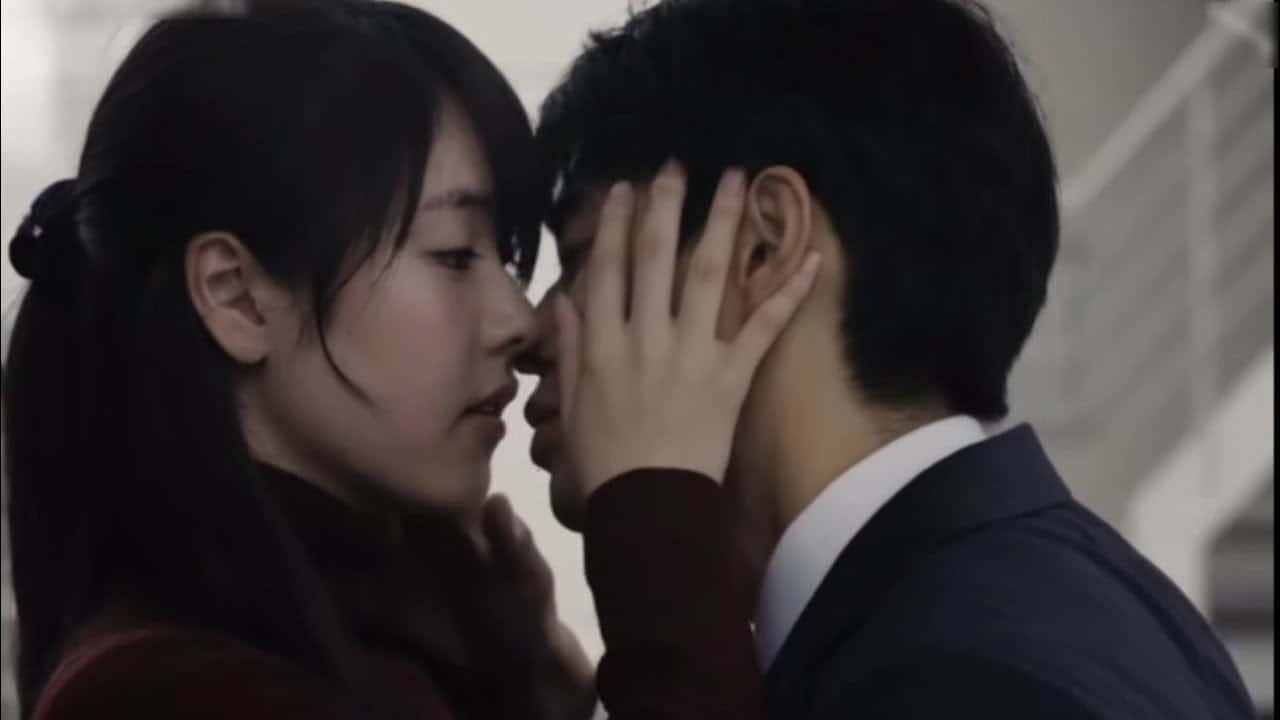
Based on the novel “Netemo Sametemo” by Tomoka Shibasaki, “Asako I & II” is an intriguing drama whose narrative shares many similarities with the style of Haruki Murakami novels. Asako, played by Erika Karata, is a 21-year-old woman living in Osaka who meets a strange young man named Baku, and the two fall immediately in love. After Asako spends the night in Baku’s house, the young man goes missing for a long time and eventually disappears completely, leaving her shattered. Two years later, she lives in Tokyo and encounters businessman Ryohei, who seems to be the spitting image of Baku. Both Baku and Ryohei are played by Masahiro Higashide. Initially Asako cannot believe he is a different man, but she eventually realizes the fact and begins a relationship with him. Five years later, however, Baku reemerges.
The narrative approach of having “unremarkable” people experiencing remarkable, somewhat surrealistic events is where the movie winks at Murakami, with the overall style and its almost total lack of action pointing the same way. The most interesting part comes with how Hamaguchi presents a relationship and a number of behaviors that are exactly the opposite of how Japanese people usually conduct themselves. The way Asako and Baku immediately express their feelings for each other and move forward with their relationship is a distinct sample of this approach. The second part falls into more “normal” territory, as Asako and Ryohei are reluctant to act on their feelings. Another focal point is the radical difference between the two relationships. The first is dream-like, occurring through circumstances that border on the miraculous and unrealistic, while the second is more typical, realistic and somewhat unremarkable but proves to be something that can actually be sustained. The way Asako reacts upon the resurfacing of Baku implies how difficult leaving your past behind can be and, at the same time, how difficult it is to choose sustainability over the prospect of a dream coming true.
The rather intelligent trick of having the same actor playing the two men allows the audience to focus on those concepts and dilemmas, since circumstances and Asako’s state of mind are the essential factors in her decision. Erika Karata portrays all the aforementioned elements in excellent fashion through a fittingly measured performance, while the way Masahiro Higashide delivers both male characters is impressive precisely because they are so different. Sairi Ito is great as Haruyo, with her characteristic voice helping in the delivery of a character who seems to be the only one who moves fast and directly at all times. Yasuyuki Sasaki captures Asako’s melancholia through the various settings, while Azusa Yamazaki’s editing induces the narrative with a fitting mid-tempo that allows Hamaguchi to analyze his characters thoroughly. “Asako I & II” combines beauty with meaningful context, but it also establishes almost completely the style Hamaguchi would use during the next phase of his career.
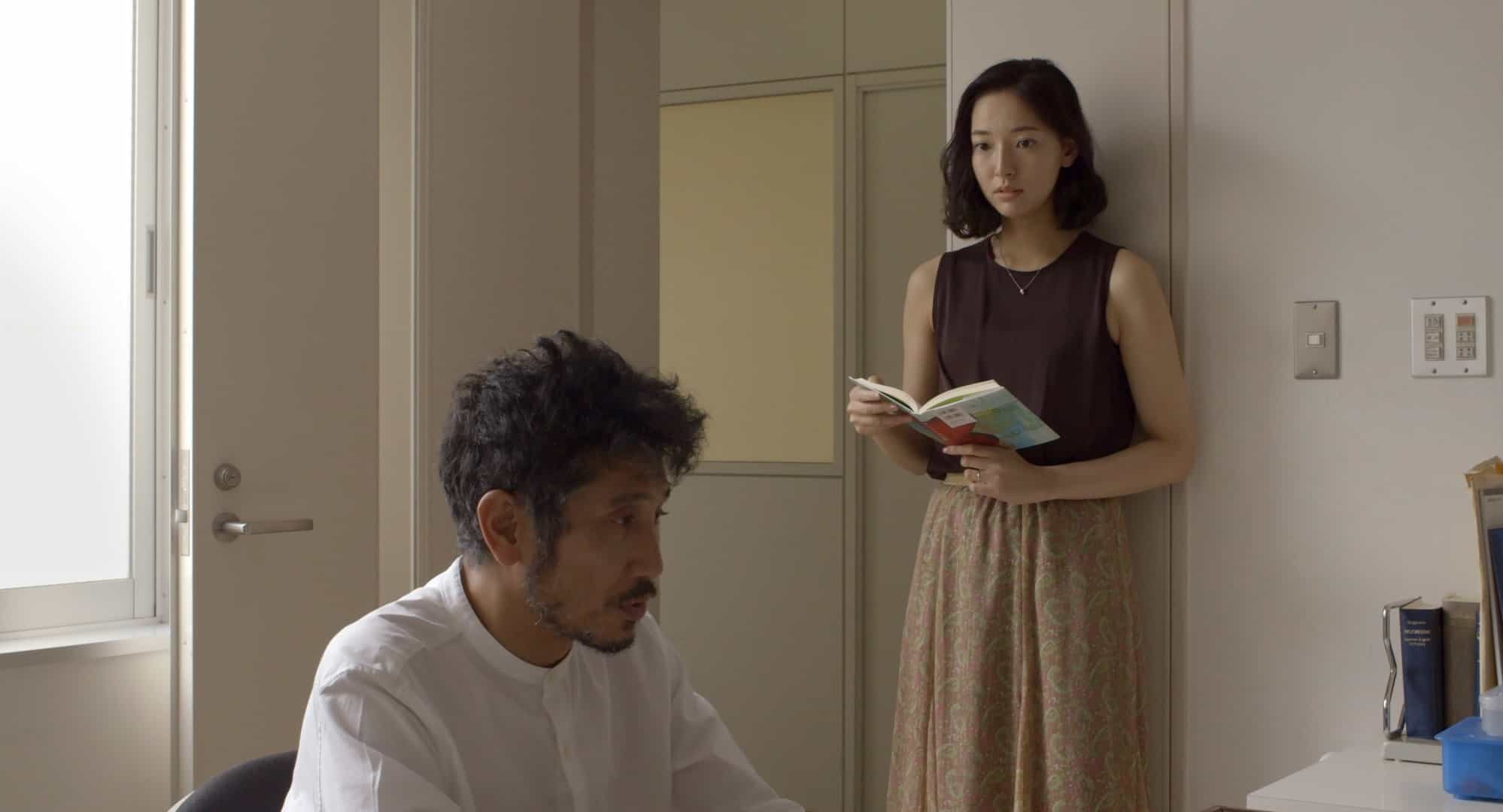
After “Asako I & II”, Hamaguchi seems to have established a specific style, contextually at least, that has “unremarkable” people experiencing remarkable, somewhat surrealistic events, and characters, particularly women, who exhibit behaviors that are exactly the opposite of how Japanese people usually conduct themselves. This approach is cemented in the three episodes of “Wheel of Fortune and Fantasy”. In “Magic (or Something Less Assuring)”, younger Meiko and Tsugumi chat in the back of a car about a man the latter met and her growing fondness for him. Soon, however, it is revealed that the man is Meiko’s ex-boyfriend. In “Door Wide Open”, Segawa, a college professor who has just won the Akutagawa Award, becomes the target of a plan by a failed student who convinces an older female classmate to seduce him. The third episode, “Once Again”, follows a middle-aged woman attending a school reunion who accidentally encounters someone she believes to be an old classmate, only to discover she has mistaken her for somebody else.
The open way the protagonists discuss their most intimate thoughts is quite contrary to usual Japanese tendencies, with Hamaguchi playing with the fact by making the dialogue as colorful and intense as possible. Through this approach, he exhibits a rather intimate knowledge of human nature and the way people think, particularly in connection with relationships. The first episode contrasts a cheerful and friendly but essentially fake discussion with a heated and controversial but utterly sincere one. The second unfolds on two axes, with sex and its impact both in real life and literature being thoroughly commented on, while the concept of the open door highlights how careful people in positions of authority now must be. The third has desire and memory as central themes, with Moka’s wish to meet her former schoolmate making her believe Nana is actually that person. Regret and the need for a second chance are presented once more, while a play-pretend sequence depicts the need for relief from these feelings in joyful fashion.
The main trait of the film, however, is the dialogue, both in context and delivery, with Hamaguchi implementing a rather minimalist approach in all production values in order to allow the viewer to focus on what the protagonists are saying. Kotone Furukawa gives a great performance as Meiko, while the chemistry of Kiyohiko Shibukawa and Katsuki Mori emerges as one of the best traits of the second narrative. Fusako Urabe and Aoba Kawai are both excellent in the final part, particularly in the way they eventually act like young girls. Hamaguchi himself has directly acknowledged Rohmer as the main inspiration for the anthology structure, explaining that “Rendezvous in Paris” showed him how three vignettes could be strung into a feature. He has also acknowledged Kiarostami’s influence on the intimacy created by people talking inside moving cars. Coincidence and its consequences emerge as the focal point of the whole movie, but “Wheel of Fortune and Fantasy” ultimately highlights once more the filmmaker’s intimate knowledge of the human psyche and the original cinematic language he developed to present its various aspects.
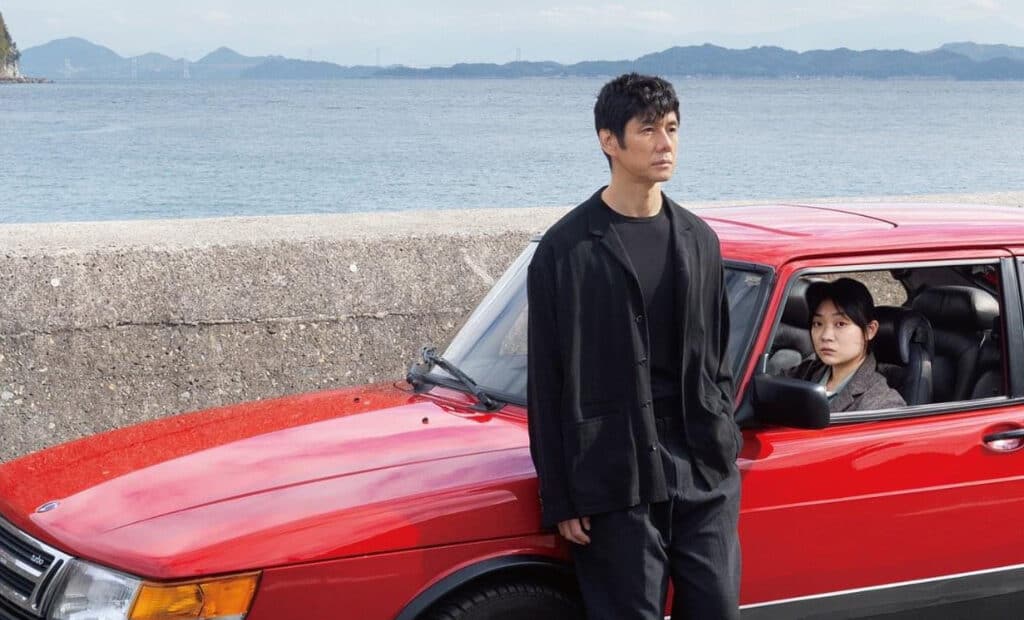
“Drive My Car” is an adaptation and extension of Murakami’s short story of the same title from the 2014 collection “Men Without Women”. A 40-minute first act introduces Yusuke Kafuku, played by Hidetoshi Nishijima, and Oto Kafuku, played by Reika Kirishima, a married couple whose apparent intimacy contains profound secrets. He is a renowned theater actor who rehearses Chekhov’s “Uncle Vanya” while driving his beloved red Saab 900, using recordings of his wife’s voice, while she is a scriptwriter with an unusual creative process. Yusuke discovers Oto having sex with another man but does not confront her, and shortly afterwards she dies suddenly. Two years later, he arrives in Hiroshima to stage an experimental multilingual production of “Uncle Vanya”, where company policy forces him to accept a chauffeur, Misaki Watari, played by Toko Miura. Slowly, the two begin to communicate.
If Murakami had concisely packed a great deal of themes in his short story, in Hamaguchi’s very personal adaptation and extension those ideas breathe, flourish and take flight. There is a story of a marriage threatened by tacit secrets, then a story of sweet revenge and a growing friendship between two strangers in a car who discover they have more in common than they initially thought. These narrations beautifully intertwine and overlap in a meditation about loss, grieving and survival. One of the central themes is the struggle and inability to know the people close to us in their completeness. Yusuke is tormented by his blind spot, not so much the physical shadow zone of his eye as the details he could not see in Oto: her infidelity, what attracted her to her lover and the endings of the stories she created during their intimacy. “Uncle Vanya” is everywhere, its lines punctuating and commenting on the narration, and only by channeling Chekhov does Yusuke eventually find the courage to articulate things he cannot state directly. Performing and role-playing become a way for people to connect with their true feelings.
Hamaguchi’s captivating script strongly relies on dialogues and actors’ performances. Hidetoshi Nishijima and Toko Miura have the difficult task of conveying their characters’ introversion and the silent way they both keep living with secrets buried in their hearts, and little gestures become keys. The photography is pleasantly crisp, highlighting the bright red Saab from Tokyo to Hiroshima to Hokkaido, while the score is discreet and apt. At the same time, the film’s extraordinary international success also illustrates another aspect of Hamaguchi’s position. The Saab, the staging of a European play, the road-movie element, the multinational and multilingual cast and a style very compatible with contemporary European art-house preferences made “Drive My Car” particularly suited to the international festival ecosystem. Yet reducing its achievement to those elements would ignore how completely it distills the director’s long-running concerns. Stories inside stories, people talking inside cars, performers using fiction to discover truths about themselves, secrets within relationships and the possibility of healing through opening up to someone else all converge here. Hamaguchi ends on a positive note, placing his idea of magic in the ability to open up to others and share feelings.

“Evil Does Not Exist” unfolds within the secluded mountain village of Harasawa. Here, a closely knit local community leads a tranquil existence, deeply immersed in the balance between the surrounding woods and the rhythms of nature. The inhabitants gradually come into focus, notably the versatile handyman Takumi, portrayed by Hitoshi Omika, and his daughter Hana, played by Ryo Nishikawa. The equilibrium is abruptly disrupted by the arrival of representatives from a Tokyo-based company seeking approval for the development of a glamping site. The irreconcilability between urban reality and the village comes to life most clearly during a community meeting, where the residents eloquently and at times humorously express their concerns about the project. Nevertheless, it is not a simple dichotomy between village and capital, since the corporate representatives gradually emerge as pawns of a larger power.
There were several themes Hamaguchi could have critically analyzed or at least addressed more directly, such as eco-criticism and eco-anxiety, Japan’s industrialization or even the inherent malevolence in nature itself. Yet he decides to leave much of this in a deliberately superficial or ambiguous state. For an hour and a half, the viewer becomes accustomed to the dry sobriety of the acting and mise-en-scène, as well as the semi-documentary essence of the movie. The final minutes, however, completely subvert these structural premises. The repressed violence simmering beneath the surface, accumulating between moments of silence, suddenly erupts into brutality. In that sense, the title becomes both provocative and ironic, particularly since Hamaguchi refuses to offer a straightforward “man versus nature” moral.
The acting and directorial style are characterized by their simplicity. The true strength of the film resides in its soundtrack, composed by Eiko Ishibashi, who previously contributed to “Drive My Car”. This connection is particularly important since “Evil Does Not Exist” originated as a musical project before evolving into an actual film, with Ishibashi initially asking Hamaguchi to create visual imagery for her compositions. She crafts dramatic and often unsettling soundscapes that elevate the modest visual aesthetics of the sequences. The enigmatic ending will probably remain the film’s most discussed feature, and it also points toward a potential danger within Hamaguchi’s increasing international auteur status: the possibility of becoming entrenched in a type of cinema whose impenetrability itself becomes the attraction. Nevertheless, the film’s patient observation, environmental texture, prolonged conversations and sudden eruption of hidden violence make it another logical, if markedly different, development of his style.
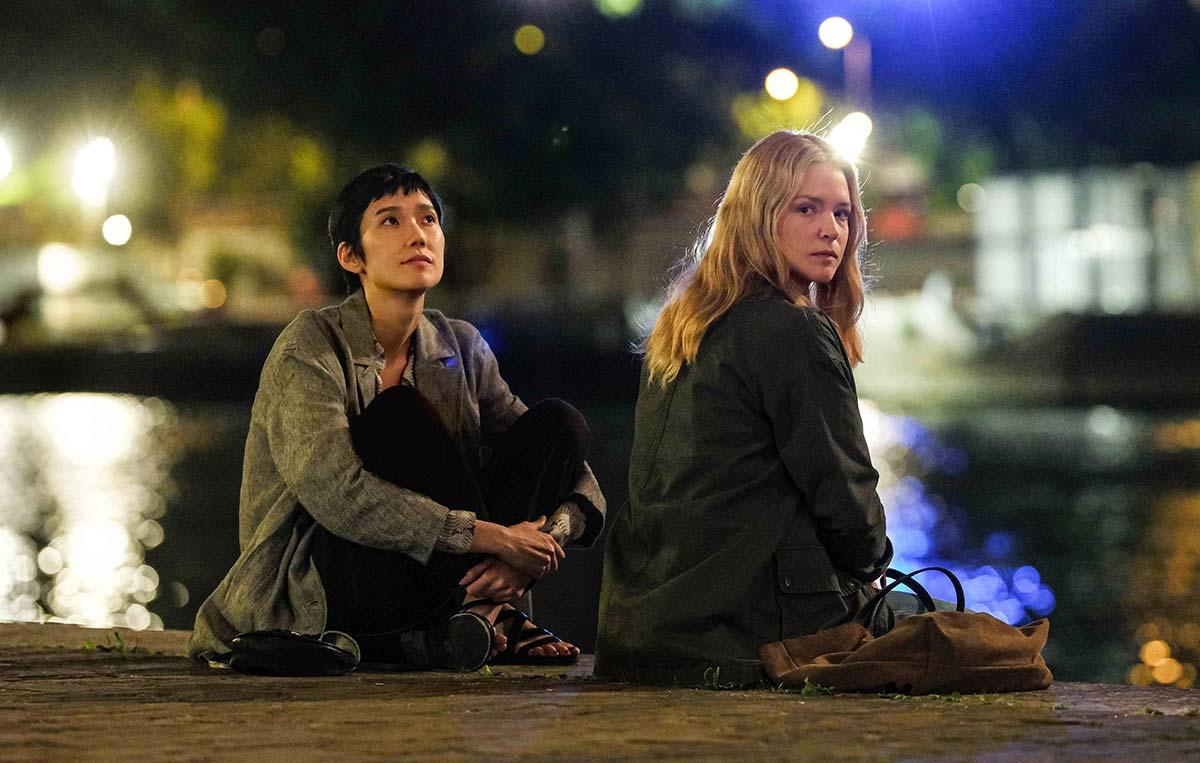
With “All of a Sudden”, Hamaguchi joined the long list of Asian directors who have gone to France to work with local casts and crews, a bold and dangerous move as filmmakers leave their usual collaborators behind and work in a language they do not understand. The film follows Marie-Lou Fontaine, the manager of a private nursing home in the suburbs of Paris, with the movie shot in a real care facility and featuring some of its actual residents as extras. Much of the picture concerns Marie-Lou’s efforts to introduce Humanitude, an actual humane care technique designed to prioritize the needs of elderly residents over efficiency and profit. She encounters strong resistance both from management, which cares more about shareholders and returns on investment than patients, and from staff, who view her ideas as unrealistic. The story then expands through her encounter with Mari Morisaki, a Japanese playwright living with cancer, and the friendship that emerges between the two women.
This aspect of the picture is both fascinating and frustrating. Certainly, the issues being raised are important and topical, and Marie-Lou’s extraordinary efforts to change a system set against her are deeply affecting. At the same time, “All of a Sudden” is an intensely didactic film, one in which characters almost seem to address the audience directly in order to outline the systemic issues society faces. Through the story of the nursing home, the feature offers possible solutions to a floundering healthcare system as well as to the larger evils that beset market-driven societies. Humanitude is one; another is art itself. Mari and Marie-Lou casually discuss late capitalism, extractivism and the benefits artistic expression can bring to elderly people and human beings in general. Hamaguchi drew inspiration from “You and I – The Illness Suddenly Get Worse”, a book bringing together the correspondence between philosopher Makiko Miyano and medical anthropologist Maho Isono. The literary origins of these conversations, however, are palpable, and at more than three hours the accumulation of repetitive scenes occasionally makes the film feel overlong and overly verbose.
What truly bridges the cultural and linguistic divide is the melodramatic mode, a form in which Hamaguchi excels. Melodrama knows no borders, and its inherent focus on emotions and relationships, friendship and family means it can convey feelings and even ideas in a universal language. The performances by Virginie Efira and Tao Okamoto are crucial, breathing life and depth into characters who could easily have become little more than vehicles for Big Ideas, and both received the Best Actress prize at Cannes. The director’s greatest achievement is that, despite structural flaws and passages of easy sentimentality, the film still manages to be deeply touching at key moments, particularly in its quiet scenes of rest and companionship between people who genuinely respect one another. Given the importance of theater and the stage throughout the picture, “All of a Sudden” can also be seen as another variation on the idea that fiction and performance may transform the people participating in them, an idea that has followed Hamaguchi from his earliest films to the present.
Hamaguchi’s filmography is not without unevenness. “The Depths” shows a filmmaker whose command of characterization had not yet reached the level of his later work. “Storytellers” can become monotonous because of its length and talking-head structure. Even highly accomplished works such as “Evil Does Not Exist” and “All of a Sudden” expose potential weaknesses in his increasing reliance on ambiguity, length and intellectualized conversations. Nevertheless, few contemporary Japanese directors have developed such a recognizable cinematic grammar while continually finding different ways of applying it.
From the painful confrontations of “Passion” to the workshop-born intimacy of “Happy Hour”, the surreal romantic dilemmas of “Asako I & II”, the coincidences of “Wheel of Fortune and Fantasy” and the theater, grief and multilingual communication of “Drive My Car”, Hamaguchi repeatedly returns to the same essential question: how can people genuinely understand each other when language itself is inadequate? His characters talk constantly, but the important truth is rarely found simply in what they say. It appears in pauses, performances, misunderstandings, role-playing, gestures and the moments when conversation finally cracks through the defensive structures they have constructed around themselves.
This is perhaps why cars, theaters, classrooms, restaurants, apartments and other enclosed spaces play such an important role in his cinema. They force people to remain together long enough to speak, listen and occasionally reveal themselves. Hamaguchi’s best films highlight his intimate knowledge of the human psyche and the rather original and intelligent cinematic way he has developed to present its various aspects. Whether dealing with romance, grief, ecological conflict, illness or simply a chance encounter between two strangers, his cinema ultimately returns to the possibility that communication, imperfect as it is, may still open another possible way, another world.



