
First, the country was a Nazi ally; then it became a NATO stooge. The latest allegation: It’s a reckless Russia-basher that deserves a ruthless response from the Kremlin. Who said Finland was boring?
Amid all the focus on Russia’s war against Ukraine, it is easy to overlook another prime target of Moscow’s imperialist ire. Russia has long used a skewed interpretation of history as a weapon to attack and delegitimize its neighbors—and, if the Kremlin’s latest rhetorical escalation is any guide, it now has Finland in its gunsights. The Finns are understandably nervous, given recent precedent: In 2021, Russian leader Vladimir Putin’s lengthy historical essay denying Ukraine’s claims to statehood and decrying its independence from Russia provided a pretext for his full-scale invasion of Ukraine a few months later.
The details might seem arcane: Who really cares these days about Finland’s tangled history during World War II, let alone the legal status of the Grand Duchy of Finland within the old tsarist empire? But history is not an academic discipline in Russia. It is an instrument of power, used to strengthen the Kremlin’s grip on society, legitimize aggression, and undermine other countries’ sovereignty.
Moscow wields history with fiery emotion. Take, for example, former Russian President Dmitry Medvedev, who posted on X on Jan. 2 that the Bolsheviks’ recognition of Finnish independence from Russia in 1917 was a “blunder” (that presumably should now be reversed) and that the country must pay for its “vile Russophobia.”
Painted by Western commentators as a liberal-minded modernizer during his 2008-12 stint as head of state, Medvedev has assumed the mantle of Russia’s chief Finland-basher. This time, the specific target of his bile was “some guy called Stubb.” That was a derogatory reference to Finnish President Alexander Stubb, one of the savviest figures ever to have held high office in Finland. His English is flawless, and his golf is pretty handy, too, which has enabled him to strike up an unlikely but useful friendship with U.S. President Donald Trump. Unlike past generations of Finnish leaders, he comes across as chatty, even extroverted.
The Finnish president’s New Year’s message, which prompted Medvedev’s tirade, would have struck most outsiders as anodyne. On Ukraine, Stubb said—with understatement—that “we cannot be certain that Russia is ready for peace,” warning Finns that any deal over Ukraine’s future may have elements “that do not align with our sense of justice.” He also insisted that Russia would not be allowed to continue its aggression elsewhere: “Together with our allies, we will make sure that Russia will never again attack one of its neighbours.”
Stubb continued: “Our relations with Russia have changed permanently. What remains unchanged is that Russia is our neighbour. Both Finland and Europe aim to have functioning and peaceful relations with Russia. But, ultimately, it all depends on Russia’s actions.”
In the thin-skinned public discourse that prevails in Putin’s Russia, even a breath of criticism is treated as an insult. It offered a chance for Medvedev to resume the attacks that he launched last year in a lengthy essay titled “The New Finnish Doctrine: Stupidity, Lies, Ingratitude.” Published following a trip to the Russo-Finnish border in September, the text argued that the Finnish leadership’s newly hawkish stance had “ruined” good relations built up over decades. He cited wartime Finland’s “bloody partnership” with Adolf Hitler’s Third Reich, highlighted Finnish participation in the siege of Leningrad (in which more 800,0000 civilians died), and accused postwar Finland of being ungrateful for its supposedly gentle treatment by the Kremlin.
By joining NATO in 2023, Medvedev wrote, the “pro-American puppet authorities” in Helsinki lost their right to any “political pardon” from Moscow; Finland now “directly and rudely tramples” on the historical and legal basis for its existence as an independent state. Russia, he argued, is therefore entitled to renounce the treaties under which it recognized Finland’s independence, sovereignty, and borders; litigate charges of genocide and warmongering; and claim reparations from Helsinki for World War II-era damage. All this, he wrote, “could lead to the collapse of Finnish statehood once and for all.”
The Russian context makes this much more than Medvedev’s personal bugbear. His efforts are part of a bigger campaign to whip up anti-Finnish sentiment among Russians and to intimidate and demoralize Finns. Russian state TV frequently features pundits and talk show hosts threatening Finland with conquest. The campaign includes physical attacks on seabed infrastructure—most recently in the form of an episode in late December in which the Fitburg, a cargo ship sailing under a Caribbean flag of convenience, damaged a data cable linking Helsinki and the Estonian capital, Tallinn. A special forces unit of the Finnish Border Guard boarded the vessel, which was under way with its anchor dragging along the seabed, and detained it. The Finnish authorities say they are investigating the incident as possible “aggravated criminal damage, attempted aggravated criminal damage, and aggravated interference with telecommunications.”
Finns have responded firmly to these real-world incidents while downplaying the likelihood of a military confrontation and quietly underlining their resilience and preparedness. They do not want their country to be seen as a geopolitical hot spot.
But observers in neighboring Sweden are less inhibited. In a newly published study for the Swedish Psychological Defence Agency, Patrik Oksanen—one of the country’s leading experts in Russian dirty tricks—outlines the repeated historical smears and provocations directed against Finland in 2025. He argues that a long-running campaign to portray Finland as a Nazi collaborator intensified last year through “orchestrated legal actions, destruction of monuments, political statements and open threats.”
Again, the parallels are worrying: Russian war propaganda has long insisted that Ukraine is a hotbed of Hitlerite Nazism. Local courts and activist groups in neighboring regions of Russia, Oksanen writes, were used “to provide a façade of legitimacy and grassroots support,” constructing a “false juridical foundation for potential reparations or even — in the long term — territorial claims” against Finland.
Oksanen highlights the political backing that this campaign receives from Putin on down. Putin’s advisor on “historical affairs,” former Russian Culture Minister Vladimir Medinsky, plays a leading role. So too does Foreign Minister Sergey Lavrov, who recently penned an introduction to a lengthy work of pseudo-history arguing that Lithuania’s statehood over the past seven centuries is bogus. Three senior Russian lawmakers amplified Medvedev’s latest statements, claiming that Finland is a pseudo-state that is stoking tensions with Russia, which may well be forced to take drastic measures in response—just the sort of language that preceded Russia’s attack on Ukraine. This war of words involves Russia’s security and intelligence services, courts, the Foreign Ministry, prosecutors, politicians, government officials, think tanks, Kremlin-aligned “activists,” media, Western shills, and anonymous social media accounts.
Since Oksanen’s study was published, Moscow upped the ante further. On the Russian Foreign Ministry website, there appeared a revised English-language edition of the “Black Book,” a tendentious account of the supposedly endemic Russophobia in not just Finland but also Sweden. The book’s editor, Johan Bäckman, is a freelance Finnish academic of Swedish heritage who has frequently tussled with the authorities in Helsinki over his pro-Kremlin activities and been awarded honorary Russian citizenship.
Finnish officials dislike discussing these issues publicly, for fear of drawing further attention to the Russian smears. The country’s strategic culture, honed during decades of uncomfortable neutrality during the Cold War, involves speaking quietly, slowly, and rarely on sensitive topics. But one of the country’s leading contemporary historians, Henrik Meinander—whose new history of Helsinki will be published in English in February—described the Black Book to me as a “grotesque but unsurprising example” of modern Russia’s “Stalinist history policy.”
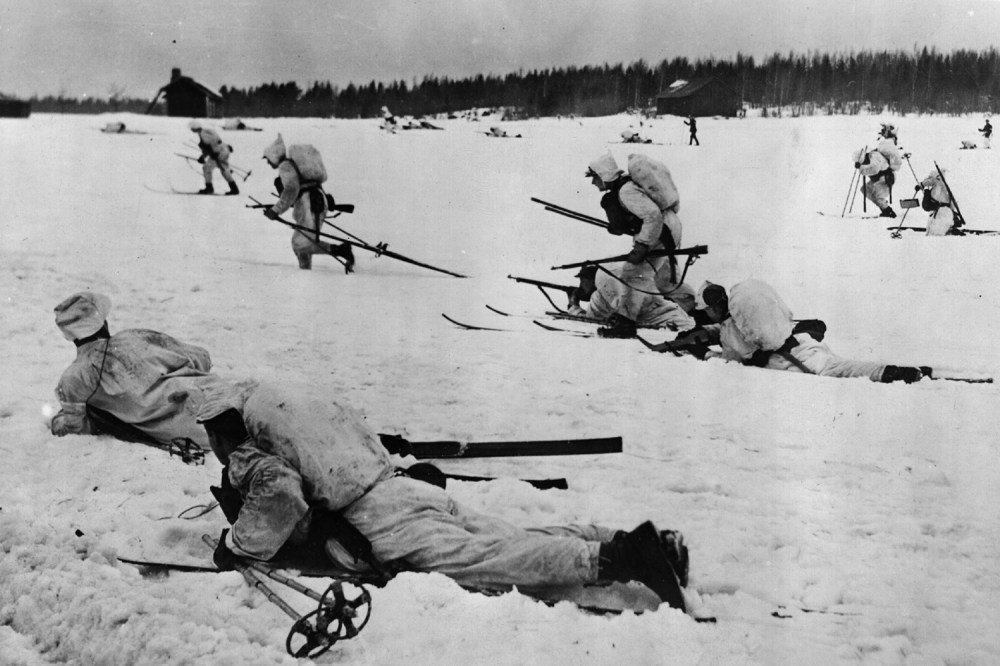
The attacks on Finland are part of a much bigger strategy to weaponize Russia’s patriotic historiography, which depicts the Soviet Union as both blameless and heroic. It makes no mention of Joseph Stalin’s quasi-alliance with Hitler, the atrocities perpetrated by Soviet forces across Eastern and Central Europe, or the fact that Stalin launched a disastrous, unprovoked invasion of Finland in the Winter War of 1939-40.
Finland beat back that attack, but it received only modest support from allies and neighbors. It had to give up substantial territory to strike the peace deal with the Soviets that ended the Winter War in 1940. When Hitler attacked the Soviet Union in 1941, Finland launched its own offensive in attempt to regain its lost territories. It was a co-belligerent but not a formal ally of the Axis powers. It broke with Berlin in 1944 and concluded a separate peace with the Soviet Union, including heavy reparations, territorial concessions, and forced neutrality.
Russia’s black-and-white narrative about the “Great Patriotic War”—its name for World War II—leaves no room for complexity or nuance. It adopts a simple, syllogistic argument: The Soviet Union fought and beat the Nazis. Therefore, anyone who attacked or resisted the Soviets, for any reason, is a heinous collaborator. Today’s Russia claims all of this mantle, ignoring the role of non-Russians (notably Ukrainians and Belarusians) as both victims of and fighters against the Nazis.
Instead, Moscow demands unconditional, permanent gratitude—and legitimizes countermeasures against countries that fail to display it. The result, Oksanen argues, is to make Russian modern imperial ambitions appear legitimate and its opponents morally reprehensible. In short, Russia seeks to control the past in order to shape the future.
Should we take Russia’s war over history seriously? Russia clearly does. It can and does escalate its rhetorical war in scope and intensity. It easily shifts from the information battlefield to the legal one, filing lawsuits and issuing court rulings against Finland for war damages. However spurious and unfair, these can then create the basis for sanctions. The campaign can also include actions such as removing Finnish war memorials from formerly Finnish battlefields that are now in Russia, disrupting commemorative events at these sites, and harassing diplomats—all of which have occurred in the past year.
As the next level of escalation, it is not difficult to imagine operations conducted on Finnish territory: anonymous vandalizing of museums or monuments or Russian-orchestrated actions that would purport to show that pro-Nazi, far-right elements in Finland are on the rise. However trivial and symbolic such stunts may seem, they damage the targeted country’s international image. They also spread anxiety, fear, confusion, and polarization in the population. This would make two wins for Russia before a single shot is fired.



