
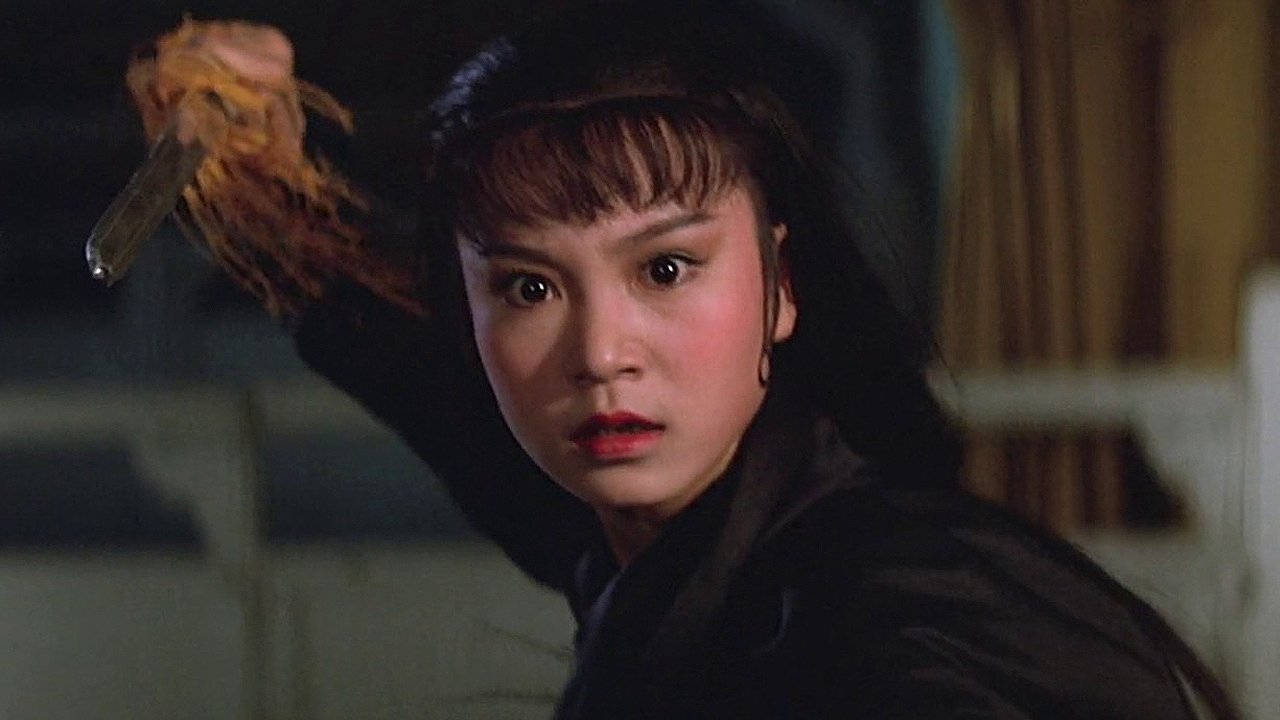
After immigrating to Hong Kong from the mainland in the 1960s, Lu Chin Ku began his acting career with Cathay Studios before eventually transitioning into directing. Upon joining Shaw Brothers Studio in the early 1980s, he directed “The Master”, starring Chen Kuan Tai and Yuen Te. To this day, Lu’s “Bastard Swordsman” and “Holy Flame of the Martial World”, both from 1983, remain his best-known fantasy wuxia works.
Buy This Title
by clicking on the image below
Based on real historical characters from the Qing Dynasty, “The Lady Assassin” unfolds as an epic swordplay tale of betrayal, intrigue, and revenge. Set within the Qing court, the story centers on the frail Emperor Kang Xi. Among all his sons, he chooses the kind-hearted 14th Prince as his successor. However, the power-hungry 4th Prince, Yin Zhen, played by Tony Liu Yung, senses that his younger brother will inevitably ascend the throne and attempts to have him killed. He then tries to bribe the 14th Prince’s royal bodyguard, Tsang Jing, portrayed by Norman Chui, to work for him instead, but this effort ultimately fails.
At the same time, the 4th Prince encounters a highly skilled yet arrogant soldier, Nian Gengyao, played by Jason Pai Biao, and appoints him as his chief commander. In addition, he gains the trust of an anti-Qing Han scholar, Lü Liuliang, portrayed by Ku Feng, along with his family, by promising fair treatment for both the Han and the Manchu should he become Emperor. After learning that Emperor Kang Xi has written a decree naming his successor, he convinces the scholar’s niece, Lü Siniang, played by Liu Hsueh Hua, to steal it from the Palace.
Assisted by the heroes Pak and Kam, Lü succeeds in her task, and using his calligraphy skills, her uncle alters the decree, changing the name of the intended successor from the 14th Prince to the 4th Prince. Shortly afterward, Emperor Kang Xi dies, and as planned, the 4th Prince ascends the throne, adopting the name Yongzheng. The Han supporters who trusted him soon realize they have been deceived, as the new Emperor fails to keep his promises and rules the land unjustly.
Although the story of Lü Siniang and Emperor Yongzheng’s struggle for the Qing throne has been depicted many times in cinema and television, Lu Chin Ku’s production offers a faithful retelling of this familiar court drama. Nevertheless, due to its extremely fast pace and relatively short running time of eighty six minutes, the narrative occasionally feels rushed. Even so, the work stands out as a lavish visual spectacle, largely thanks to its huge and intricately detailed indoor sets. The recreation of the Palace, particularly the Just and Open Hall, appears impressively lived in, while the colorful costumes and extensive use of extras further contribute to the production’s grand and distinctive look.
The action choreography, handled by Yuen Te, Pan Chien Chun, and Chung Wing, emphasizes frantic and over-the-top swordplay, impressive stunts, and an abundance of wirework that dominate the combat sequences. Unfortunately, the frequent use of undercranking results in speeded-up action that often appears overly jumpy and cartoonish, detracting rather than enhancing the experience. This excess becomes even more pronounced during the climactic confrontation, where combatants fly and spin through mid-air clashes while ninjas dressed in gold emerge from the shadows. Interestingly, Lu Chin Ku himself appears as one of the ninjas and nearly steals the scene, although the abrupt and shocking freeze-frame ending remains the most memorable final image.
In contrast, the performances emerge as one of the strongest elements throughout. Tony Liu Yung, who previously portrayed Emperor Qianlong, fits seamlessly into the role of the ambitious 4th Prince and later Emperor Yongzheng. Equally compelling is Jason Pai Biao, who fully inhabits the role of the arrogant commander Nian Gengyao. Both actors bring charisma and credibility to their characters. Norman Chui is, as always, captivating as Tsang Jing, the righteous bodyguard of the 14th Prince, while Liu Hsueh Hua delivers a convincing portrayal of Lü Siniang, combining emotional depth with assured physicality.
The supporting cast further strengthens the narrative, particularly veteran Ku Feng, whose engaging performance as the Han scholar Lü Liuliang helps anchor the intricate web of intrigue and betrayal. Sun Chieh and Yuen Te briefly showcase their fighting skills as the heroic guardians Kam and Pak, while Wang Lung Wei appears as Lord Longkodo in a non-action role.
Ultimately, although “The Lady Assassin” was underrated and largely ignored upon its local release, even proving to be a box office failure in Hong Kong despite performing better in Taiwan, it remains a well-produced and entertaining court drama. With its intriguing characters, striking visuals, and abundance of action, it deserves greater recognition than it originally received.



