
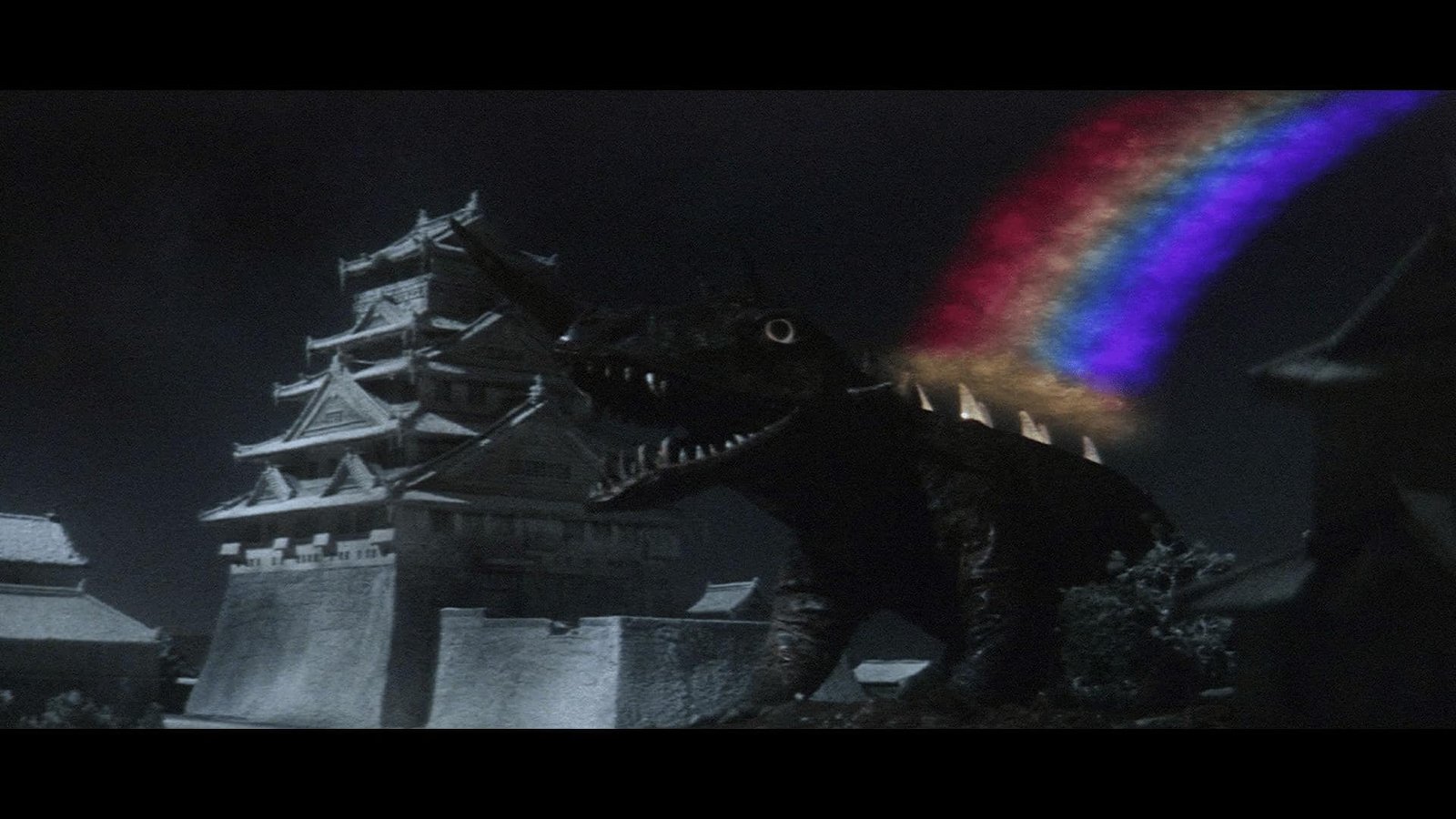
After the huge commercial success of “Gamera, the Giant Monster”, it was only a matter of time before Daiei Film continued its series featuring the giant creature, which was originally conceived as a way to compete with Toho Studios and their successful Godzilla franchise. Although directing duties officially went to experienced director Shigeo Tanaka, Noriaki Yuasa, who helmed the first entry, is also mentioned on IMDb in connection with “Gamera vs. Barugon”, most likely due to the use of stock footage from the original production. Another notable change is the switch from black and white to color, while the higher budget granted to the second entry also allowed for more advanced special effects. This improvement is particularly evident in the battle between the two monsters and in the miniature work featured throughout. Beyond its technical advancements, “Gamera vs. Barugon” also tells a story centered on greed and the immense chaos this particular human trait can unleash upon the world.
Half a year after the world witnessed Gamera being shot toward Mars, the creature unexpectedly returns to Earth when the rocket collides with a meteor, altering its trajectory. Upon its return, Gamera destroys the Kurobe Dam before disappearing once again, this time in search of powerful heat sources scattered across the planet’s surface.
At the same time, Keisuke Hirata (Kojiro Hongo) has concerns far removed from the reappearance of a giant monster, as he is about to embark on what could prove to be a highly lucrative venture. According to his brother, a former prisoner of war during World War II, a giant opal has been hidden inside a cave in New Guinea. When Keisuke arrives on the island alongside two companions, the local inhabitants attempt to stop them, warning of a powerful curse tied to the cave, one that could unleash great evil upon the world. Ignoring these pleas, the trio reaches the cave and discovers the opal, only for Keisuke to be betrayed by Onodera (Koji Fujiyama), who escapes with the precious stone and makes his way toward Kobe. However, when the ship carrying him sinks, the opal is seemingly lost to the sea.
Only minutes after the sinking, a giant monster emerges from the ocean. Later named Barugon, the creature advances toward the city, destroying everything in its path while growing stronger by the minute. As military firepower proves ineffective against the monster, whose icy breath freezes anything it touches, humanity’s last hope rests on the return of Gamera, who may be the only force capable of stopping Barugon.
As was common in kaiju productions of the era, the second entry in the Gamera series embraces the concept of a monster-versus-monster confrontation, a development already signaled by the title itself. Somewhat ironically, this also reinforces the idea of Gamera aligning, at least indirectly, with humanity, echoing the claim from “Gamera, the Giant Monster” that the creature was not evil by nature, even though that notion was never fully substantiated in the original story. Nevertheless, thanks to the modest improvements in special effects, the eventual clash between the two monsters is, considering the period of production, executed with notable competence.
Interestingly, much of the narrative focus remains on Keisuke and the human drama surrounding greed, betrayal, and exploitation. While these themes resurface most explicitly during the closing moments, culminating in a rather didactic message that underscores the young target audience the work was intended for, screenwriter Nisan Takahashi still manages to introduce several compelling ideas. Perhaps the most striking, and ironic, element is how the greediest character quite literally gives birth to Barugon through his own selfishness and disregard for warnings.
Ultimately, “Gamera vs. Barugon” stands as a solid second entry in the series. Thanks to its improved technical execution, it succeeds in entertaining its intended audience, even if the overly didactic tone of the finale feels somewhat unnecessary.



