
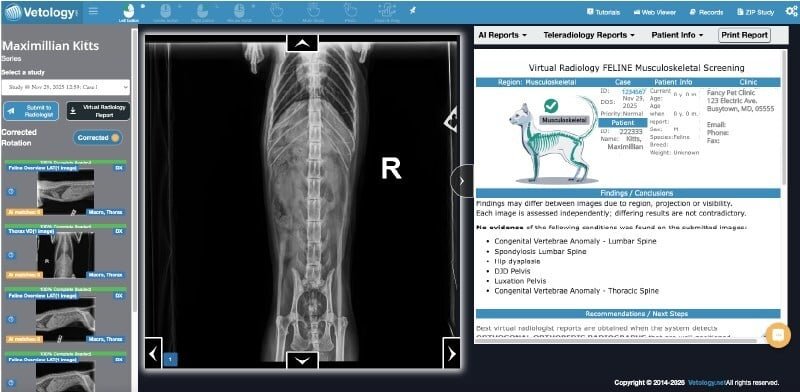
SAN DIEGO – Vetology Innovations is poised to become a leader in AI-powered software that streamlines reading pet X-rays for radiologists and veterinarians.
The company announced earlier this month it has released the performance metrics of more than 89 classifiers, diseases or complications its AI is trained to find in images.
Vetology is the first company to do so from a handful of players in this new industry that include the Mars PetCare-owned Antech Imaging, SignalPET and Radimal.
According to Vetology President Eric Goldman, the American College of Veterinarian Radiology has long requested more transparency from technology companies, who traditionally look to protect their processes.
“We’re changing that,” he said. “Complete transparency isn’t a competitive advantage we’re protecting, it’s a professional obligation we’re fulfilling.”
Workflow Efficiency for Impacted Industry
Vetology was founded in 2010 by Seth Wallack who spun the company out of his Veterinary Imaging Center of San Diego (VICSD) business. Imaging centers like VICSD provide radiograph, ultrasound, CT, MRI and other services to vet clinics and radiologists and Wallack saw an opportunity in improving workflows in the industry through teleradiology and software solutions.
Goldman pointed out that in the U.S. there are only around 760 board-certified veterinarian radiologists, and only just over 500 in Europe. At the same time, the number of vet clinics and pet owners are “proliferating.”
“The people who need to send [X-ray images] to radiology keeps going up every year and there’s so few radiologists, so the diagnostic costs keep going up and up,” Goldman said.
Wallack eventually tapped Goldman to lead Vetology’s AI initiative that would use VICSD’s library of images and radiology reports to train a software that can expedite review of medical images of animals and release a report of potential problems or diseases, what the company refers to as classifiers.
“The technology is to give the vet a bunch of information to help them make that next level of treatment,” Goldman said, adding that sometimes that next level is not necessarily a firm diagnosis but rather a proposal for a more pointed question to the radiologist – such as whether an obstruction, for example, would require medicine or an operation.
“Now we can make teleradiology more efficient, as opposed to giving the radiologist 15 images and saying, ‘I don’t know why the dog is throwing up, tell me what’s going wrong,’” he said. “They now have an AI report that says, ‘There’s something in the stomach. It appears to be in the small intestines. Can you tell me should I cut or not cut?’
“I always call it: ‘Human and AI go better together.’ It’s combining those two sets of services, and that’s really what we do,” Goldman added.
Transparency Feeds Faster Growth
When Vetology first set out to train its AI, the company started by first looking at the most common issues that prompt people to bring their pets in for imaging. Its initial classifiers were developed by feeding the images and radiologists’ interpretations of them into the AI.
Vetology’s AI then uses its algorithm to generate a report that includes things like the pet’s heart size; shows what images were used and with the click of the screen gives the vet the ability to send the images and report to a radiologist for further investigation. Radiologists can then rate the report with either a thumbs up or a thumbs down.
“They can say, ‘Hey, it didn’t seem to mention bladder stones, I see bladder stones here,” Goldman said, adding that this double-check feature allows for quick retraining of the AI on things it misses.
“When the company started, it would take a year to put out a small group of classifiers,” he said. “We are now releasing 10 to 15 new ones a month; that includes things we’re retraining.”
Besides allowing for an easy way to peer review the reports the AI puts out, Vetology has also worked with top universities – schools like Tufts University, Cummings School of Veterinarian Medicine, Animal Medical Cener of New York and Purdue University – to scrutinize its data and validate the platform’s accuracy.
The results of those studies are available on Vetology’s website and include breakdowns of the AI platform’s condition-level sensitivity, specificity, and sample sizes across 300,000 test cases covering Vetology’s canine thorax, canine abdomen, feline thorax, feline abdomen, and spine/musculoskeletal classifiers, among other tools like showing the rate that radiologists agree on the findings of each classifier.
Growing Business at Home and Abroad
Vetology’s platform is currently being used by “a little under 1,000 clinics,” Goldman said.
“And it continues to grow. We’ve been growing year-over-year anywhere between 30 to 40 percent since we started this effort.”
The company is profitable, Goldman added, and was launched with mostly money from VICSD, which owns 75% of Vetology and its board serves as directors of both companies.
Goldman said that the only outside funding the company has taken is about $1 million from a handful of radiologists who were early adopters of the platform.
“Year over year we’ve been profitable and we haven’t raised,” he said. “Maybe at some point we will, but at the moment we can control our own destiny.”
Vetology’s destiny for its next phase of growth will likely be markets other than in the U.S. and Europe where vet practices have easy access to a variety of radiology services
“When you get into all sorts of other countries, they don’t necessarily have radiologists. You have a lot of [doctors of veterinarian medicine], to be honest, guessing,” Goldman said. “There’s a market opportunity to be able to help these DVMs in other countries.”
Vetology Innovations
FOUNDED: 2020
HEADQUARTERS: San Diego
CEO: Seth Wallack
BUSINESS: radiograph interpretation services for veterinary clinics
EMPLOYEES: 30
WEBSITE: https://vetology.net/
NOTABLE: Vetology has partnered with top veterinarian schools to validate the efficacy of its AI platform




