
On January 26, China’s President Xi Jinping described China and India as “friends and partners.” His statement was part of a congratulatory message for India on its Republic Day, in which he envisioned the “dragon and the elephant dancing together.”
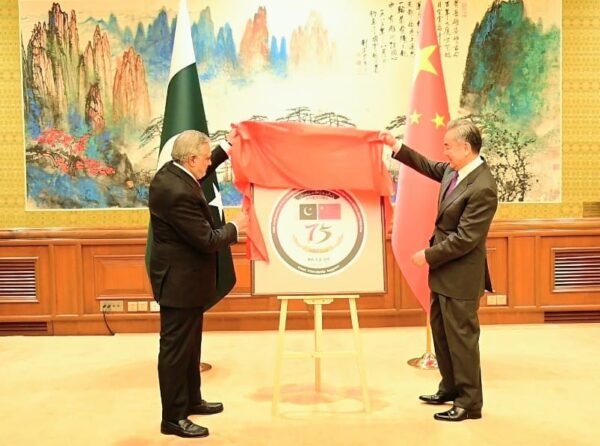
Xi’s statement came three weeks after the seventh round of China-Pakistan Foreign Ministers’ Strategic Dialogue, to commemorate the 75th anniversary of the bilateral relations between the two countries. Vows to “strengthen mutual trust” echoed in Beijing, alongside the customary reminders that the two are “all-weather friends.”
The strategic dialogue capped off a year that saw ebbs and flows in bilateral ties.
In May, Pakistan used Chinese military equipment, headlined by the J-10C jets, during clashes with India. The clashes, celebrated as a “triumph” in Pakistan, saw an immediate rise in Chinese defense stocks and an offer from Beijing to sell its latest equipment, including the fifth-generation J-35 fighter jets, to Islamabad.
However, the China-Pakistan defense collaboration was immediately overshadowed by U.S. President Donald Trump’s orchestration of the ceasefire between Islamabad and New Delhi in May. Trump spent the rest of the year intermittently reminding the world that he stopped a potential “nuclear war” between the South Asian rivals, talking up Pakistan’s downing of the Indian jets, and in turn drawing the U.S. closer to the hybrid regime in Islamabad spearheaded by the omnipotent military establishment.
Pakistan joined Trump’s “Board of Peace” in January, underscoring Islamabad’s recent realignment with Washington’s interests beyond South Asia. The U.S. president considers Pakistan a key player for implementing his plans for Iran as well.
As the Pakistani leadership successfully wooed Trump last year, Beijing also sought better relations with New Delhi, with Xi Jinping and Indian Prime Minister Narendra Modi pictured smiling and laughing alongside Russian President Vladimir Putin in September at the Shanghai Cooperation Organization summit. In October, China and India resumed direct flights after five years, building on the 2024 agreement to deescalate border tensions, vowing enhanced trade and bilateral investment.
Where improved China-India and Pakistan-U.S. relations could be seen as diplomatic counterplay, observers maintain Beijing wouldn’t be too surprised by Washington’s increased proximity to Islamabad.
“The Chinese are curious about the improvement of ties between the U.S. and Pakistan, but the materialization of ideas is more important than signals and gestures,” Yun Sun, the director of the China Program at the Stimson Center in Washington, D.C., told The Diplomat.
Sun believes that despite a thaw in China’s relations with India, Beijing would continue to eye Pakistan as a counterweight to India. “Cooperation with Pakistan is important for China to check India’s behaviors and ambitions. For the U.S., the current priority appears to be a recalibration of relations with India,” she added.
Trump’s amplification of the Pakistani position on last year’s clashes with India was coupled with Washington’s doubling of import tariffs on New Delhi to 50 percent over purchase of Russian oil. In January, the U.S. president asserted that the tariffs could rise further. India responded to U.S. pressures with a landmark trade deal with the European Union announced on January 27.
A potential breakthrough in the India-U.S. relationship came this week, with Trump and Modi declaring on social media that they had reached a “trade deal” to lower U.S. tariffs on Indian goods to 18 percent. But many of the details – such as India’s imports of U.S. agricultural products and India’s future imports of Russian oil – are in question, or outright disputed.
“It would serve U.S. interests to engage more broadly and consistently across South Asia to help maintain regional balance and prevent strategic overconcentration in any one direction. In this context, improving U.S.-Pakistan ties is a constructive step,” said Farwa Aamer, the director of South Asia Initiatives at the Asia Society Policy Institute.
“Of course, strong U.S.-India ties are also very important to counterbalance some of China’s influence in the region.”
That Chinese influence goes beyond Pakistan, and has developed via economic engagement, infrastructure investment, and strategic partnerships across South Asia. This expansion, likewise, is being carefully monitored in Washington.
While multiple avenues for cooperation remain between Beijing and Islamabad, the India-Pakistan clashes, for many, mean that defense collaboration between China and Pakistan will be a focus area.
“Pakistan successfully showcased Chinese military equipment to the entire world. The defense cooperation between Pakistan and China can only increase after that,” former Pakistan Foreign Minister Khurshid Kasuri told The Diplomat. “Of course, the U.S.-China rivalry has existed for a while, and is only getting stronger, but Pakistan has always managed to strike the right balance in its relations with either of them.”
While many in Pakistan speak of a diplomatic equilibrium with Beijing and Washington, many outsiders view China as benefiting from a turbulent security environment in South Asia. Any volatility with Pakistan requires India to allocate significant attention and resources to its western front, limiting New Delhi’s ability to concentrate fully on competition with Beijing.
“From the standpoint of China-Pakistan security collaboration, renewed India-Pakistan tensions tend to deepen Islamabad’s reliance on Chinese defense platforms, technical support, and strategic backing,” said Miles Yu, the principal China policy and planning adviser to former U.S. Secretary of State Mike Pompeo.
“In moments of confrontation, Pakistan has strong reasons to accelerate military procurement and integration with Chinese systems, which can further tighten the operational and political links between Islamabad and Beijing,” he added.
Observers insist that the India-Pakistan clashes also reshaped how the U.S. viewed China’s role as a military and strategic actor in South Asia, with Washington increasingly interpreting regional crises through the broader lens of China-U.S. competition. Episodes of India-Pakistan escalation spotlight the degree to which Chinese military technology and strategic support can influence outcomes and deterrence dynamics.
“This matters even more given India’s regional ambitions and Washington’s interest in India’s long-term rise: a crisis that highlights Pakistan’s China-backed capabilities can reinforce U.S. concerns about China’s ability to affect regional balances indirectly, without deploying force directly,” said Yu.
While some saw Trump enforcing the India-Pakistan ceasefire as, in part, a bid to limit Chinese strategic space and weaken Beijing’s ability to influence regional actors, others view enhanced U.S. engagement with Islamabad as evidence of Pakistan’s greater geopolitical importance.
“It is quite evident that Pakistan is not being viewed from the China lens or the India lens. The prominence that Pakistan is enjoying, not only in the White House, but also in various regional alliance, is a testament to the importance that the country now enjoys globally,” said Kasuri.
Even so, there is little doubt that the China-U.S. dynamics would continue to have a major influence over Islamabad’s respective relations with Washington and Beijing, Aamer said. “Heightened tensions [between the U.S. and China] would complicate Pakistan’s positioning, while improved relations between the two would place Pakistan among the key beneficiaries,” she said.
Immediately after initiating his second term in the White House, Trump announced plans to “take back” the Panama Canal, citing growing Chinese influence there, while bringing renewed focus to security flashpoints in Taiwan and South China Sea. This was complemented by a string of tariffs on China, duly reciprocated by Beijing, eventually culminating in a trade truce last year.
Trump’s actions across the globe have remained a focus of Chinese concerns, as underlined in the joint statement issued during the China-Pakistan Foreign Ministers’ Strategic Dialogue: “The sudden changes in Venezuela have drawn high attention from the international community… China never believes that any country should act as a world policeman.”
While the U.S. and China might not appear to be moving toward a direct military or fiscal confrontation in South Asia, many believe that could change if Pakistan-U.S. cooperation expands into areas such as critical mineral supply chains and technology-related coordination. “For Beijing, Pakistan moving closer to the United States does not merely imply a change in Pakistan’s foreign policy tone – it threatens the strategic leverage China has accumulated over Pakistan’s financing, infrastructure planning, telecommunications ecosystem, and major port projects,” Yu said.
Pakistan offered rare earth minerals as part of its package to lure the U.S. back into the region.
As Pakistan seeks to profit from the China-U.S. rivalry, any revival in Islamabad’s relations with Beijing would be evident in the fate of the China Pakistan Economic Corridor (CPEC), long described by Washington as a “debt trap.” The China-Pakistan Foreign Ministers’ Strategic Dialogue reverberated with claims of pursuing an upgraded version of the project: CPEC 2.0.
“There is certainly hope in both Islamabad and Beijing, and renewed commitment to CPEC 2.0 has been signaled at all recent high-level exchanges,” Aamer said. “However, meaningful progress will depend on addressing the challenges that slowed the first phase.”
For Yun Sun, CPEC is always going to a glass half empty for Pakistan. “The primary reason for the stall is not external, but the challenges and questions within the scheme itself,” she said. “But neither China nor Pakistan will give it up, so progress will happen. The question is the degree.”
Launched over a decade ago as Beijing’s largest-ever overseas investment, the $62 billion CPEC has stalled for a host of reasons, punctuated by Pakistan’s ongoing security crisis. While Islamabad had sought to renegotiate the financial terms of the project – which Pakistani officials have privately described as skewed and dictated by Beijing – the continued terror attacks targeting CPEC and the Chinese presence in Pakistan have prompted vocal condemnations from China.
Kasuri said that addressing the security situation is critical for Pakistan itself, beyond Chinese or American interests. It’s “not just CPEC,” he said. “No economic growth is possible if the investments face a security threat.”
“CPEC is a long-term agreement, and as soon as Pakistan begins to overcome the security challenges hampering the project, progress will become evident,” he added.
Yu believes any progress on CPEC 2.0 will depend on Pakistan’s political leadership, and whether it concludes that the economic and security risks are manageable. “While both Islamabad and Beijing have incentives to revive CPEC rhetorically, implementation will be shaped by hard constraints: Pakistan’s fiscal weakness, domestic political instability, security threats to projects and personnel, and the long-term burden of repayment and strategic dependence,” he said.
That means that Islamabad must decide whether expanding CPEC advances Pakistan’s financial interests or if it signifies more external debt obligations and strategic constraints. While strengthening security would be an imperative, Islamabad might also seek to renegotiate the terms and extract more balanced benefits. This would include “industrial development and employment rather than debt-heavy megaprojects,” said Yu.
Whether CPEC remains more of a political slogan, or if it sees a genuine relaunch, will determine the status of the much-touted China-Pakistan “all-weather friendship.” And any revival will inevitably factor in the U.S. asserting itself in the region, and India vying to emerge as a global power.



