
Welcome back to World Brief, where we’re looking at limited progress in U.S.-Iran peace talks, Israeli forces killing Hamas’s new military leader, and corruption allegations within Spain’s ruling Socialist Party.
The Race to November
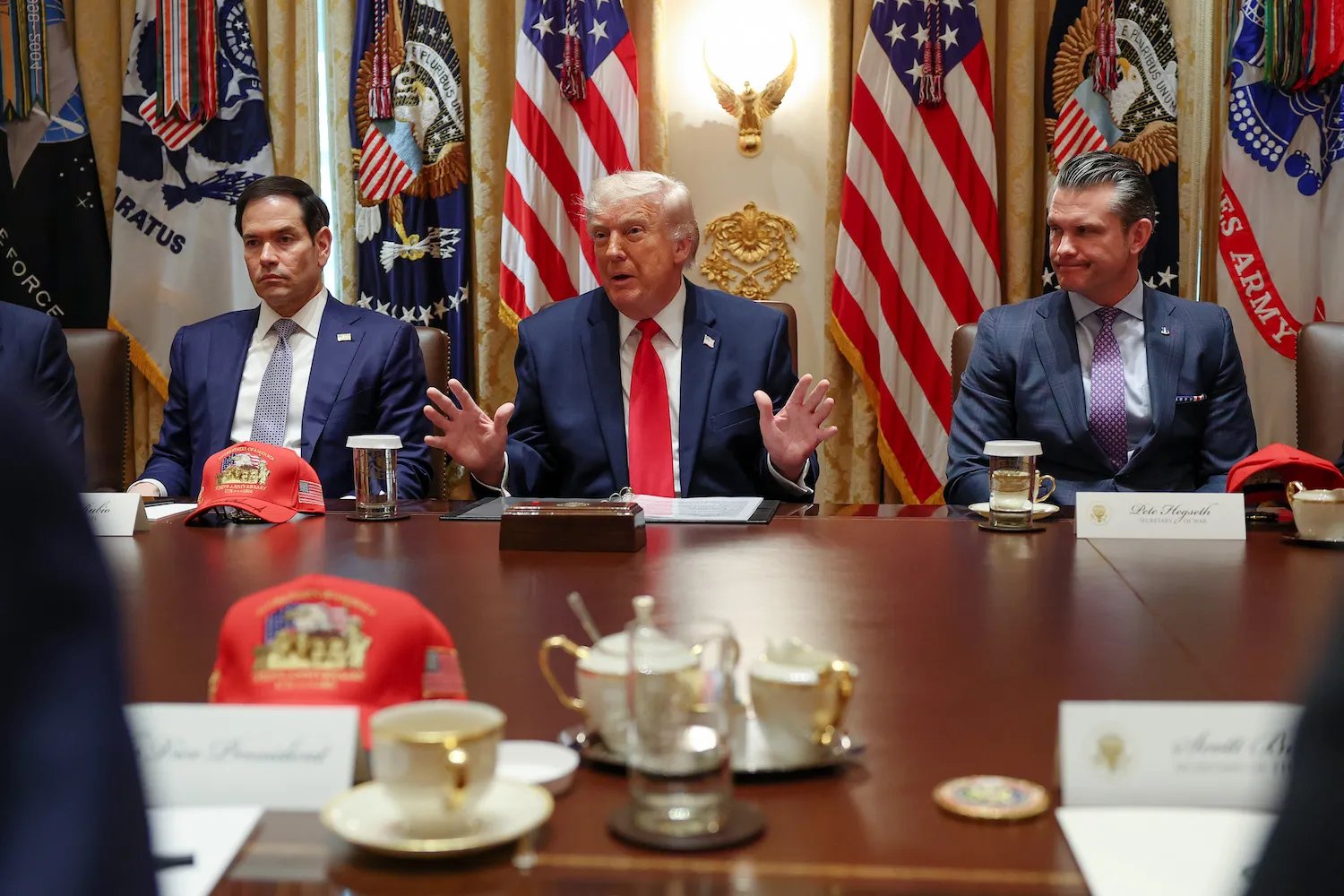
U.S. President Donald Trump accused Iran on Wednesday of stalling peace talks in the hopes that looming U.S. midterm elections might force the White House to cave on several key demands. “They thought they were going to outwait me,” Trump said during a televised cabinet meeting.
Welcome back to World Brief, where we’re looking at limited progress in U.S.-Iran peace talks, Israeli forces killing Hamas’s new military leader, and corruption allegations within Spain’s ruling Socialist Party.
The Race to November
U.S. President Donald Trump accused Iran on Wednesday of stalling peace talks in the hopes that looming U.S. midterm elections might force the White House to cave on several key demands. “They thought they were going to outwait me,” Trump said during a televised cabinet meeting.
With Trump facing low public approval ratings, Republicans appear concerned that rising fuel prices due to the Iran war could cause the party to lose control of Congress come November. Still, Trump insisted on Wednesday, “I don’t care about the midterms,” and he expressed confidence that a deal to end the war was in reach.
The Iranians “want very much to make a deal,” Trump said. “So far, they haven’t gotten there. We’re not satisfied with it, but we will be. Either that, or we’ll have to just finish the job.” The day before, U.S. forces launched so-called “self-defense” strikes on southern Iran, prompting Tehran to accuse Washington of violating the two countries’ precarious cease-fire.
U.S. Secretary of State Marco Rubio stressed on Wednesday that “diplomacy is always the first option” when it comes to ending the conflict, even as Trump said that Tehran is “negotiating on fumes.” Experts suggest that this mixed messaging—as well as continued U.S. threats of active fighting—could jeopardize the peace talks.
Several issues appear to remain unresolved in the talks, including two of the biggest ones: Iran’s nuclear capabilities and reopening the Strait of Hormuz.
Regional officials and a senior Trump administration figure told The Associated Press on Wednesday that a potential deal could see Washington offer sanctions relief to Iran in exchange for Tehran giving up its stockpile of highly enriched uranium.
Yet Trump appeared to reject this concession on Wednesday, saying, “We’re not talking about any easing of sanctions, no money, no nothing.” Such a denial could be an effort to appease members of his own party—including Republican Sens. Roger Wicker, Lindsey Graham, and Ted Cruz—who have argued that these terms are too favorable to Iran and too similar to the nuclear deal that then-U.S. President Barack Obama negotiated in 2015. Trump withdrew the United States from that deal in 2018.
As for the Strait of Hormuz, Trump said on Wednesday that the strategic waterway will “be open to everybody,” adding that nobody will control it, as it is in international waters. At the same time, Trump suggested that the United States would “watch over it.” He did not indicate how the country might do this.
Today’s Most Read
What We’re Following
Israel’s multifront war. Hamas confirmed on Wednesday that Israeli forces had killed the new leader of the group’s military wing. According to local authorities, an Israeli strike on a market in Gaza City on Tuesday killed at least five people, including Hamas commander Mohammed Odeh, and injured 12 others. Israeli Defense Minister Israel Katz described Odeh as “one of the architects” of Hamas’s Oct. 7, 2023, attack on Israel.
Meanwhile, along Israel’s northern border, the country’s military declared on Wednesday that all areas south of Lebanon’s Zahrani River are now “combat zones” and that residents should flee their homes to avoid Israel’s use of “extreme force” against Hezbollah. The warning comes just days after Israeli Prime Minister Benjamin Netanyahu signaled that Israel plans to intensify its campaign against the Iranian proxy group.
Experts suggest that Israel’s actions in Gaza and Lebanon could hinder U.S. efforts to negotiate a peace deal with Iran. Previously, Tehran had argued that a cease-fire in Lebanon must be part of any U.S.-Iran peace proposal—a demand that Israel and the United States have both rejected.
Searching Socialists. Spanish police searched the headquarters of Spain’s ruling Socialist Workers’ Party on Wednesday for documents connected to an alleged scheme to interfere in judicial proceedings. The investigation delivered another blow to Prime Minister Pedro Sánchez, whose closest confidants (including his wife) have become the subjects of corruption scandals that have degraded public trust in the party’s ability to govern.
Judge Santiago Pedraz ordered the country’s civil guard on Wednesday to “confiscate diverse documentation and electronic archives in an investigation of a ring designed to destabilize judicial processes that were affecting the ruling party.” Pedraz said he is investigating multiple people who were allegedly involved—including at least two former Socialist Party heavyweights, a regional government official, a police officer, a business owner, and two lawyers—on suspicion of bribery, forgery, false testimony, influence peddling, and corruption, among other offenses.
Wednesday’s search came one week after the country’s National Court indicted former Prime Minister José Luis Rodríguez Zapatero for alleged money laundering, influence peddling, and other offenses. Rodríguez, who has denied wrongdoing, was a close ally of Sánchez.
The Socialist Party has also denied any wrongdoing, and on Wednesday, Sánchez stressed that the party will cooperate with judicial authorities. At the same time, the prime minister rejected calls to resign, saying: “I cannot call elections for partisan interests. I have to call elections for the general interest of the citizens.”
Mass deportations. The Trump administration deported nearly 13,000 third-country nationals to Mexico between Jan. 20, 2025, and March 9, 2026, according to a Human Rights Watch report published on Wednesday. Neither Washington nor Mexico City has publicly disclosed the details of these deportations, though Trump has long vowed to crack down on undocumented immigration.
The report alleges that the U.S. government did not conduct individualized screenings prior to these deportations. Deportees interviewed by Human Rights Watch also reported suffering inhumane conditions while in U.S. detention facilities, and most said that they were sent to Mexico without money, documentation, or other personal belongings.
According to the report, once in Mexico, many immigrants found themselves vulnerable to rampant cartel violence.
“They’re casting us aside to die,” one Cuban national deported to Mexico told Human Rights Watch. “There’s no help; we can’t work because we don’t have papers. They don’t give us anything, nothing.” Cubans made up the majority of people deported from the United States to Mexico during this time.
Odds and Ends
Starbucks has found itself in hot water in South Korea. Last Monday, on the anniversary of a deadly popular uprising in the South Korean city of Gwangju, Starbucks Korea kicked off a new marketing campaign. It declared May 18 to be “Tank Day” and promoted a new, large-sized tumbler that it nicknamed the “tank.” The campaign drew instant backlash, as South Koreans accused the popular coffee chain of mocking the victims of the 1980 Gwangju uprising, during which the country’s military dictatorship killed and wounded hundreds of pro-democracy activists.
South Korean billionaire Chung Yong-jin, whose Shinegae Group owns a 67.5 percent stake in Starbucks Korea, apologized for the second time on Tuesday for the company’s insensitivity. Still, Interior Minister Yoon Ho-jung has said that Starbucks products will no longer be used at government events, and nationwide sales of the company’s goods have suffered a significant drop.



