
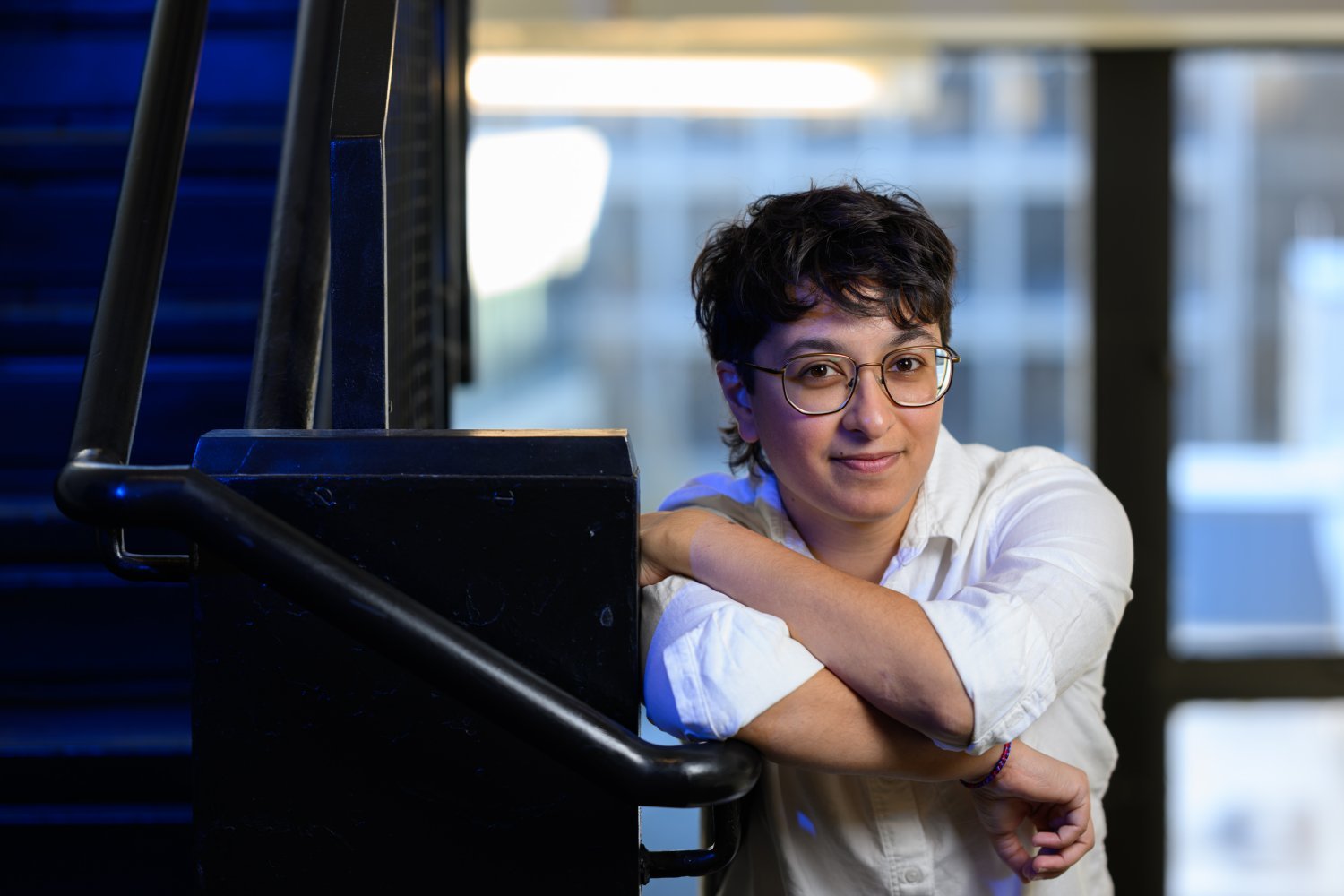
“I’ve loved space for as long as I can remember,” says Palak Patel, a sixth-year doctoral student in MIT’s Department of Mechanical Engineering (MechE). As a girl, she “devoured” books about planets in the solar system, and her parents nurtured her growing interest in space through visits to observatories, air and space museums, and NASA centers. Spending time with her grandfather, who oversaw the radiation protection division of India’s Bhabha Atomic Research Center, also made a big impression on her.
Now, Patel specializes in developing advanced materials that could transform the future of human spaceflight. “My research fundamentally tries to figure out how to keep astronauts safe in space,” she says. From designing radiation-shielding nanocomposites to training as an analog astronaut, she’s at the forefront of work that bridges the nanoscale and interplanetary scale.
Born in the United States, she moved to India at age 13. As an undergraduate in mechanical engineering there, she became heavily focused on research. Patel interned at the Indian Space Research Organization (ISRO) during her senior year, where she was drawn to the challenges of space-grade manufacturing. “It’s one of the few areas where you need things to be really precise and clean and perfect,” she says.
After graduation, she joined a company that built components for ISRO missions as a project engineer. She was in charge of setting up a facility and standard operating procedure for manufacturing rectangular aluminum waveguide bends and twists for satellites — a process that she had helped ISRO develop and optimize as an intern. The experience cemented her interest in space research — and prompted her application to MIT. “I wanted something a bit more technical, a bit more research-focused,” she says.
Harnessing the power of nanotubes
At MIT, Patel joined the lab of Brian Wardle in the Department of Aeronautics and Astronautics (AeroAstro). She specializes in synthesizing nanotubes and manufacturing multifunctional nanocomposites — tiny cylindrical structures with hollow cores, known for their remarkable strength and versatility.
For her master’s degree, she used her mechanical engineering expertise to integrate nanotubes into existing aerospace materials. “Modern-day airplanes are more than 50 percent composite materials — glass fiber, carbon, fiber composites,” she explains. “Putting carbon nanotubes into existing composites can improve their mechanical properties and add multifunctionalities.”
Beyond structural enhancement, the nanotubes provide additional functionalities. For instance, integrating nanotubes into composite materials allows airplane wings to resist ice formation, extending flight durations. The materials can also help detect cracks before catastrophic failures occur.
After finishing her master’s studies, Patel decided she wanted to focus explicitly on space applications, so Wardle connected her with colleagues at NASA. One of them, Valerie Wiesner — a NASA scientist who would later become her research mentor — introduced Patel to boron nitride nanotubes, which have a different superpower: radiation shielding.
Developing safer materials for spaceflight
Ionizing radiation is one of the biggest obstacles to space travel. When space radiation hits the aluminum used in most spacecraft, it can create dangerous secondary neutrons — a serious risk for humans on board. “You can’t safely travel to Mars with the current state-of-the-art materials,” Patel says.
Boron nitride nanotubes offer a lightweight, high-performance way to block that radiation without compromising mechanical integrity. And thanks to a breakthrough process developed in Wardle’s lab, Patel can synthesize them at concentrations far beyond NASA’s previous limits — up to 50 percent by weight, compared to 5-10 percent in earlier composites.
This kind of work requires an unusual blend of disciplines, and Patel credits her coursework at MIT for helping her build a strong foundation. “When you think about manufacturing on a large scale, you’re like, I could just figure out how to cut this. But then, on a micro and nano scale, you can’t physically take a knife and cut anything. You have to think about chemical methods and atomic scale synthesis and processes.”
Patel’s research earned her a prestigious NASA Space Technology Graduate Research Opportunities fellowship, which allows her to regularly test her materials at multiple NASA sites. “MIT is the only place where you can synthesize these nanotubes the way we do,” she says. “We’ve got some results that look great.”
In May 2025, Patel took part in a microgravity flight to assess the feasibility of manufacturing these materials in space. The mission was successful: The nanotubes she manufactured have since made it to the International Space Station (ISS).
In addition to her primary research on boron nitride nanotubes, Patel also participates in NASA competitions aimed at solving practical space exploration challenges. Her first project involved developing a system to drill into lunar and Martian surfaces to extract water, tapping her hands-on engineering skills. These competitions have not only provided her with practical experience, but have also led to additional collaborations with NASA scientists.
Patel also participated in a Swiss-based analog mission called Asclepios III, serving as the CAPCOM (capsule communicator) for the analog astronaut team. The 14-day mission involved extreme environment training. “We did mini-parabolic flights to where you can experience microgravity in a plane, which is really nice. And it was in Italy, over the Alps, so that made it twice as nice!” she says.
“The best part of MIT”
When she’s not at NASA, Patel splits her time between the AeroAstro and MechE departments — and between her lab work and her hobbies. Most of her extracurricular activities involve her friends, whether it’s paint nights (painting planets in abstract form is one of her favorite subjects), playing soccer, or exploring the outdoors, especially skiing, hiking, kayaking, and camping. “My time with friends here at MIT has been really important to me. I’ve made so many important friendships along the way,” she says.
Now in the home stretch of her PhD, Patel is focusing on developing novel materials for spaceflight applications, from improving thermal protection systems to safeguard astronauts during atmospheric re-entry to mitigating the impact of lunar dust — a significant problem during the Apollo missions, she notes. “The dust, sharp and electrostatic, stuck to everything and cut through spacesuits.”
After graduating, she plans to continue working on technologies that support human spaceflight. “The space industry is at a really exciting stage with the return to the moon and the focus on getting humans to Mars. I think it would be really fun to enter the industry at the moment and work closer to where all the action is happening. I imagine it being very similar to how people felt working on the Apollo, space shuttle, and ISS missions years ago.”
No matter where her career leads her next, Patel feels well prepared.
“There are amazing opportunities at MIT, and I’ve gotten to work on some really cool projects,” she says. “But it’s only cool because I get to work with other people. The students, the staff, the professors — they’re the best part of MIT.”
Source: news.mit.edu



