
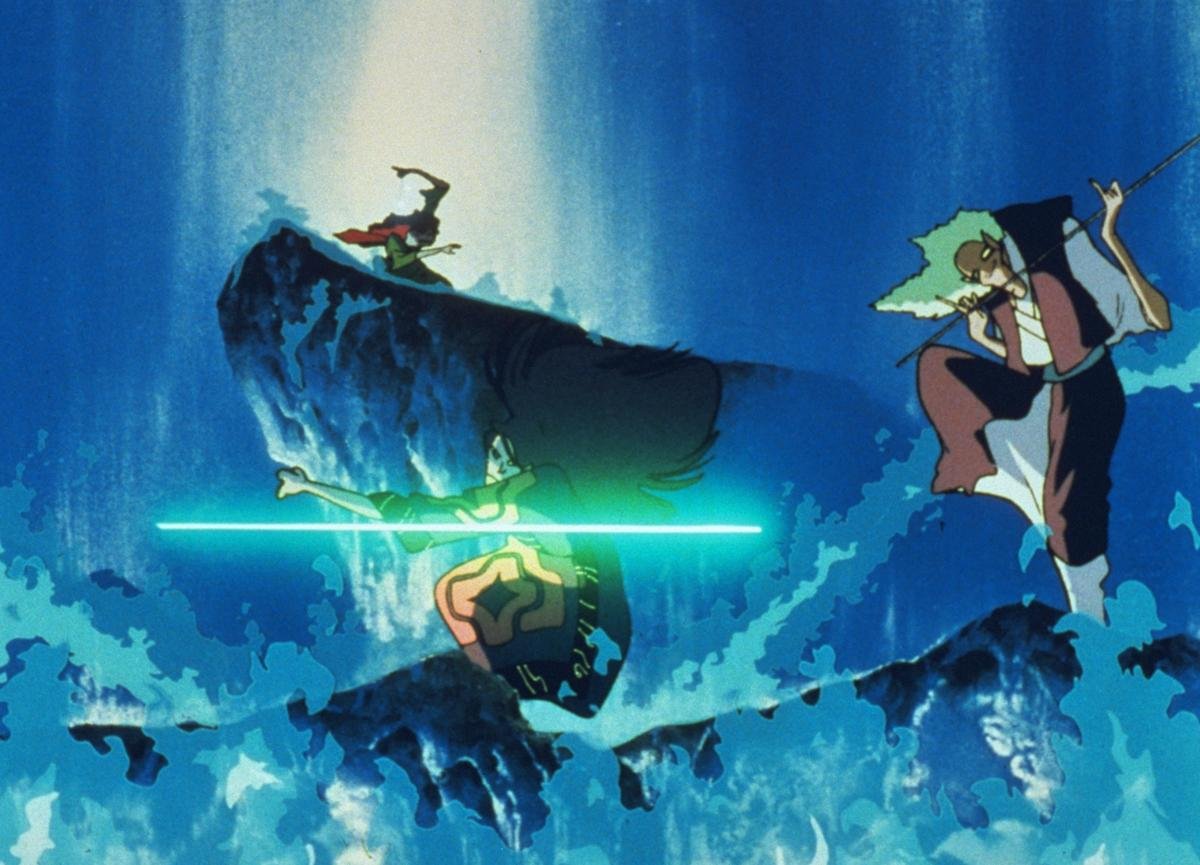
Released in 1985, “The Dagger of Kamui” is a historical adventure anime directed by Rintaro and produced by Madhouse, based on the novel series by Tetsu Yano published by Kadokawa Shoten between 1984 and 1985. The movie blends ninja adventure, historical drama and global travelogue, unfolding across late Tokugawa Japan, the United States and the Pacific world, while incorporating both fictional characters and real historical figures such as Saigo Takamori, Mark Twain and the Apache leader Geronimo. Furthermore, the narrative incorporates elements of Ainu culture, with words from the Ainu language appearing in the soundtrack, including the song featuring the words “Arororo” and “Hoochippu,” evoking lullaby and rowing rhythms.
Produced during a period when Japanese animation was increasingly experimenting with feature length storytelling aimed at older audiences, “The Dagger of Kamui” stands out for its sweeping scope and dense historical background. In particular, the story references major events of the Bakumatsu and early Meiji period, including the Boshin War and the fall of the Tokugawa Shogunate, while weaving them into a fictional conspiracy surrounding Captain Kidd’s lost treasure. Although it was not a major box office hit upon release, the production gained recognition for its scale, mature storytelling and detailed historical references, later achieving cult status among anime enthusiasts and historians of Japanese animation. The title has since been screened at retrospective events dedicated to classic anime and Madhouse productions, and remains notable for the rare early voice performance of actor Hiroyuki Sanada as the protagonist Jiro.
Buy This Title
by clicking on the image below
“The Dagger of Kamui” follows the story of Jiro, a boy of mixed Japanese and Ainu heritage raised in a remote village on the Shimokita Peninsula. His life is shattered when a mysterious shinobi murders his adoptive mother and sister, leaving behind a strange dagger that becomes the key to a far larger mystery. Accused of the crime by the terrified villagers, Jiro escapes execution and falls under the influence of Tenkai, a Buddhist monk secretly serving as an intelligence agent for the Tokugawa Shogunate. Tenkai manipulates the young boy into training as a ninja while secretly using him as a pawn in a long-running quest to uncover a hidden treasure believed capable of preserving the Shogunate’s power.
As Jiro grows into adulthood, fragments of his past gradually emerge. His journey leads him across northern Japan and into Ainu communities, where he learns the truth about his parents and the origins of the titular dagger, an heirloom connected to an Ainu chieftain and to his own mother, Oyaruru. Realizing that Tenkai has orchestrated the tragedies that shaped his life, Jiro sets out on a quest for vengeance and truth that takes him across the Pacific to the United States and later on back to Japan, during the final battles of the Boshin War.
Rintaro, despite the evident lack of any concern about history, geography and occasionally logic, has come up with a truly epic work, where action, drama and intense road movie elements are constantly mixed, resulting in a thoroughly entertaining spectacle that retains interest from beginning to end. At the same time, the impact of the overall approach, including the many enemies that appear throughout the story and the shadowy leader who uses everyone like puppets, becomes increasingly apparent, particularly in the way it anticipates later iconic titles such as “Ninja Scroll.”
However, the most appealing element here is the way Rintaro approaches the whole project as a spectacle. The combination of non-stop and quite rapid movement, in a trait that has been missing from cinema in general lately, the excellent music with the themes “Kamui’s Lullaby” and “The Dagger of Kamui” being truly memorable, the rapid editing cuts, and the brutality of the action scenes all come together into a truly impressive work. At the same time, although the faces of the characters may look somewhat blunt today, the quality of their attire and overall appearance, courtesy of the excellent designs by Moribi Murano, along with the impressive animation by Madhouse and Project Team Argos, results in a number of scenes that can only be described as memorable.
The audiovisual extravaganza continues in the scenes where more individuals appear on screen simultaneously, with the surrealism of their movements giving the anime a more artistic dimension. At times, this approach even recalls “Belladonna of Sadness,” although the visual style here is definitely more raw and less intricate. Lastly, the fact that the Japanese arc in particular is based on actual events and historical figures gives the narrative a more grounded approach, which ultimately benefits the overall storytelling. Lastly, the presence of Hiroyuki Sanada as the voice of Jiro concludes the technical prowess of the movie.
Even if there are occasions where “The Dagger of Kamui” clearly shows its age, it has nevertheless aged well, remaining a work that deserves to be counted among the early classics of anime, and definitely one that fans of ninja anime will enjoy.



