
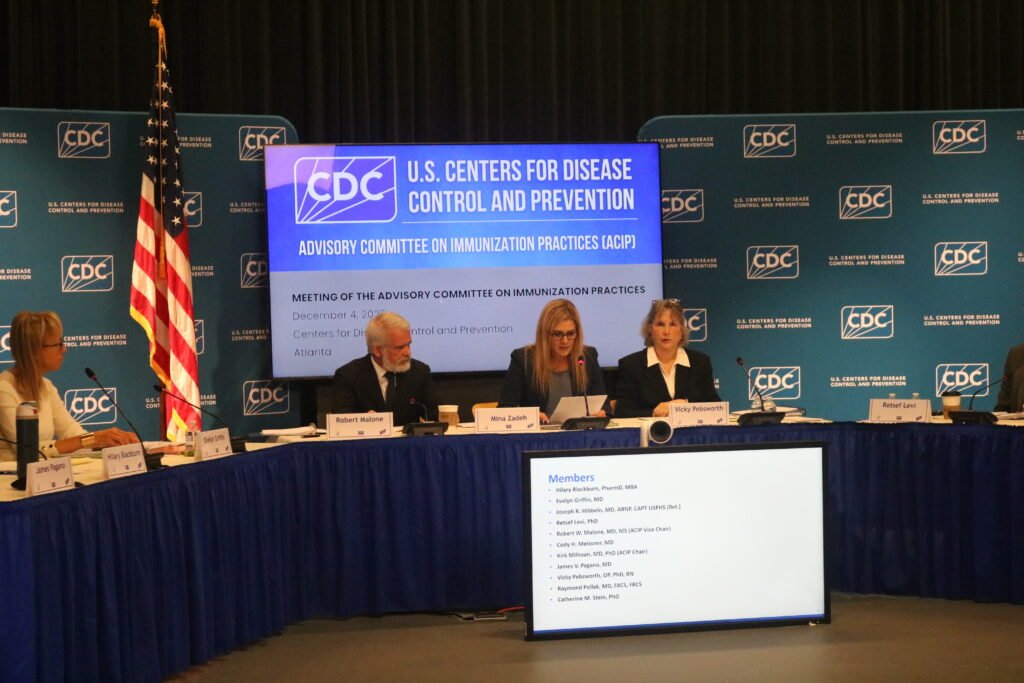
A federal judge in Massachusetts has halted enforcement of several key vaccine policies imposed by Health Secretary Robert F. Kennedy Jr., ruling that the Trump administration illegally overhauled a Centers for Disease Control and Prevention committee dedicated to issuing immunization recommendations.
The decision, which comes in response to a lawsuit filed by the American Academy of Pediatrics last July, temporarily blocks the enforcement of all recommendations voted on by the panel. That includes the overhaul of a decades-old recommendation that all newborn babies receive a vaccine against hepatitis B, a push to emphasize the risks of COVID-19 vaccines and a ban on vaccine preservatives like thimerosal.
The ruling also temporarily halts participation from 13 of the panel’s 15 members, complicating a meeting that was scheduled to begin later this week.
The CDC’s committee, known as the Advisory Committee on Immunization Practices, is charged with setting national guidelines around which people should be vaccinated against a wide range of preventable diseases and when those vaccines should be administered. The recommendations play a key role in determining which vaccines insurance companies are willing to cover and how accessible those immunizations are to the public.
Last June, Kennedy abruptly dismissed all 17 members of the committee and replaced them with a slate of hand-picked appointees, many of whom are seen as vaccine skeptics. In his Monday decision, District Court Judge Brian E. Murphy ruled that the Trump administration likely violated the Administrative Procedure Act by failing to appoint qualified, nonpartisan experts, as the panel’s charter requires.
By ignoring those requirements, “the Government has disregarded those methods and thereby undermined the integrity of its actions,” Murphy’s ruling reads.
Dr. Andrew Racine, the president of the American Academy of Pediatrics, celebrated the ruling, calling it “a historic and welcome outcome for children, communities, and pediatricians everywhere.”
“For decades, the AAP partnered closely with the federal government to advance our mission of attaining the optimal health and well-being of children and youth,” Racine added. “We would much prefer to return to that partnership and collaborate with federal healthcare agencies instead of litigating against them.”
A spokesperson for the U.S. Department of Health and Human Services did not immediately reply to a request for comment.
This story was originally produced by Georgia Recorder, which is part of States Newsroom, a nonprofit news network which includes New Jersey Monitor, and is supported by grants and a coalition of donors as a 501c(3) public charity.



