
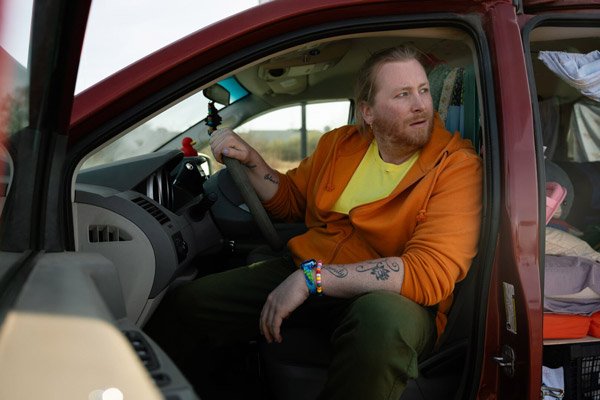
It is rare for a film to capture a major social issue and equally rare for a film to burrow its way into audiences’ hearts. What We Dreamed of When does both and on a budget that wouldn’t even cover lunch on a Hollywood film set.
Taylor Olson, the film’s writer, director, and star, was the 2021 New Jersey International Film Festival Best Feature winner for his film, Bone Cage; which centers around Jamie, a forestry worker whose conflicting views about wildlife feed into a cycle of cognitive dissonance and greater turmoil. What We Dreamed of When, hosts a similar but unique parallel struggle as its main character Gideon struggles to keep his life as normal as possible despite living out of his car.
What We Dreamed of When embraces silent homelessness and the compounding pressure of family life and Covid-19, with the name ‘unseen’ being at one point considered. Part of the film was modeled after a season Olsen spent coaching swimming and living out of a van. He blended this experience with interactions and conversations from his work with unhoused individuals. And perhaps most important for Olsen, the film aims to highlight the impact of Covid on one of Canada’s most vulnerable yet least vocal groups.
The film embraces both heartwarming love and bubbling frustration in a fresh and creative way. Filmed in a style heavily influenced by documentary filmmaking, Olsen and his crew, which included many semi-experienced locals, determined to shoot the film as if it was happening live. This directorial angle paired with the film’s material make it both endearing and eerie to watch. Our first look at Gideon sees his fun-loving nature on full display as he leads the local girls swim team, whom he coaches, in a goofy battle chant guaranteed to kill at any pep rally. In the film’s opening scenes, we see just how much Gideon adores his daughter. However, as his nighttime call with her comes to an end the cracks start to show and the film forks in-two.
Reach New Jersey’s largest arts & entertainment audience, click here for info on how to advertise at NJ Stage
Aside from Gideon, the true star of the film is the creative structure of its timeline. As time moves forward in the ‘now’ narrative, a ‘then’ narrative begins. Working back from the moment Gideon was evicted from his empty apartment, the ‘then’ narrative juxtaposes Gideon’s current struggles. The events leading up to his situation unfold in reverse order, seeing him sell off furniture and even his guitar all while keeping his daughter laughing during her every other weekend visit. His big smile and ‘goofy’ demeanor contrast heavily with a world that seems to be falling further and further apart around him. Without a home anymore, his weekly visits disappear, and he struggles to remain a part of his daughter’s life.
The dual nature of the film’s timelines allows Olsen to explore Gideon’s difficulties being a good father, when he can’t even afford gas money, and also explore back through Gideon’s separation. From custody arrangements to the fight that ended his relationship with his ex-wife, a slow march takes us to the origin of Gideon’s slide. Described by Olsen as a ‘death by a thousand cuts’, the audience comes to learn the full extent of Gideon’s yearlong slip into homelessness. Happy moments are fleeting as scenes of divorce and the towing of his car pair together and overshadow what once seemed like limitless enthusiasm. By nature of the inverse parallel narratives, we are able to see Gideon back ‘then’ laughing among friends contrast alongside Gideon’s ‘now’, a homelessness experience made worse by Covid-19. An intentional move by Olsen, that he describes as intending to show Gideon as far as part from old-housed experience, to entirely unhoused.
What We Dreamed of Then will screen Online Only for 24 Hours on Sunday May 31, 2026. Get more info and buy tickets here.
The 31st Annual New Jersey International Film Festival will be taking place on select Fridays, Saturdays, and Sundays between May 29-June 7, 2026. The Festival will be a hybrid one as we will be presenting it online as well as doing in-person screenings at Rutgers University. Most of the films will be available virtually via Video on Demand for 24 hours on their show date. VOD start times are at 12 Midnight Eastern USA. Each General Admission Ticket or Festival Pass purchased is good for both the virtual and the in-person when both are offered. The in-person screenings will be held in Voorhees Hall #105/Rutgers University, 71 Hamilton Street, New Brunswick, NJ beginning at 5PM or 7PM on their show date. General Admission Ticket=$15 Per Program; Festival All Access Pass=$120; In-Person Only Student Ticket=$10 Per Program. For more info on the Film festival go here: https://2026newjerseyinternationalfilmfestival.eventive.org/welcome



