
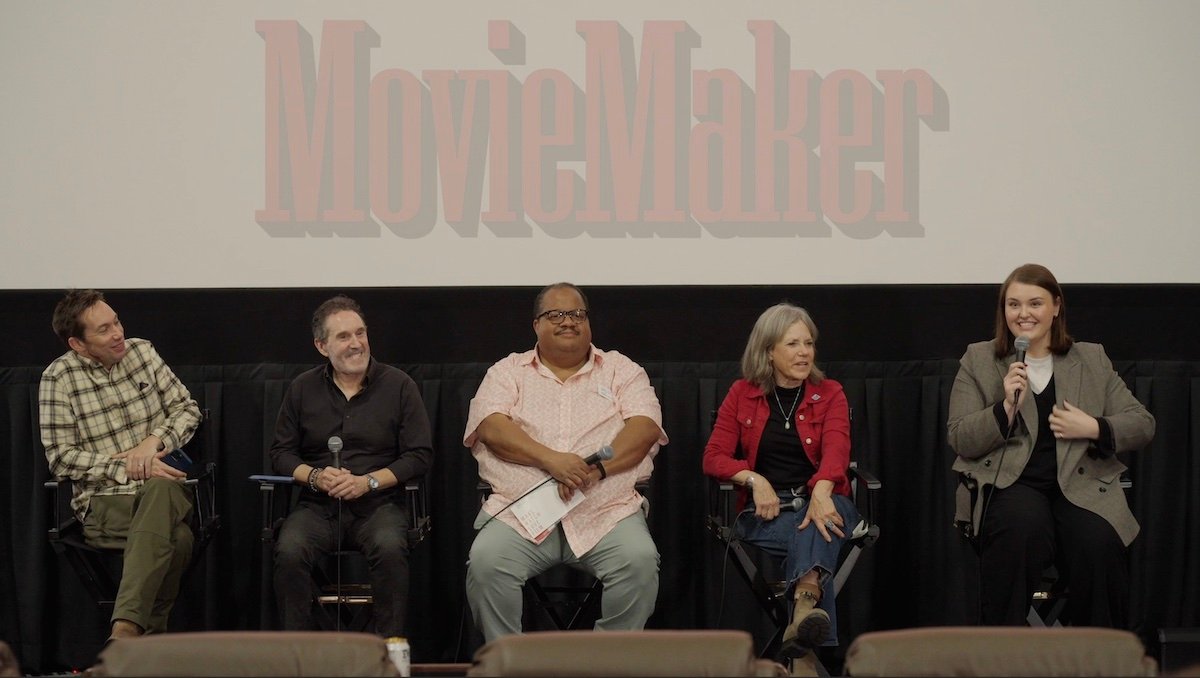
When representatives of four of our Best Places to Live and Work as a Moviemaker gathered in Austin this past weekend, they agreed that one way the host city became such a film hub was by valuing sustainability and resisting the temptations of a boom-and-bust cycle.
The panel included Edmonton Screen CEO Luke Azevedo, Kansas City Film Office director Rachel Kephart, Albuquerque film liaison Cyndy McCrossen, and head of Austin Studios Martin C. Jones. They gathered at the Alamo Drafthouse Cinema Mueller, just a few minutes from Austin Studios, and discussed using tax incentives, training programs and smart planning to create a sustainable film community. You can watch video of the panel above or here.
“I think anyone on this panel can relate to the idea that if a project comes that’s too big and you give them all of your incentive, and then you’re turning filmmakers and studios away the rest of the year that leaves a lasting impression, and they won’t come back,” Kephart observed “And so there’s a strategy involved with with not building too quickly, or over-building too quickly.”
Azevedo emphaisized finding your niche and how you can stand out in complicated times for the industry.
“You can’t just go in with complaints,” said Azevedo. “You have to have solutions for the environment that we’re in with all the mergers and acquisitions, the changes that we’ve seen, budgets going down, expectations rising, and less projects being done globally,” he said. “At this point, we have to be in a position where we start looking a little bit inward, trying to ensure that our local producers and creators have opportunities that they may not have had in the past.”
McCrossen noted that while Albuquerque has just over half a million people, it super-serves the film community, with New Mexico’s state and local governments pulling together to train and hire local talent.
“We’re punching above our weight against much larger cities, and we do that through our sense of community, our sense of culture,” added McCrossen. “The incentives were designed to build crew from the bottom up.”
The full list of the Best Places to Live and Work as a Moviemaker in 2026 is here.
Austin Studios Head Martin C. Jones on Building a Sustainable Film Scene
Many regions have long aspired to be the next Austin, one of the first cities to prove that it’s possible to build an enduring American film hub outside New York and Los Angeles.
Jones noted that both the studio he leads and the Alamo Drafthouse location that hosted the panel were built on ground once occupied by the former Robert Mueller Municipal Airport, which local filmmakers Richard Linklater and Robert Rodriguez pressed to have turned into studio space. The land also includes hundreds of new homes and businesses built within the last few years.
“You’re sitting on top of the old airport,” Jones told the audience. “And 25 years ago, when it got shut down, Rick and Robert went to the city and said, ‘Those old airplane hangars would be a great place to make movies.’ Well, now, 25 years later, we’ve hosted over 1,200 projects at our studio. We have seven sound stages, two office buildings, a backlot. People stay at this wonderful boutique hotel next door, The Origin. When they have work, they have a whopping three-minute commute when they get home. They can go out to the lake, ride their bike, jog, they can go to pilates or Orange Theory. They can come here to the Alamo Drafthouse. They can go to our studio about a mile from here, and there’s 60 restaurants in this neighborhood.”
He said that kind of development comes from patience community, which Linklater started in 1985.
“It wasn’t built overnight — it was built over the last 40 years,” Jones said. “Get your tribe, get your people, and just start laying bricks down. And before you know it, you’ll have your infrastructure and your foundation.”
Edmonton Screen CEO Luke Azevedo on Advancing Rising Moviemakers
Azevedo had tremendous success making Alberta a top-tier location as the film commissioner in Calgary, before moving north to take over as CEO of Edmonton Screen. While the industry is slowing down in much of the U.S., it’s gaining traction in Edmonton, thanks in part to incentives that include Edmonton Screen’s Elevation Program, which provides direct investment into film and TV projects produced in the city.
Azevedo is especially interested in promoting the many rising Indigenous filmmakers in the area.
“I work for an organization that has the privilege of being able to support at a significant level, so we are not only trying to attract production from outside, but we’re trying to expand and grow the local production. And one of the things that’s super important for us is that we have a lot of very talented Indigenous producers in our region. So we have aspirations to become one of the top locations on the planet for indigenous production.”
One of Edmonton’s coolest recent success stories is Skinamarink, an atmospheric horror phenomenon that local filmmaker Kyle Edward Ball made for just $10,000. It earned more than $2 million at the box office, drawing the attention to A24, which signed on for his Ball’s feature, The Land of Nod.
“They created The Land of God in our region, which Kyle was happy to take on as a creator, but wanted to ensure that it was done in Edmonton with Edmonton talent. So we were super supportive of that,” Azevedo said.
Kansas City Film Office Director Rachel Kephart on Tax Incentives and Courting Indies
Missouri reinstated its tax incentive about three years ago after a few years when the state didn’t have one. The time on the sidelines allowed the state — and Kansas City — to be very strategic about creating the ideal program, Kephart noted.
Missouri’s transferable tax credit for eligible expenditures ranges from 20 to 42%, and Kansas City offers its own additional cash rebate of up to 12% on all qualified production expenditures, which is stackable with the state incentive. That means filmmakers in Kansas City can get up to 52% of their money back, one of the best incentives anywhere.
Kephart says the city has targeted independent productions budgeted at $15 million and under.
“Really targeting the independent film market has been our key,” she said. “Pretty much like $15 million and below has been our bread and butter for the past three years, and has been very steady, which has been nice.
“As we all know, at least nationally, the industry has been having a tough time. A lot of these big, big studios are taking their their projects overseas, and so, by virtue of the fact that we were kind of late to the game, we had this ability to cater to a budget line that isn’t always in a position to leave. And so that’s been very beneficial for us.”
Not all the projects are small: The region has also landed a big-scale hit, Apple TV’s Ted Lasso, whose star and executive producer, Jason Sudeikis, grew up in the Kansas City suburbs. Kephart stressed the importance of maintaining and building connections with industry standouts who have strong local ties.
Albuquerque Film Liaison Cyndy McCrossen on Relationships Being Key to the Best Places to Live and Work as a Moviemaker
McCrossen is another strong example of someone who maintains close ties with people connected to the region.
Vince Gilligan created Breaking Bad, which put the spotlight on New Mexico’s stunning vistas and diverse locations (it doubled as regions as diverse as New Hampshire and Germany). He also co-created Better Call Saul, which further cemented the state’s reputation. New Mexico has secured major deals with Netflix and NBCU for productions well into the future, and the state has recently hosted major productions like Ari Aster’s Eddington and Benny Safdie’s The Smashing Machine. Like Austin, Edmonton and Kansas City, it benefits from strong tax incentives and training programs.
But none of that guaranteed Gilligan would return for Pluribus, his new Apple TV hit.
To help win him over, the Albuquerque Film Office led a major undertaking to help Pluribus build the neighborhood where main character Carol (Rhee Seahorn) resides. To get permission for the building project, she and her team had to send certified letters to local homeowners, abide by Dark Sky initiatives to preserve the starry night views, and coordinate with tribal lands, a national park, and more. Ultimately, Gilligan was won over by the extraordinary cohesion and cooperation — to say nothing of the natural visuals.
“We felt it was amazing that they did decide to come back and use the family of crew members that they built over so many years,” McCrossen said. “And capture the beauty of New Mexico the sky, as he always loves the clouds. I cannot take credit for the cumulus clouds that build up over the Sandia Mountains, but it helped.”
Main image: MovieMaker editor Tim Molloy, Edmonton Screen CEO Luke Azevedo, Austin Studios head Martin C. Jones, Albuquerque film liaison Cyndy McCrossen, and Kansas City Film Office director Rachel Kephart.



