
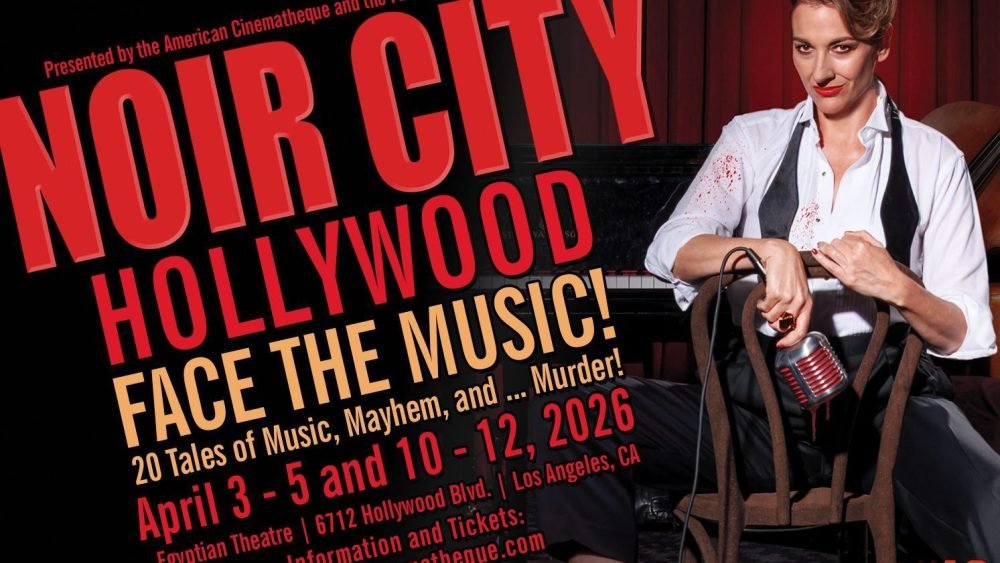
For 28 years, the Noir City film festival has been unfolding every spring under the aegis of the American Cinematheque, give or take a couple of early name changes since it began in 1999. The festival has had enough themes over those years that you might imagine its curators had already used up whatever subtopics of film noir might have counted as something new under the black sun. But hosts Eddie Muller and Alan K. Rode are back at their usual haunt, Hollywood’s Egyptian Theatre, on April 3-5 and 5-12 with a fresh selection of vintage classics and obscurities under the banner “Face the Music! 20 Tales of Music, Mayhem, and… Murder!” In other words, horns and homicide, together again.
The films that have been selected very nearly constitute a de facto jazz film festival, given how many of the movies selected have primary characters who are jazz musicians (including “Young Man With a Horn” and “The Man With the Golden Arm”), appearances by real-life jazz greats (look for Louis Armstrong and Coleman Hawkins aplenty), and/or jazz scores. But the two-weekend festival also includes tales of mayhem set in the classical world (“Hangover Square”) or, as noir edged into the late ‘50s and early ‘60s, featuring some of the most recognizable singers of the day, from Doris Day to Elvis Presley to Sammy Davis Jr. to Pat Boone, the last of whom will be making an in-person guest appearance. (Scroll down for the complete lineup of films.)
“In the 1940s, when Hollywood scores were mostly orchestral, jazz was shown on screen as symbolic of the underworld,” says Muller, who, besides being president-founder of the Film Noir Foundation, is seen weekly hosting “Noir Alley” on TCM. “The way jazz is used in ‘Phantom Lady,’ it’s representative of descending into this underworld. Then it’s very interesting how five or six years go by, and all of a sudden filmmakers like Otto Preminger are saying, ‘The music is propulsive and exciting. Why does it have to represent something dark and unpleasant? Well, why aren’t we using jazz as the score of the film?’ So you really see that change, where in the ‘50s they started using those musicians to actually score the films.”
Points out Rode, the Film Noir Foundation’s treasurer and charter director: “A number of these movies are basically jazz score-based, like Duke Ellington and ‘Anatomy of a Murder,’ the Modern Jazz Quartet and ‘Odds Against Tomorrow’ and, of course, ‘Sweet Smell of Success’ with Elmer Bernstein’s score. I think the watershed for that was Alex North’s score for ‘Streetcar Named Desire’; that really was a sea change, where jazz was no longer the background to James Cagney or things like that, but viable as something that was good, not shady.”
But the focus for this selection of films really stuck to having the portrayal of music on screen as a criterion for entry. The only real exception among the 20 films is the 1970s version of “The Long Goodbye,” which they found irresistible, because of John Williams’ ingenious use of a continually evolving main instrumental theme throughout the movie… and also, candidly, because star Elliott Gould was up for being a guest. (That screening is the only one to have immediately sold out.)
“Some people would ask, ‘Why isn’t “An Elevator to the Gallows” in here? It’s got the greatest jazz score on a noir of all time!’ And the answer is simply because we actually were able to get so many movies that were about musicians, where the music is actually being played on screen, that that became a precedent. Of course, in ‘Elevator to the Gallows,’ you never see Miles Davis on screen performing any of the music. It’s not a movie about musicians. But besides the Modern Jazz Quartet doing the score for ‘Odds Against Tomorrow,’ the great thing is that Harry Belafonte is a musician in the film and you see him performing in this club in the movie. And in ‘An Anatomy of a Murder,’ they got Duke Ellington to do this fantastic score, but Jimmy Stewart is an amateur piano player in the movie, and Ellington actually plays with Stewart in the film. So it’s like, OK, we can definitely show ‘Anatomy of a Murder’ — it fits right in with the scheme of things.”
Alan K. Rode and Eddie Muller of the Film Noir Foundation
Courtesy Film Noir Foundation
Lest film noir be seen as purely the stuff of escapism, the hosts note that many of these music-centric films deal with issues of race and/or personal economics.
“As much as possible, I wanted the films to be about musicians and the challenge of making music as a living” Muller says. “I mean, that in itself kind of has a noir aspect to it.” Musicians in some of the films have a bad reputation even if they’re upstanding citizens, like poor Martin Milner in “Sweet Smell of Success.” As Muller says, “Burt Lancaster says this guy has to be disreputable. He’s clearly a drug addict, if he plays a guitar! But it’s also very timely in a way, because I think artists today are asking themselves, is there a way to actually be an artist in a culture that places money above everything else? There’s a big fear about committing to a life in the arts, if you can’t survive doing that in this culture. And that’s one of the things that runs through all of the films we’re showing is that question: Is this a way to make a living? And then when those characters are Black, it compounds it even more. That’s why that that picture ‘A Man Called Adam’ (with Sammy Davis Jr.) is so powerful, because it confronts that issue directly.”
The Noir City festival — which has grown to have offshoot festivals in different cities around the country all year long, not just in Hollywood — attracts a crowd of hardcore noir buffs who will anticipate some screenings of films that have flown under the radar for decades, if not been literally impossible to see at all. But then much of the audience comes in based on the hepness of noir and may not have even seen some of the most canonical films, like “Double Indemnity,” before they end up seeing some B-film rarities the Film Noir Foundation has helped restore. It’s a surprisingly young crowd, at least as evidenced at some showings, becoming attached to a genre, or quasi-genre, whose two-decade heyday was close to wrapped up by the end of the ‘50s.
Says Rode, “The thing that dawned on me last year was when Eddie and I introduced a double bill of ‘Out of the Past’ and ‘The Killing,’ and this festival has gone on so long, we have a new generation of audience. One of the questions we typically ask, both of us when we’re hosting a show, is how many people have not seen this movie? And Eddie added that almost perfunctorily for ‘Out of the Past,’ but two-thirds of the audience raised their hands, and the same thing for ‘The Killing.’ It just dawned on me, we’re now, we’ve now into a different generation where people are discovering these films, and we can’t assume that our audience in 2026 is the same audience from 25 years ago, because it isn’t.”
“My job is to make this stuff irresistible to a younger generation,” says Muller. “I mean, that’s my job at Turner Classic Movies. I am the oldest person at TCM. I mean, I’m not talking just on-air hosts; I’m talking about everybody at TCM — I am the oldest person there now. But, you know, I don’t feel that way at all. I like to think I maintain my youthful enthusiasm for this stuff, and the job is really to make this not just palatable for a younger generation, but to make them really realize and embrace the virtues of classic storytelling, and how none of this stuff goes out of style. That’s the most important thing that we do.”
Knowing that they may be appealing to at least two different audiences — hard-boiled cineastes and fresh-faced newbies — influences why the curators continue to make the evening programs double-features, when the host Cinematheque venues have mostly gone toward single features with most of their programming.
“There are the hardcore who are like, ‘What are you pulling out for us this year that we haven’t seen?’ And then there are the people, obviously the younger folks, who are just dipping their toe in the dark waters for the first time,” jokes Muller. “Which is why I’ve always enjoyed the notion of presenting things as double bills, even if the venue doesn’t necessarily price it that way. It’s structured so that you’re getting a title that’s recognizable. and then pairing that with something a little more obscure. And in this case, we’re starting with that on opening night.

“Black Angel”
Noir City Hollywood American Cinematheque
“We’re showing ‘Black Angel,’ which is not a well-known movie, but it’s based on one of Cornell Woolrich’s novels, and he’s become almost synonymous with the film noir genre, because so many movies are based on his stuff,” Muller continues. “But we’re showing it with this obscure Warner Brothers film from 1941 called ‘Blues in the Night,’ which is so weird and so startlingly bizarre, and not easy to find. There is no print here in the United States, so we’re paying top dollar, really, to bring in a 35 millimeter print in from England. But I was adamant about doing that, because I just think it sets the tone. Not only is it a noir musical, basically, but it checks all those boxes: It’s an obscurity. It has historical significance. Elia Kaza has a supporting role in the film; it’s the biggest part he ever had in a movie. Anatole Litvak directed it; it’s got fantastic, bizarre montage sequences by Don Siegel. I’m not gonna argue that it’s a missing masterpiece or anything; it’s not. But for the hardcore, this is exactly the kind of film that they expect at Noir City.”

Pat Boone and Barbara Eden in “The Yellow Canary”
Noir City Hollywood American Cinematheque
Sometimes just the titles make for a swell double-feature, as when the first Saturday night of the festival features “The Crimson Canary,” not to be confused with “The Yellow Canary.” It’s the latter film that will be the occasion to bring the man with the white bucks to the Egyptian for a Q&A on his descent into the dark genre.
“Pat Boone in a noir!” exults Muller, anticipating this re-premiere of a restoration of a little-remembered film. “I mean, it really is a noir, with a screenplay by Rod Sterling, and Barbara Eden plays his wife, with Jack Klugman investigating the kidnapping of their kid. And it’s filled with 1960s character actors, Harold Gould and Jesse White, and it is exactly the kind of thing that the audience in L.A. will go nuts for.”
Meanwhile, notes Rode, “On the back end of Saturday night’s double bill is ‘The Crimson Canary,’ which I guarantee maybe one person in the audience might have heard of. This was a discovery of Nick Rossi, who is an extraordinary musician who will be leading the live-music part of the festival. I had never seen it. It’s a 1945 Universal programmer, with the most signficant actor, the star above the title, being — are you ready for this? Drum roll! — Noah Beery Jr. And you have basically a cadre of film noir character actors as jazz musicians in a murder mystery. But there is a slice of Coleman Hawkins, unbelievably, playing a number in this movie, and some other really renowned African American jazz musicians. And they’re only on screen for about five or seven minutes, playing that number, but the fact that they were even put into this movie in 1945 is pretty extraordinary.”
Muller is thrilled with the discovery of this slice of jazz history in “The Crimson Canary,” too. “Oscar Pettiford plays the bass in this thing with Coleman Hawkins, and Josh White, the folk singer, has two numbers in the movie, including this song he had a big hit with called ‘One Meat Ball.’ What happened was, these guys were all playing in L.A. at the time this film was made, and the producer had the foresight to say, ‘Let’s bring these guys in for a day and film them doing their thing.’ And quite honestly, the plot stops for these guys’ performance. But that was done intentionally, so that that scene could be removed from the film when it was distributed in the South, because there was no way they were going to put these guys on screen below the Mason Dixon line. And so it’s kind of fascinating to see how the whole thing was constructed so that they could easily extricate this scene from the movie. But now, of course, that scene is the main reason you watch the movie.”
“Exactly,” says Rode. “It’s the backdrop for a prosaic murder mystery. It is a really eclectic cast in this film, and it’s a real discovery, for those of us that like to mine the depths of film noir. And one of the jazz musicians used to be one of the co-hosts on ‘The Musketeers Show,’ Jimmie Dodd.”
“You know what our audience is like at these festivals,” says Muller, “and it’s pretty amusing when you get up there and you introduce a movie and there’s so much to talk about. We obviously focus on particular things, like, ‘This is the only filmed performance of Coleman Hawkins that you’re ever gonna see.’ It was so funny to come off-stage [after showing ‘The Crimson Canary’ at Noir City Oakland] and, after the show, 15 people came up to me and said, ‘Why didn’t you mention that Jimmie Dodd was a Mouseketeer?’” He laughs. “I’ll talk till I’m blue in the face, and then I’ll always leave something out, and that’s what they’re gonna let me hear about.”

Sammy Davis Jr. in “A Man Called Adam”
Noir City Hollywood American Cinematheque
Other little-known highlights they point out include “A Man Called Adam,” which Muller describes as “a really intense 1960s film where Sammy Davis Jr. kind of plays a variation on Miles Davis. He’s a trumpet player, going through the turmoil of the civil rights era and his own self-destructive natureand that film is directed by Leo Penn, Sean Penn’s father.” Then there’s “All Night Long,” “this fantastic British film of the early ‘60s that Dave Brubeck and Charlie Mingus are in, and Patrick McGoohan plays the Iago of of jazz drummers. Don’t miss it. It’s Shakespeare’s ‘Othello’ as a 24-hour jazz thing in a loft in London, and it’s just sensational.”

Elvis Presley in “King Creole”
Noir City Hollywood American Cinematheque
Two different music genres are represented in a double-feature of films directed by Michael Curtiz, who is Rode’s speciality, since he wrote an acclaimed biography of the director. “We have Curtiz jazz-style with ‘Young Man With a Horn’ and rock-style with ‘King Creole,’ which was Elvis’ favorite film and his best film. It’s a great new digital restoration. They had to speed up the production of this film because Elvis was inducted into the army, and Elvis was so unsure about ‘What’s gonna happen with rock ‘n’ roll by the time I’m a civilian again?’ that he was hitting up Hal Wallace, saying, ‘I want you to send me to the Actor’s Studio.’ As for ‘Young Man With a Horn,’ the first half of that is just a tremendous movie, and Kirk Douglas did a good job with Harry James actually providing the trumpet, and Doris Day. There’s a story about how Jack Warner changed the ending, in an unfortunate way, but we won’t go there.”

Kirk Douglas in “Young Man With a Horn”
Noir City Hollywood American Cinematheque
On the last day of the festival, it goes truly neo-noir with a showing of Robert Altman’s 1996 “Kansas City,” which Muller in particular believes is ripe for reconsideration. “It was a movie I did not like when I saw it the first time,” he admits, “and I really included it because I just think the score is so extraordinary. They got every great jazz musician in the world to be in this movie playing their idols, so Joshua Redman plays Lester Young in the film, and James Carter plays Coleman Hawkins… Jennifer Jason Leigh did not get great reviews for her performance in that movie, but having seen it again recently, she’s pretty incredible. I didn’t really understand what she was doing the first time I saw it, and now with a further 20-something years under my belt, I can see what Altman was going for, and how freaking courageous Jennifer Jason Leigh was to kind of follow his lead and play this movie-obsessed amateur criminal. I think it’s a great performance.”

“Kansas City”
Noir City Hollywood American Cinematheque
Harry Belafonte is in the Altman film, and Muller also thought it appropriate to have “Kansas City” as a closing bookend because Belafonte also stars in a much earlier film that is being screened. “We’re showing ‘Odds Against Tomorrow,’ where you see Belafonte play a jazz musician. It’s a heist film, not a film about music. But the great thing there is, what he couldn’t say at that time was that he was actually the producer of the film. Belafonte had to do that behind the scenes, silently. And then we progress to where we’re showing ‘Kansas City,’ Belafonte’s last great performance in a film, when he plays the gang boss and is just fantastic. In ‘Kansas City,’ Altman shot an entire concert in this club and then edited it into the flow of the film, where the musicians are providing a Greek chorus to all the shenanigans that are going on with the white characters. So this was a very conscious decision to show the progression in Hollywood movies of how African Americans were depicted on screen, and it fit so perfectly with the musical theme.”

“Odds Against Tomorrow” set for Noir City Hollywood American Cinematheque
American Cinematheque
As it has in some past years, but especially appropriate for 2026, the festival will also include some live music, from Nick Rossi, a musical preservationist who is well known for his Duke Ellington tribute band, and Elizabeth Bougerol, a New York singer who fronts a band called the Hot Sardines, and the “Ms. Noir City” poster gal in this year’s festival artwork. Bernard Herrmann expert Steven C. Smith will also be on hand to help introduce the composer’s work on “Hangover Square” and to sign copies of his book “Hitchcock and Herrmann: The Friendship and Film Scores that Changed Cinema.”
Each year at the Egyptian, the two hosts marvel at the endurance of the festival. The Cinematheque had invited Muller to program the first one in 1999 based on his book that had come out the year before, “Dark City: The Lost World of Film Noir.” Rode did not come on as co-host until year 3 or 4, but he still remembers the guests for the opening night of year 1 being Richard Fleischer, Stanley Rubin and Marie Windsor for “The Narrow Margin,” in the sadly bygone days when the original talent from the ‘40s and ‘50s was largely still around to pop in.
“When we started out, the premise was just we’re going to resurrect somewhat obscure noir films,” Muller says. “Just film noir was the idea. Then, if I can say this without sounding a bit over the top, all of this kind of led to a renaissance in the whole concept of noir. And now it’s no longer enough to just say it’s film noir. There has to be some kind of additional theme that we apply at each festival to attract attention and not just say we’re doing the same thing over and over again. As Alan says, we sometimes color a little bit outside the lines, because I find it very valuable to show that there were all these subsets and offshoots of film noir that are really interesting. So doing a whole festival based around music and stories about musicians lets you pull in certain films that don’t readily seem to be film noir. If you watch ‘Love Me or Leave Me’ with Doris Day and Jimmy Cagney, nobody’s gonna think of this big MGM musical at first glance as a film noir, and then when you really are in it, you’re like, ‘Oh, I get it. I see the themes working here.’”
Rode also notes that the festival has turned into “a launching pad for the Film Noir Foundation’s preservation work, as we’re doing again this year with ‘The Yellow Canary,’ and then later on in Palm Springs with ‘Slightly Scarlet’” [referring to that second film’s upcoming re-premiere at the Arthur Lyons Film Noir Festival, which he programs and hosts each May]. “So this festival has really served a dual purpose, with the mission of the Film Noir Foundation’s film preservation endeavor and ‘restoring America’s noir heritage.’ It’s a multifunction festival.”
The full itinerary for Noir City Hollywood 2026:
Friday, April 3
BLACK ANGEL / BLUES IN THE NIGHT + Live musical performances by singer Laura Ellis and the Nick Rossi Trio. Introductions by Eddie Muller, Alan K. Rode and Nick Rossi.
Fri. Apr 3, 2026 | 7:00pm
Saturday, April 4
HANGOVER SQUARE + Live musical performance by pianist Chris Dawson. Introduction by Eddie Muller and author Steven C. Smith.
Sat. Apr 4, 2026 | 12:00pm
Book signing with Steven C. Smith for his new book, “Hitchcock & Herrmann: The Friendship & Film Scores That Changed Cinema,” prior to the screening at 11 a.m.
ANATOMY OF A MURDER + Live musical performance by pianist Chris Dawson. Introduction by Alan K. Rode.
Sat. Apr 4, 2026 | 3:00pm
THE YELLOW CANARY / THE CRIMSON CANARY + Q&A with actor Pat Boone. Live musical performance by the Nick Rossi Trio. Introduction by Eddie Muller and Nick Rossi.
Sat. Apr 4, 2026 | 7:00pm
“The Yellow Canary” World Premiere of New Digital Restoration by Film Noir Foundation and Cinema Preservation Alliance
Sunday, April 5
TO HAVE AND HAVE NOT + Live piano performance. Introduction by Alan K. Rode.
Sun. Apr 5, 2026 | 12:00pm
LOVE ME OR LEAVE ME + Live piano performance. Introduction by Alan K. Rode.
Sun. Apr 5, 2026 | 3:00pm

Doris Day in “Love Me or Leave Me”
American Cinematheque
A MAN CALLED ADAM / ALL NIGHT LONG + Live musical performances by singer Laura Ellis and the Nick Rossi Trio. Introductions by Eddie Muller and Nick Rossi.
Sun. Apr 5, 2026 | 7:00pm

“All Night Long”
Noir City Hollywood American Cinematheque
Friday, April 10
THE MAN I LOVE / NORA PRENTISS + Live musical performances by singer Elizabeth Bougerol and the Nick Rossi Trio. Introductions by Eddie Muller, Alan K. Rode and Elizabeth Bougerol.
Fri. Apr 10, 2026 | 7:00pm

“Nora Prentiss”
American Cinematheque
Saturday, April 11
THE LONG GOODBYE + Q&A with actor Elliott Gould. Moderated by Eddie Muller. Live musical performance by pianist Chris Dawson.
Sat. Apr 11, 2026 | 12:00pm — SOLD OUT

Elliott Gould in “The Long Goodbye”
American Cinematheque
SWEET SMELL OF SUCCESS + Live musical performance by pianist Chris Dawson. Introduction by Alan K. Rode.
Sat. Apr 11, 2026 | 4:00pm
Sat. Apr 11, 2026 | 7:00pm
Sunday, April 12
THE MAN WITH THE GOLDEN ARM + Live piano performance. Introduction by Alan K. Rode.
Sun. Apr 12, 2026 | 12:00pm
Print from the collection of the Library of Congress

Frank Sinatra and Kim Novak in “The Man With the Golden Arm”
American Cinematheque
ODDS AGAINST TOMORROW + Live piano performance. Introduction by Eddie Muller.
Sun. Apr 12, 2026 | 4:00pm
KANSAS CITY / PETE KELLY’S BLUES + Live musical performances by singer Elizabeth Bougerol and the Nick Rossi Swing Four. Introductions by Eddie Muller, Alan K. Rode, Elizabeth Bougerol and Nick Rossi.
Sun. Apr 12, 2026 | 7:00pm



