
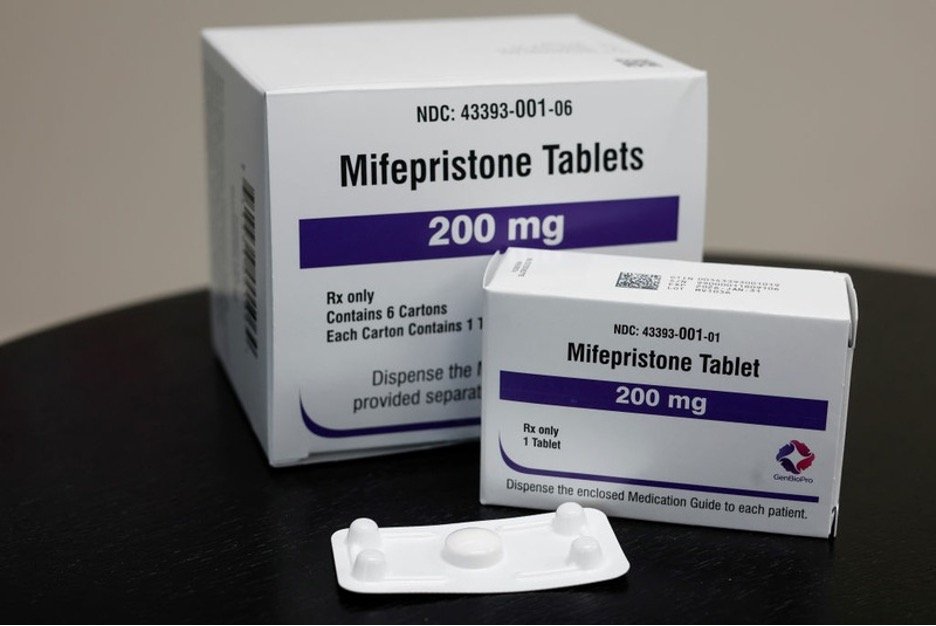
The U.S. Supreme Court decided Thursday to preserve telehealth access to the abortion drug mifepristone until after the U.S. 5th Circuit Court of Appeals has ruled on the merits of the high-stakes federal lawsuit Louisiana v. Food and Drug Administration.
Justices Samuel Alito and Clarence Thomas issued dissenting opinions.
In his dissent, Thomas said the rule violates the Comstock Act, a long unenforced 1873 law that bans the mailing of “obscene” material. During the 2024 presidential campaign, President Donald Trump said he didn’t support using the Comstock Act to stop mail delivery of abortion pills, saying he thought the federal government should have nothing to do with the issue.
Mifepristone’s manufacturer “makes a passing reference to the possibility of lost sales,” Alito wrote in his dissent. “But lost sales in states where abortifacients are generally illegal are not ‘irreparable injuries’ that can justify granting a stay.”
Abortion-rights advocates around the country called the decision a relief after two weeks of uncertainty.
On May 1, the appellate court sided with Louisiana, where state officials sued the FDA in October, arguing that a rule allowing telehealth access to mifepristone, one of two drugs used to terminate a pregnancy in the first trimester or to treat miscarriage, undermines the state’s abortion ban. Danco Laboratories and GenBioPro, two manufacturers of mifepristone, filed emergency appeals, leading the Supreme Court to issue a 10-day stay on May 4, extended until today.
“Though today’s decision means that mifepristone remains available through telehealth for now, this fight is not over,” said Dr. Camille A. Clare, president of the American College of Obstetricians & Gynecologists, in an emailed statement. “The chaos and confusion wrought by competing decisions and the revocation and restoration of access on an almost daily basis do real harm to patients and to the clinicians who care for them.”
Abortion opponents decried Thursday’s decision.
“Women deserve better than dangerous abortion drugs sent through the mail without physician oversight or in-person support,” said Jor-El Godsey, president of Heartbeat International, a major network of anti-abortion crisis pregnancy centers. “A state like Louisiana that values life in its laws should be able to protect its smallest residents as well as their moms.”
The FDA’s approved two-drug regimen via telemedicine is an increasingly common abortion method, especially for people living in parts of the country where abortion is banned or difficult to access.
Last month, a federal district court paused the lawsuit at the request of the FDA until after the completion of a safety review on mifepristone. That review was prompted by non-peer reviewed, anti-abortion research and in spite of the drug’s record of safety and efficacy since 2000. The state appealed to the 5th Circuit.
Due to multiple ongoing efforts to restrict or block mifepristone, abortion providers have told Stateline they are ready to eventually switch to a misoprostol-only method, which researchers have found to be as safe as the two-drug regimen but typically involves more symptoms and is slightly less effective.
National groups have tried to pressure the Trump administration to drop the Biden-era rule allowing telehealth abortion and called for the head of FDA Commissioner Marty Makary for reportedly slow-walking a safety review of the drug until after the midterm elections. Makary resigned on Tuesday, and anti-abortion groups wasted no time in getting Acting Commissioner Kyle Diamantas on the phone.
Live Action founder and president Lila Rose, in a written statement, said she talked to the acting commissioner on Wednesday and that he said he was morally opposed to abortion. “Diamantas told me that reviewing the abortion pill is a top priority for him and the administration,” Rose posted on X.
Students for Life of America President Kristan Hawkins wrote a similar message to supporters in an email on Thursday, saying Diamantas will be the “most pro-life FDA commissioner in American history.”
But many doctors around the country say curbing access to telehealth abortion is likely to cause harm to people in states with bans who may face more barriers to obtaining an abortion without that option.
“Women will be forced to travel long distances — at times hundreds of miles — to access safe, essential health care at a doctor’s office, no longer having the option to receive mifepristone via telemedicine,” wrote Rob Davidson, an emergency physician in Michigan and executive director of the Committee to Protect Health Care, in a letter asking the Supreme Court to maintain access to telehealth abortion. The letter was cosigned by more than 2,200 physicians.
Stateline reporter Sofia Resnick can be reached at [email protected]. Stateline reporter Kelcie Moseley-Morris can be reached at [email protected].
This story was originally produced by Stateline, which is part of States Newsroom, a nonprofit news network which includes New Jersey Monitor, and is supported by grants and a coalition of donors as a 501c(3) public charity.



