
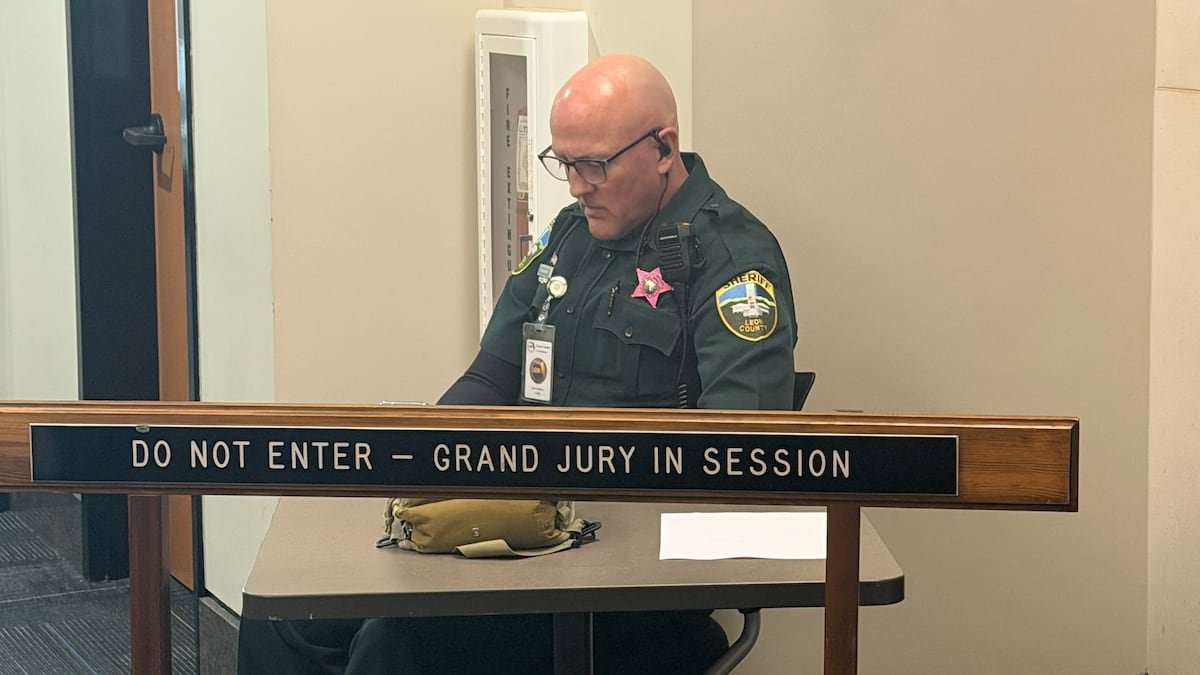
TALLAHASSEE — A Tallahassee grand jury investigating the Hope Florida scandal appears to have issued a report on its findings, but a process allowing people named in it to push for redactions could keep it secret for months.
Leon County State Attorney Jack Campbell’s office has neither confirmed nor denied the existence of a report, known as a presentment, stemming from the grand jury investigation into how Gov. Ron DeSantis’ administration diverted nearly $10 million from a Medicaid settlement to a political committee ahead of the 2024 election.
But for weeks, Campbell’s office has cited a range of exemptions in state law as justification for not releasing records about the grand jury’s activities to news outlets, including the Times/Herald. One of those exemptions is about grand jury presentments.
When a Lake Worth attorney sued over being denied the record, a circuit court chief judge wrote this month that Campbell’s use of the exemption “appears to tacitly acknowledge the existence of such records.”
The grand jury had the options of handing up an indictment, declining to indict and issuing a report known as a presentment. If indeed the grand jury chose only to issue a presentment, charges may still be possible, according to former state attorneys.
But a presentment also indicates that jurors identified concerns or wrongdoing — and possible solutions — they want made public. Past grand juries have issued reports raising awareness of shady land deals, questionable legislative appropriations and officials slow-walking public records requests.
Last month, the Florida Trident reported that the presentment exists based on the exemptions cited. The Trident and the Times/Herald made public records requests seeking any motions to repress the report.
Adam Richardson, the Lake Worth attorney who filed a lawsuit, said in a statement Monday that he was pursuing the records because a presentment “seems to be the only real accountability these people will face.”
He also said the report should be released before Attorney General James Uthmeier’s election in November. Uthmeier was DeSantis’ chief of staff at the time that the money moved through the Hope Florida Foundation and was in control of the political committee that received $8.5 million from the transactions.
“Voters should know if he was one of the grand jury’s targets and if he’s trying to suppress its findings about him,” Richardson said.
Under state law, grand jury presentments are made public only after all persons named in the report have the chance to ask a judge to order the redaction of all or parts of it that they think are “improper and unlawful.” A judge decides, and parties to the case can then appeal the decision — a process that can take months or longer.
The grand jury probe was triggered last year after Republican Rep. Alex Andrade accused DeSantis administration officials of diverting $10 million from a state Medicaid settlement to the foundation, a charity created to support DeSantis’ Hope Florida program. Andrade used the House health care budget committee he oversees to hold hearings and investigate what happened.
The Times/Herald found that nearly all of the money that went to the Hope Florida Foundation from the settlement ended up in Uthmeier’s political committee.
Andrade accused Uthmeier and foundation attorney Jeff Aaron of money laundering and wire fraud and turned over materials from his investigation to Campbell’s office and the FBI. Uthmeier has denied wrongdoing, and Aaron has said he cannot comment.
Uthmeier, Aaron and officials in DeSantis’ administration have not responded to questions from the Times/Herald since February about whether they are challenging the grand jury’s report.
On Feb. 4, amid rumors of a presentment, the Times/Herald asked Uthmeier when he had received it and what it said about his role in the Hope Florida case.
“I don’t know what I’m allowed to say publicly or not on that. I direct you to the State Attorney’s Office,” Uthmeier said. “What I will say is what I’ve said from the beginning: Nobody did anything wrong, certainly no legal issues.”
“I think this was a nothingburger complaint, as most everybody knew,” he added.
Presentments used for decades
Grand juries can issue reports when they investigate public officials, government entities, and private citizens or corporations when public funds are involved. Declining to indict doesn’t necessarily mean someone can’t be charged.
The Florida Supreme Court in 1977 called grand jury presentments an “extraordinary exercise in citizen participation” to “investigate and expose official misconduct.”
The court’s comments came from a case brought by the Miami Herald that challenged keeping a portion of a grand jury’s report secret. The jurors had issued a presentment into the shooting and killing of a Broward County man by a Florida Highway Patrol trooper. The jury found that the trooper and another radioed a false location to headquarters before entering the apartment, and one of them decided to plant a gun at the scene afterward before his partner persuaded him against it.
The troopers fought to keep secret the final page, which recommended that the troopers be fired, arguing it was an invasion of their privacy. The justices ordered the page be released, which paved the way for the expansive powers grand juries have today to investigate and criticize public officials and entities.
In Pinellas County, a grand jury in 1987 issued a presentment finding corruption in the Tarpon Springs police department and recommended it be disbanded.
In 2007, after reporting from the Tampa Bay Times, a grand jury investigated Pinellas County buying land from the property appraiser; that grand jury’s 22-page report was critical of how the office was run.
In 2015, a Hardee County grand jury slammed a former state lawmaker and local officials for taking $2.7 million in public money for their startup company.
Since 1977, judges have rarely agreed to repress any part of the reports relating to the conduct of public officials, according to former prosecutors and a Times/Herald review of past presentments. Reporters also reviewed more than a dozen appeals court decisions related to how much of a presentment should be redacted before it is released to the public.
The reports can be far more informative than a criminal indictment, said former State Attorney Jerry Hill, whose circuit was based in Polk County.
Hill, a Republican, said presentments should identify the witnesses who testified either by name or position, what they said, point out problems and make recommendations for reforms. The reports often run more than a dozen pages.
“I loved using a grand jury to investigate entities that had questions about them,” he said. “I thought they were an incredible tool.”
The grand jury’s report can include recommending someone be removed from office.
A 1987 grand jury presentment Hill’s office released cited “overwhelming evidence of misconduct and incompetence” of then-Polk County Sheriff Dan Daniels and called for his resignation or suspension. The grand jury was sparked by reporting by the Lakeland Ledger.
“He called me and thanked me for not indicting him,” Hill said of Daniels. “And then he ended up resigning four days later.”
In 2013, one of the grand juries Hill convened issued an 18-page report blasting the Lakeland Police Department’s handling of public records requests and recommended the police chief be removed. The chief and others named tried to repress the report — and a judge initially sided with them — but it was eventually released nine months later.
Senior Circuit Judge Bruce Smith was the judge in the Lakeland case. He told the Times/Herald on Tuesday he ordered the presentment be repressed because he thought the grand jury “over-reached” when it determined that the police chief “violated the letter and spirit of the law in her time frame in responding to requests for public records.”
But Smith’s order was overturned by an appellate court, and the entire report was publicly released.
“The courts lean very heavily in favor of allowing grand juries to conduct their business and to issue reports,” Smith said. “It’s next to impossible to challenge these things.”
One of the most high-profile presentments to date was by Campbell’s predecessor, former State Attorney Willie Meggs. In 2010, a grand jury indicted former House Speaker Ray Sansom on grand theft and conspiracy charges and issued a 10-page presentment criticizing the Legislature’s appropriations process. Reporting by the Times/Herald triggered the investigation.
Sansom resigned, and the charges were later dropped.
“If you make a presentment and it becomes public, it can change the way a governmental agency works,” Meggs said last week.
If the grand jury investigating the money that moved through the Hope Florida Foundation was going to indict someone, it likely would have already, Meggs said.
Still, the grand jury could recommend that the state attorney charge the person without issuing an indictment, he added.
“There’s just a multitude of things that can happen.”
Times investigative reporter Justin Garcia contributed to this report.



