
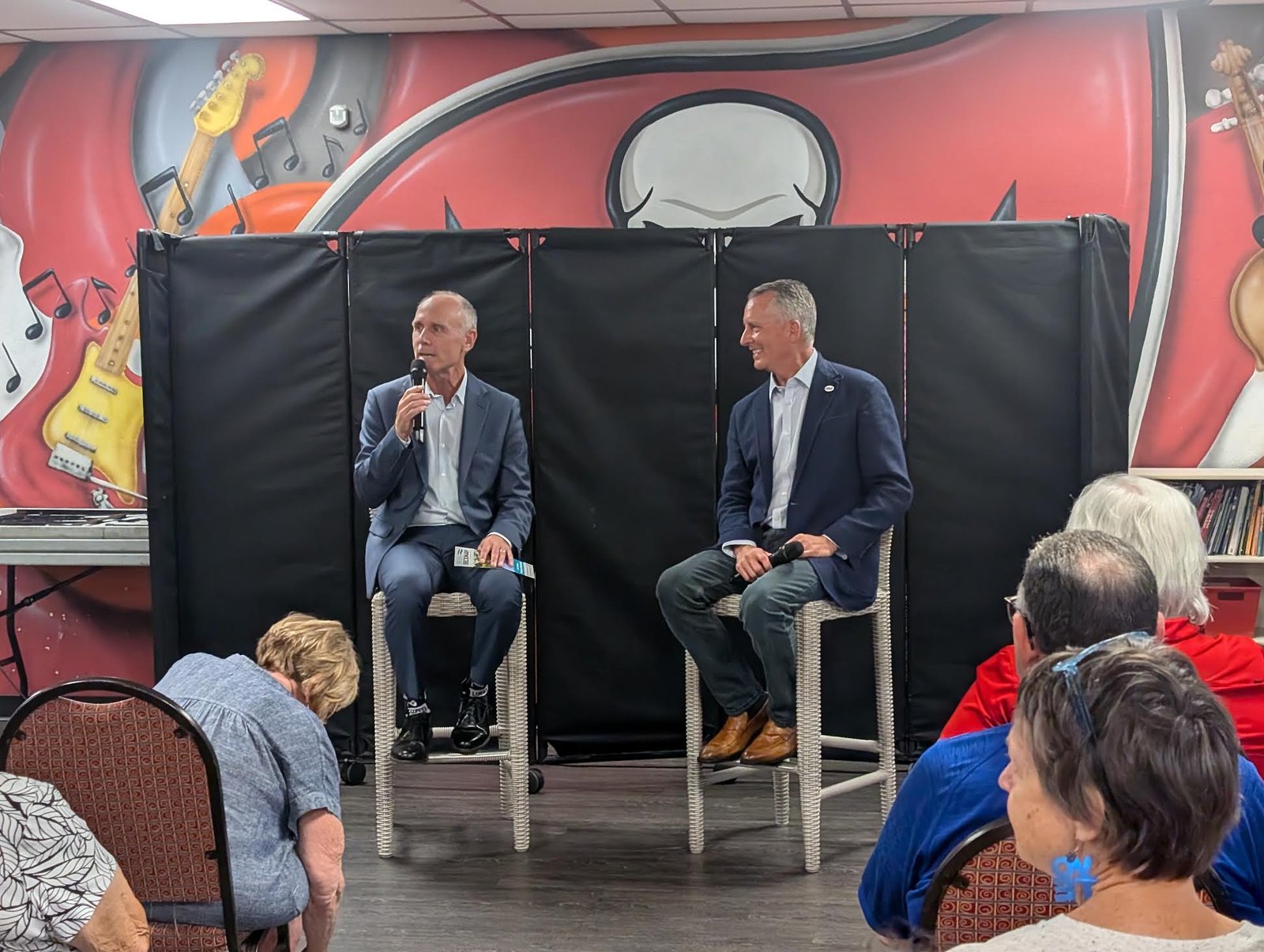
CLEARWATER — David Jolly and Jerry Demings are vying to become the first Democratic governor to lead Florida in nearly three decades. If elected, they’ll face an additional challenge — working with an opposition Republican Party that enjoys a supermajority in the Legislature.
Speaking during a campaign event in Clearwater Wednesday night, Jolly mentioned a couple of specific ways he believes he could overcome that problem to deliver his policy goals, beginning with the power to name agency heads.
“Think about a state that come January [or] February we have a new surgeon general in charge of the state,” he said, referring to how he would jettison controversial Surgeon General Joseph Ladapo from his position on his first day in office.
“Think about an education commissioner who actually is going to have the backs of teacher and kids and books and academia and science and, yes diversity,” he continued. “Think about an environmental policy that is set by people who believe in environmental science. Think about an ethics and transparency office that actually begins to reveal the corrupt campaign finance system we have in the state of Florida, and yes, there’s a lot we can do.”
One lever of power that Democrats certainly should have learned from Gov. Ron DeSantis is executive authority, something that the Republican Legislature has rarely objected to during the past seven years. Among the decisions that DeSantis has made over the heads of the House and Senate was using taxpayer funds to send undocumented immigrants from Texas to Martha’s Vineyard in Massachusetts in 2022, and working with the federal government over the past year to create the detention facility for migrants dubbed Alligator Alcatraz (now on the verge of being closed down).
If elected, Jolly said, he would “trust” the state’s attorney general to litigate the interests of Florida.
“The attorney general exercises that authority. I don’t think the governor is precluded from using that authority, so I intend to litigate a few things,” he said, specifically saying that allowing more access to reproductive care would be one issue he would be willing to spend political capital on.
Florida law prohibits most abortions after six weeks of pregnancy, with some exceptions. More than 57% of Floridians voted to overturn that law in a constitutional amendment in 2024 — a clear majority but short of the 60% required for passage.
The Florida Democratic Party’s other major gubernatorial candidate, Jerry Demings, has also been thinking about how he could govern successfully with Republican-controlled Legislature.
“As mayor of Orange County, I’ve worked with Democrats and Republicans alike to get things done,” he said in a written statement to the Phoenix.
“As governor, I will be the bulwark against radical right-wing policies and force the Legislature to work on issues that matter to Floridians, such as affordability. And I will continue to work with local governments, the Florida Association of Counties, and the Florida League of Cities on issues of mutual interest.
“I will also not be afraid to wield the veto pen to stop the out-of-control tax-funded giveaways to special interests,” he added. “I will do everything I can to help end the supermajority and bring sane governance back to Tallahassee.”
Jolly also believes that if Floridians vote a Democrat into office as governor in November, they likely will also elect enough Democrats in legislative races to overcome the Republicans supermajority.
Trifectas
Florida’s is one of 23 Republican trifectas in the United States, where the state governor and legislature are of the same party. There are 16 Democratic trifectas and 11 divided governments in which neither party holds complete control.
Of those states, a handful feature a Democratic governor and a Republican legislature: Arizona, Kansas, Kentucky, North Carolina, and Wisconsin. Vermont has a Republican governor and Democratic-led Legislature.
In Kansas, Democratic Gov. Laura Kelly is finishing her eighth and final year in office working with a Republican-led Legislature.
Sherman Smith, editor of the Phoenix-affiliated Kansas Reflector, said Kelly was “totally underestimated” by Republicans during her first couple of years in office “and she got a lot of wins because of that.”
However, after the Kansas GOP expanded its supermajority in 2020, it’s been a much harder path for her to govern, Smith added.
And, since the 2024 election, that Republicans have “just entirely written her out of the process because they have strong enough members now, they just say, ‘We don’t even have to talk to the Democrats or tell them what we’re doing, or care what the governor thinks about it.’ They took the budget process away from her and a whole bunch of other stuff — what that means now it that they own it all.”
Kelly isn’t completely helpless: Following Kansas’ most recent legislative session earlier this year, she vetoed 24 bills and 31 budget line items.
In North Carolina, Democrat Josh Stein took office in January and is now working with a GOP-controlled General Assembly in Raleigh. Five months into his tenure, the results have been “mixed so far,” according to the Associated Press.
“The General Assembly passed storm-relief packages but gave Stein roughly a little over half the money he requested,” the AP reports. “It overrode several of his vetoes on bills that build up immigration enforcement, weaken transgender rights and assert other GOP priorities — results that Stein laments.”
It should be noted at this point that even with Republicans dominating state government, there have been plenty of clashes between the governor and the Florida House, in particular, since Gov. DeSantis won reelection but lost his presidential campaign in 2024.
For example, Gov. DeSantis a year ago vetoed more than half-a-billion dollars in projects from Republicans and Democrats alike in the 2025-26 fiscal year budget. That followed the Legislature overriding DeSantis’ veto of nearly $57 million for the Legislature’s operations in January 2025.

Republican Party of Florida Chair Evan Power says the whole discussion is academic.
“We now live in a ruby red state with 1.5 million more voters than Democrats,” he said in a text message. “Neither stands a chance to lead the free state of Florida.”
Another wrinkle is that Florida governor’s share executive power with the independently elected Florida Cabinet — the attorney general, chief financial officer, and agriculture commissioner, each office held by a Republican.
‘Let’s not waste time’
Jolly says that, if elected, he’ll immediately reach out to Florida’s Republican legislative leaders (who will be Jacksonville’s Sam Garrison in the House and Manatee County’s Jim Boyd in the Senate) and say, “Let’s not waste the next four years on behalf of the state. Let’s figure out how to work together.”
As a former Republican turned political independent who tried to build up a third political party before becoming a Democrat last year, Jolly says he’s in “a very post-partisan, post-ideological” phase in his life.
But that approach might be simpler said than done.
“We’re seeing a couple of Democrats running for governor this election year and talking about how he or they can reach across the aisle and work with the Republicans if they’re elected,” Smith said of what’s happening in Kansas this year. “But the reality is, the Republicans don’t want to work with them. And they don’t have to.”
Would the Republican-controlled Florida Legislature take a similar attitude following the shock of losing the governor’s mansion for the first time since 1994? We won’t know until November.
Independent Journalism for All
As a nonprofit newsroom, our articles are free for everyone to access. Readers like you make that possible. Can you help sustain our watchdog reporting today?



