
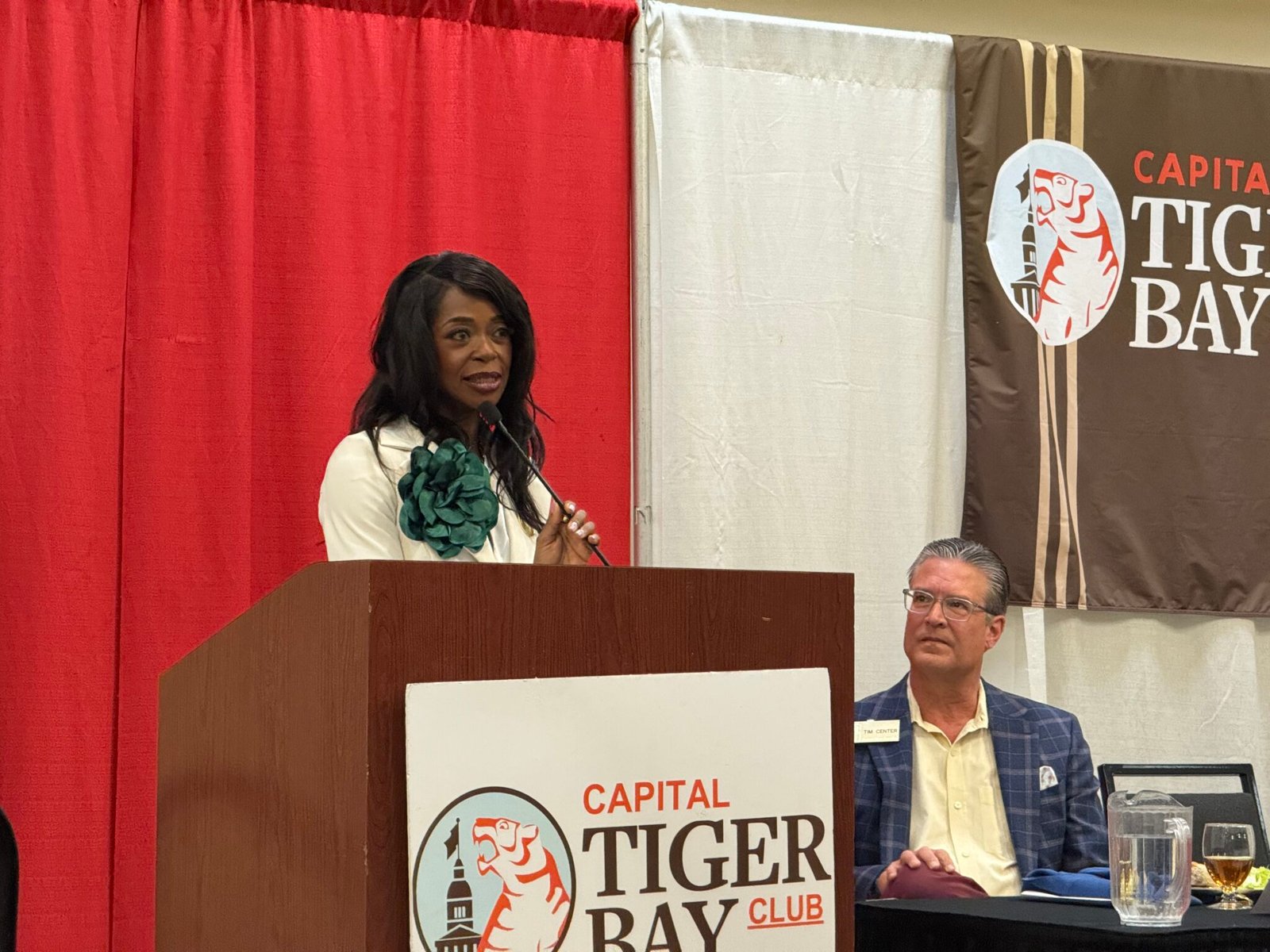
Florida A&M University President Marva Johnson reflected on her experience thus far as the university’s leader, particularly in light of widespread public pushback to her selection.
Johnson spoke Friday to the Capital Tiger Bay Club in Tallahassee.
“I know no university president has a 100% likability rate, but I’m hoping to try to make sure that I listen in a way that is constructive, that I make decisions that are well informed, not just from peoples’ opinions but from data,” Johnson responded to a question about how opposition has changed since her selection nearly a year ago.
The pick to run Florida’s only public HBCU is an ally to top Florida Republicans
“And that at the end of the first year, the second year, third year, fifth year, that what people are truly measuring and commenting on is the outcome and the impact, and we expect that to be phenomenal,” Johnson continued.
Johnson highlighted FAMU successes, such as being ranked the No. 1 public historically Black college and university by U.S. News & World Report and No. 1 HBCU by Niche, and for the economic support the university provides to the state.
Alumni and FAMU stakeholders questioned Johnson’s political ties when she was announced as a finalist, having been appointed to boards by former Gov. Rick Scott and Gov. Ron DeSantis, prompting protesters’ concerns that she may prove a political president.
Those political ties, paired with a perceived lack of higher education experience, resulted in petitions and community events opposing her presidency and prolonged FAMU Board of Trustee meetings.
“I’m a lawyer and a corporate executive. Not exactly a part of the academy from the traditional higher education experience,” Johnson acknowledged Friday.
Johnson was vice president for governmental affairs for Charter Communications before coming to FAMU and previously served as chair of the State Board of Education, which oversees K-12 education in the state and the Florida College System.
She was education chair for Florida’s Constitution Revision Commission in 2016. That, paired with her State Board of Education experience, gave her “a clear perspective and appreciation” for the constitutional responsibility the state has to educate, and she came to FAMU with “clarity and with purpose and with deep respect for what this institution represents.”
Marva Johnson is now FAMU president despite widespread pushback
“I spent years navigating a career in corporate board rooms, state legislatures, regulatory battles across nine states simultaneously, and I thought that I really understood complex institutions. I thought I understood complex politics. I thought I understood difficult people, and what I really learned is all that was just gonna be preparing for coming to FAMU. This is probably, in truth, the hardest job I’ve ever had, but it’s also the most rewarding.”
During the Board of Governors meeting in which she was confirmed for the position last year, she committed to having an open door and “full engagement on campus and in our communities.”
“One of the interesting things about the open-door policy is some people tell me I listen to too many people. For me, I can’t listen to too many people. The only limitation I have is time,” Johnson told reporters Friday.
“By having that open door, I think that it’s worked in both directions. I think that some people initially who didn’t understand who I was, didn’t understand what my vision was, who may have been reticent because of those things, I think they’re coming around,” Johnson told reporters.
GET THE MORNING HEADLINES.
Independent Journalism for All
As a nonprofit newsroom, our articles are free for everyone to access. Readers like you make that possible. Can you help sustain our watchdog reporting today?



