
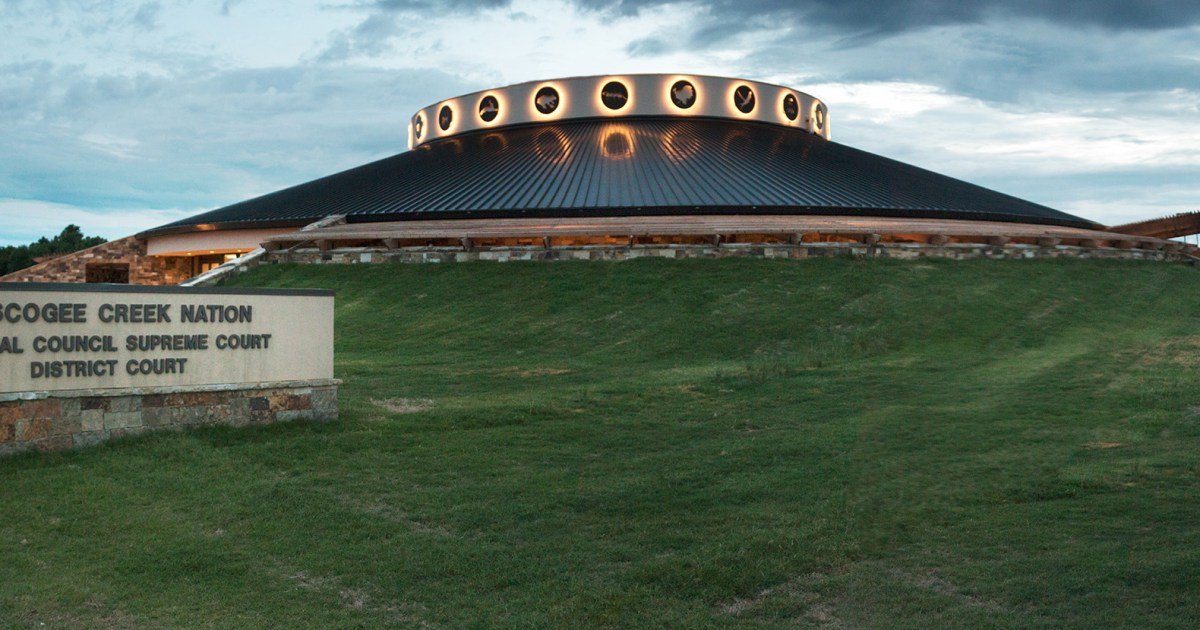
The Muscogee (Creek) Nation’s Mound building, which houses the National Council. Amanda Rutland/Muscogee Nation/ZUMA
Last August, citizens of the Muscogee (Creek) Nation began hearing whispers of an AI data center coming to their reservation. Kenzie Roberts and Jordan Harmon, both Muscogee citizens, were immediately worried. It “didn’t seem like something that should align with our values as Indigenous people,” Roberts said. The center would be located on Looped Square Ranch, a 5,570-acre plot of land where the tribe runs its food sovereignty initiative, a program that allows the Muscogee Nation to directly serve its citizens’ food needs. At the ranch, the tribe hosts youth agricultural activities like 4H; citizens can visit for hunting, fishing, trapping, and gathering; and the nation runs a fully functioning cattle ranch and meat processing center. The proposed legislation would rezone that land for industrial purposes—potentially taking that all away. “We give so much from the heartland, and then they still try to extract more from us,” Roberts said.
As developers scope out land across rural America for the hyperscale data centers needed to power generative AI, Native lands have become the latest target for Big Tech—from the Arizona desert to the Great Plains in Montana to the hills of central Virginia. Often, when tech companies come into Indigenous communities, they promise jobs and economic benefits for the community, but community activists say those benefits rarely materialize. Instead, data centers bring a threat of land loss and displacement that feels all too familiar for Indigenous people. “It’s just layer upon layer of exploitation, of violence, of continued colonialism. All in the name of imperialism,” said Krystal Two Bulls, an Oglala Lakota and Northern Cheyenne organizer who is the executive director of Honor the Earth, a national organization promoting Indigenous sovereignty that has been leading the fight against data centers. According to Honor the Earth, there are currently at least 106 proposed data center projects near or on Native lands. In western New York, a proposed $19.46 billion data center project would sit adjacent to the Tonawanda Seneca Nation’s territory, threatening an old forest that tribal citizens use for hunting, fishing, and gathering traditional medicine. In Reno, Nevada, an industrial park with a number of data centers planned threatens the water supply of Pyramid Lake, which is home to the Pyramid Lake Paiute Tribe and completely surrounded by the tribe’s reservation.
Companies attempting to construct data centers on Indigenous lands likely see it as an opportunity not just to access large plots of land, but also to use tribal sovereignty to bypass cumbersome state regulations that tribes don’t have to follow. Many tribal nations don’t have the legal codes or regulatory bodies in place yet to regulate utilities, Two Bulls said, so developers are moving quickly to begin data center projects while that’s still the case. Two Bulls also said that many developers see Indigenous communities as easy targets, especially poorer tribes that don’t have the legal or financial infrastructure to pursue litigation. “They don’t think they’re going to get a lot of pushback,” said Ashley LaMont, an enrolled tribal member of the Absentee Shawnee Tribe of Oklahoma and the campaign director at Honor the Earth, who’s been organizing with Roberts and Harmon in Oklahoma.
The data center boom feels like yet another example of developers treating Native lands as an unlimited commodity for exploitation.
Two Bulls said that tribes with large land bases are open to the purported economic development that a data center could bring—because they need it. But tribal nations also need to consider whether they will be able to hold companies responsible for harm or depleted resources on their lands and whether they’ll have oversight of data centers. Community organizers and experts cite concerns about air pollution, electrical rate hikes, and the depletion of finite resources like water. “For Indigenous communities as a whole, water is going to be a continued worry,” said Lance Tubinaghtewa, a program coordinator at the Southwest Environmental Health Sciences Center at the University of Arizona. Tubinaghtewa, who’s Hopi, has been closely monitoring data centers that could threaten Indigenous communities in Arizona.
The organizers I spoke with say that the concern about data centers mirrors other issues—oil and natural gas pipelines, uranium and lithium mining, rollbacks on environmental protections for sacred lands, and man-made dams—that some Native communities have been fighting for years. They see parallels to the Dakota Access Pipeline protests of 2016, when activists flocked to the Standing Rock Indian Reservation, where the pipeline was threatening sacred lands and water in the area. At the time, these protesters often referred to themselves as “water protectors” and repeated the Lakota phrase “Mní Wičóni” or “Water is life.” Today, as corporations attempt to place hyperscale data centers—which can guzzle up to 5 million gallons of water per day—on Indigenous lands, organizers are again taking up the water protector mantle. For them, the data center boom feels like yet another example of developers treating Native lands as an unlimited commodity for exploitation.
For months, Harmon and Roberts traveled all around the Muscogee Reservation—which covers 11 counties in Oklahoma—holding town halls to organize against the data center. Some Muscogee citizens they met were concerned about water or electric bill increases—a recent Bloomberg analysis shows that electricity costs were up by 267 percent in areas near data centers. Others wondered if a data center would bring jobs for local laborers. In one town hall, Harmon argued that while job prospects are an “alluring promise,” research shows that data centers aren’t providing the job opportunities that tech companies claim. Ultimately, those conversations paid off. “Our National Council reps were saying they were getting more calls about the data center than anything they ever had before,” Harmon said.
One of those calls came from James Floyd, the Muscogee Nation’s former Principal Chief, who said every aspect of the data center proposal seemed in opposition to traditional Muscogee values. “Our citizens own this land,” he said. “We as a nation own this. It’s been our tradition—before removal—that land was held in common and we all had a say in how the land was going to be used. Fast forward 200 years later and we get into a situation like this. It speaks to how we disregard our own culture in trying to pursue something that will make somebody some money.” The specific legislation for this project was proposed by the tribe’s administration—its executive branch—but the decision about whether the ranch should be rezoned and used for a potential data center was ultimately left up to the National Council, the tribe’s legislative branch. But Dode Barnett, a member of the Muscogee Creek National Council, said council members looking for information about the project kept hitting a brick wall.
Big tech companies and their developers often come with non-disclosure agreements in hand, and if they sign, officials are limited in what they can disclose about the projects. The NDAs can limit important information—like the amount of water and energy a data center would use and sometimes even the name of the company building it—in the name of protecting corporate secrets, leaving the public in the dark. In the case of the Mvskoke Tech Park legislation, the tribe’s administration had signed NDAs, meaning they couldn’t discuss any details about the project with members of the National Council who would ultimately make the decision. For Barnett and other members of the National Council, this made understanding the proposed project difficult—and ultimately led Barnett to vote against it. “There was just a broader sense of alarm for me, personally, around the NDAs,” she said. As a result, Barnett has drafted legislation that would make it illegal for certain Muscogee officials to sign NDAs in the future. She sees it as a chance to return the nation’s government to its values, echoing Floyd. “The Muscogee Creek Nation government was based on the citizens themselves having a lot of power,” she said.
With all the secrecy surrounding data centers, actually knowing the locations of projects is no easy task. Honor the Earth recently launched a map compiled from crowdsourced information to help keep track of data centers on or within 30 miles of Indigenous lands. Once it has identified a data center project on Native land, Honor the Earth drafts a letter to the tribal communities that could be impacted to give them information about how the project will affect their community, and provides them support if they want to resist.
Despite the downsides, the US Department of Energy’s Office of Indian Energy Policy and Programs has encouraged tribes to get involved with the data center boom, calling the centers a “big economic opportunity” and downplaying their drawbacks. The department is offering technical, financial, and legal assistance for tribes who might want a data center on their land, including site evaluations, introductions to industry partners and subject matter experts, and consulting on regulations and deals.
Some Native people also see data centers as an opportunity for tribes. Last fall, a group of researchers at the Colorado School of Mines, two of whom are Indigenous, wrote a piece called “The Future of AI Runs Through Indian Country” arguing that data centers could be an opportunity to place “high-tech infrastructure on Native American lands.” The authors argue that, thanks to their unique assets—which include large land bases, water rights, and tribal sovereignty—tribal nations stand to benefit greatly if they get in on the data center game. Tribes can avoid the risks of extraction and exploitation by implementing the proper safeguards, they say, without spelling out what those safeguards are.
When the Muscogee National Council voted on the data center bill last November, Roberts and Harmon were nervous. Sitting in the audience with other organizers, it felt like the decision could go either way. But the bill failed by a 4-11 vote. They were relieved—but the fight isn’t over yet. In addition to the four council members who voted in favor of Mvskoke Tech Park, Harmon thinks other council members might reconsider the proposal in the future if the NDAs aren’t in place and they can see more information about the proposed project. She also worries that the project might be approved if it’s moved to a less controversial location. Already, more bills are popping up in nearby city councils for data centers that would extend onto Muscogee land. To eliminate that worry, Harmon wants to see the National Council pass a full moratorium on data centers on Muscogee land.
“We should always oppose colonization. We shouldn’t back down.”
And Harmon’s concerns aren’t just limited to data centers in Oklahoma. Nearly 1,000 miles away in Twiggs County, Georgia, another developer has proposed a data center on Muscogee ancestral lands. Before the US government forcibly removed them in the 1830s, the Muscogee (Creek) Nation had inhabited this part of Georgia for thousands of years, and the proposed data center could threaten the preservation of ancestral Muscogee mounds and villages that remain in that area. Some Muscogee citizens—including former principal chief Floyd—traveled down to Coweta County, Georgia, last fall to speak against a proposed data center there called Project Sail. Harmon and Roberts hope that moving forward, they can motivate more Muscogee citizens to pressure the tribal government to turn their attention towards their homelands before it’s too late. “It carries an extra emotional burden because it’s hard to be this far away from our homelands and to hear from white people, ‘We want to protect your sacred sites,’ and then to hear from our own tribal leaders that they’re not interested in that,” Harmon said.
Seeing this fight play out on so many fronts could be discouraging for some. But for Harmon, it’s a motivator. “We should always oppose colonization,” she said. “We shouldn’t back down.”
Harmon and Roberts have helped form the Stop Data Colonialism coalition, a national group founded by Honor the Earth, bringing together Native organizers working to halt data center projects in Indian Country. The Stop Data Colonialism coalition has also been organizing in other parts of Oklahoma. In the past week, the Tulsa City Council passed a nine-month moratorium on new data center construction, a data center project in Tulsa pulled its rezoning request, and another developer in Coweta pulled its data center proposal all together. The group also held a town hall with the Seminole Nation of Oklahoma, which then unanimously passed a moratorium on hyperscale data centers on its land. “We’re hoping that tribes will…actually say, ‘We don’t want this here.’ There’s more work to be done,” Harmon said.



