
Lunar Ice at the South Pole: A Key Resource for Future Moon Missions
A new international study has provided encouraging evidence that water ice in the Moon’s permanently shadowed regions (PSRs) is far more stable than scientists previously believed. The findings strengthen the possibility that the lunar south pole could support future human missions, scientific exploration, and even long-term lunar bases.
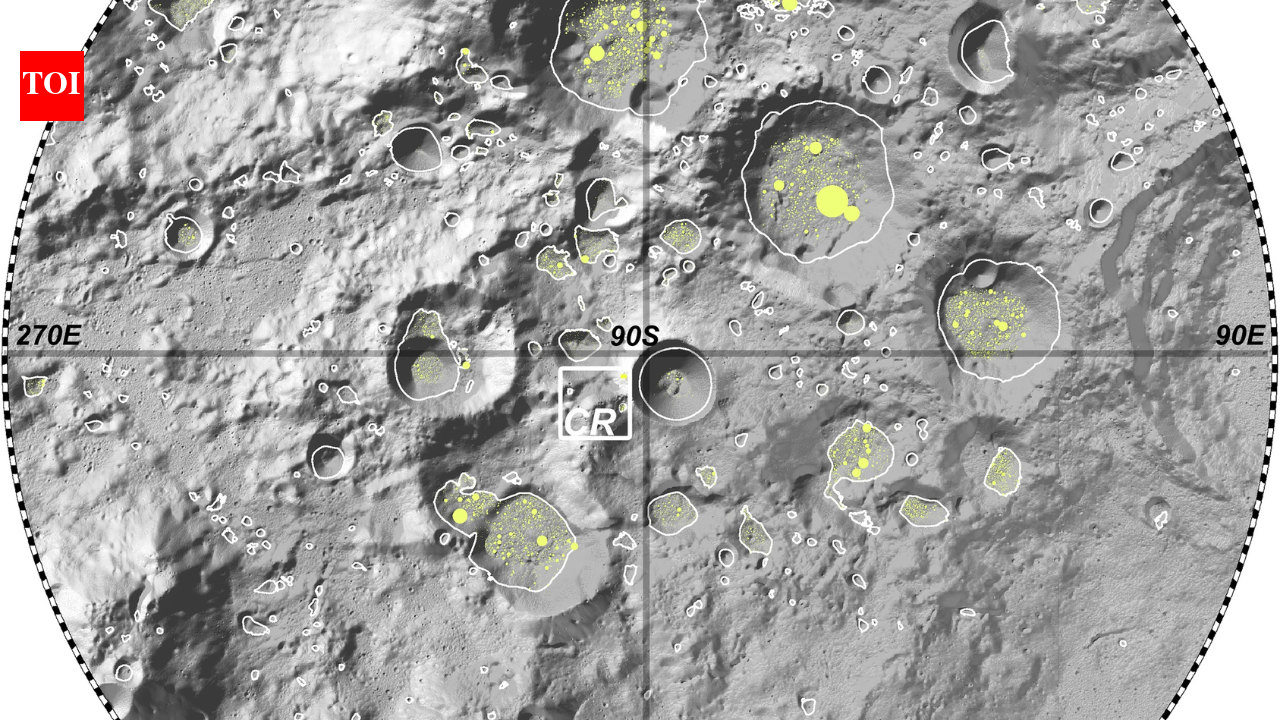
The research, published in Nature, involved scientists from Physical Research Laboratory, Indian Institute of Science Education and Research, and the Institute of Remote Sensing. By analyzing high-resolution imagery and impact simulations, researchers discovered that the majority of the Moon’s shadowed polar regions remain largely undisturbed by impacts, allowing water ice to survive for billions of years.
Why the Moon’s Permanently Shadowed Regions Matter
The Moon’s south pole contains areas that never receive direct sunlight. These locations, known as permanently shadowed regions (PSRs), maintain extremely low temperatures—sometimes below −200°C. Because of this extreme cold, volatile substances such as water can remain frozen and stable for extremely long periods.
Scientists have long suspected that these dark craters could act as natural cold traps, preserving water ice delivered by comets, asteroids, or solar wind interactions. However, the question remained: Could repeated asteroid impacts disrupt or destroy these deposits?
The new study suggests that in many cases, the answer is no.
Researchers found that approximately 74% of PSRs at the lunar south pole appear to be unaffected by impacts, meaning large portions of ice deposits may remain intact beneath the surface.
Mapping Millions of Lunar Craters
To reach these conclusions, scientists conducted one of the most detailed analyses ever performed on lunar shadowed regions.
The team mapped millions of craters ranging from 1 meter to 20 meters in diameter across the Moon’s south polar region between 85° and 90° south latitude. Larger craters between 5 meters and 7 kilometers were also analyzed to understand the long-term geological history of the region.
This mapping effort relied heavily on imagery from:
- NASA’s ShadowCam instrument
- Indian Space Research Organisation’s Chandrayaan-2 Orbiter High-Resolution Camera
ShadowCam, designed to capture extremely faint light inside dark craters, allowed scientists to observe features inside areas that had previously been impossible to study.
Through detailed crater counting and impact modeling, researchers were able to estimate how often meteor impacts might disturb buried ice deposits.
Impact Craters and the Stability of Lunar Ice
Although the lunar south pole has experienced millions of impacts over billions of years, the study suggests that these events may not completely destroy ice deposits.
When impacts occur in PSRs, they can expose subsurface material and release trapped volatiles. However, the study indicates that many impacts are small and shallow, meaning deeper layers of ice may remain protected beneath the surface.
Interestingly, scientists also highlighted a process known as “regolith gardening.”
This natural process occurs when tiny impacts gradually churn the Moon’s surface soil over time. Rather than destroying ice, this mixing can actually bring buried ice closer to the surface, making it easier for future missions to detect and extract.
This means certain locations in the lunar south pole may contain accessible shallow ice deposits, making them ideal targets for future exploration.
Chandrayaan Missions and the Discovery of Lunar Water
India has played a major role in advancing our understanding of water on the Moon through its Chandrayaan missions.
The landmark discovery came with Chandrayaan-1, launched in 2008, which first detected evidence of water molecules on the lunar surface.
This discovery changed scientific understanding of the Moon and opened the door to the possibility of using lunar water as a resource.
Later missions continued to build on this foundation:
- Chandrayaan-2 confirmed that water is particularly stable in the Moon’s polar regions.
- Chandrayaan-3 provided further evidence that hidden or buried ice may exist beneath the lunar surface near the south pole.
These missions collectively marked a major milestone in lunar science and strengthened global interest in the Moon’s polar regions.
The Role of Lunar Water in Future Space Exploration
Water on the Moon is not just scientifically interesting—it could be essential for the future of human space exploration.
Water ice can be used in several important ways:
Life Support:
Astronauts could convert water into drinking water and breathable oxygen.Rocket Fuel:
Water can be split into hydrogen and oxygen through electrolysis, creating propellant for spacecraft.Radiation Protection:
Water can also help shield astronauts from harmful cosmic radiation.These capabilities could allow the Moon to serve as a fueling station and staging point for missions to Mars and beyond.
The LUPEX Mission: The Next Step in Lunar Exploration
To better understand these ice deposits, India and Japan are planning a major joint mission called the Lunar Polar Exploration Mission (LUPEX).
This mission is being developed collaboratively by:
- Indian Space Research Organisation
- Japan Aerospace Exploration Agency
The LUPEX mission is expected to launch around 2027–2028 and will aim to land near the Moon’s south pole.
Unlike previous missions, LUPEX will carry a heavy Japanese rover capable of drilling and analyzing lunar soil. The rover will search for water ice beneath the surface and study its distribution, composition, and accessibility.
If successful, LUPEX could provide critical data needed to support future lunar bases.
Global Race to the Moon
The discovery of stable water ice is fueling a renewed global interest in lunar exploration.
Several major space agencies are currently planning or executing missions aimed at returning humans to the Moon.
For example, Artemis II, part of the broader Artemis program led by NASA, aims to send astronauts around the Moon as a precursor to future lunar landings.
Meanwhile, countries such as India, China, Japan, and members of the European space community are expanding their lunar programs with the goal of establishing sustainable human presence on the Moon.
The Moon’s south pole has become the primary focus of these efforts because of its potential water reserves.
A New Era of Lunar Resource Exploration
The latest research reinforces a growing scientific consensus: the Moon’s permanently shadowed regions could be among the most valuable locations in the solar system for future exploration.
If water ice is indeed preserved beneath the lunar surface for billions of years, it could transform the Moon from a distant scientific target into a strategic resource hub for deep-space missions.
With upcoming missions such as LUPEX and Artemis, humanity may soon begin exploring and utilizing these frozen reserves.
The next decade could mark the beginning of a new era where the Moon becomes not only a destination for exploration but also a gateway for expanding human presence deeper into space. 🚀



