
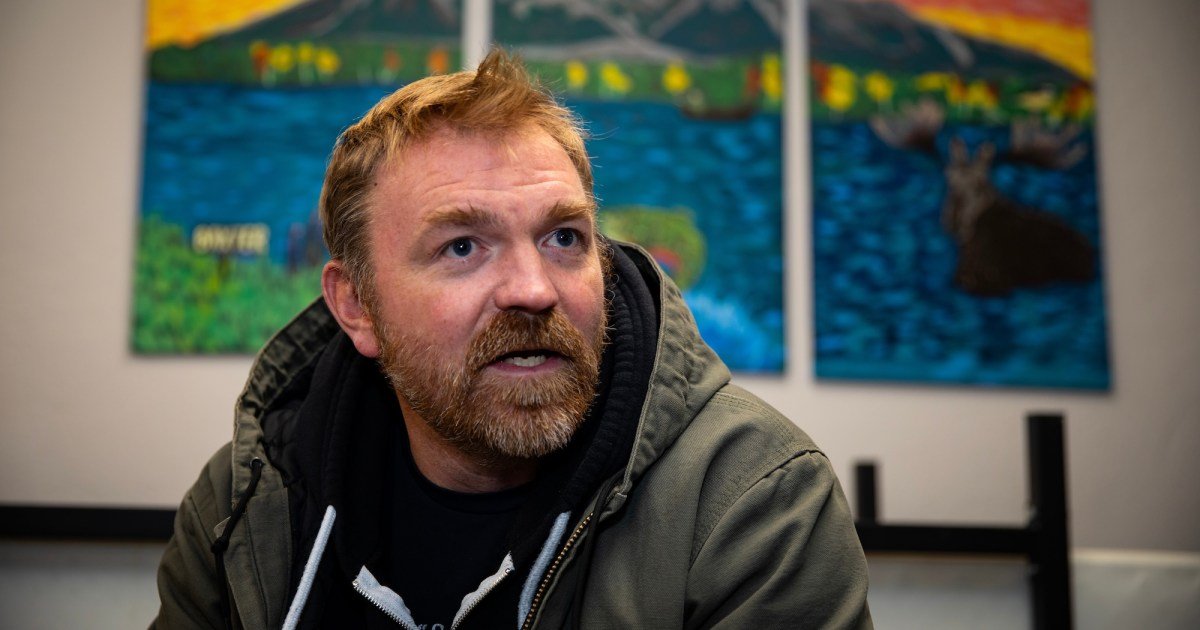
Democratic senate candidate Graham Platner used the r-word in a recent interview. Melanie Stetson Freeman/Christian Science Monitor/AP
Graham Platner could very well be the Democratic nominee running against Sen. Susan Collins (R-Maine) for her long-held Senate seat.
Platner’s run has not been without controversy, to put it lightly. A tattoo that Platner had, a Totenkopf, was worn by Nazis and is still a symbol embraced by Neo-Nazis today. In an article published in the local publication Maine Monitor on Saturday, the Senate candidate explained his initial reaction:
Platner said he didn’t know what it was until it became an issue during this campaign. Even when someone working with his campaign told him there was a rumor going around that he had a white supremacist tattoo, he said he didn’t connect it to the skull and crossbones on his chest. “I was like, ‘Well, that’s the fucking most r-tarded shit I’ve ever heard in my life,’” he told me. “‘No, I don’t have a white supremacist tattoo,’ and I never thought about it again. And then it came up later on, and I was like, ‘God fucking damn it.’” (He had the tattoo covered in late October.)
Platner has made some attempts to reconcile with Maine Jewish communities, including hosting a Passover seder. But now, as healthcare data wonk Charles Gaba raised on Bluesky, why is Platner using the r-word, a slur that is greatly offensive to many disabled people, in 2026?
I asked the Platner campaign for comment, but they have not responded by the time of publication.
The Arc, which supports those with intellectual and developmental disabilities, explain, “If you constantly heard a core part of your identity used as shorthand for ‘stupid’ or ‘worthless,’ how would you feel? It chips away at dignity. It sends a message about who is valued and who isn’t.”
If it’s casually part of someone’s vocabulary, they might not get the harm. This also points to a lack of engagement with disabled people.
Considering how the Trump administration has targeted disabled people—including enacting brutal cuts to Medicaid, which will alter the services some disabled people receive—some people may argue that others are overreacting to Platner’s use of the r-word. However, having better standards than President Donald Trump has for himself is a good thing when trying to play a role in flipping the Senate to Democratic power.
As I’ve reported previously, Trump has a long history of making offensive remarks targeting disabled people. This includes casually using the r-word on the Howard Stern show, as well as calling Deaf actress Marlee Matlin the r-word behind her back when she competed on The Apprentice.
Trump’s use of the r-word has also been a dealbreaker for some Republicans. Back in November, Republican Indiana State Senator Michael Bohacek said that he would not vote for redistricting in the Republican state after Trump used the r-word to refer to Minnesota Governor Tim Walz. “I have been an unapologetic advocate for people with intellectual disabilities since the birth of my second daughter,” Bohacek wrote on Facebook, “I will be voting NO on redistricting, perhaps he can use the next 10 months to convince voters that his policies and behavior deserve a congressional majority.” Redistricting efforts in Indiana, after Bohacek’s remarks, proceeded to fail.
This is not the first time that Platner has been criticized for using the r-word. As reported by CNN, Platner used the r-word several times in Reddit posts in 2021. After his Reddit history leaked, he distanced himself from his posts, saying that his views have changed and came from a troubled place after serving in the military.
“I didn’t feel connected. I didn’t feel like I understood my place in the world, my place in our society,” Platner said, according to Maine Public, “And that of course resulted in a lot of feelings of alienation and loneliness. And that’s when all this happened.”
None of this excuses why Platner is still using this slur in 2026. It also shows that the left have their own ableism problems to grapple with, not just Republicans.



