
The parking lot across from Ybor City’s Hotel Haya is something special.
The spot on East Seventh Avenue is where the Sanchez y Haya Cigar Company opened the first cigar factory in Ybor City. On April 13, 1886, it’s also where someone rolled the first cigar in Cigar City.
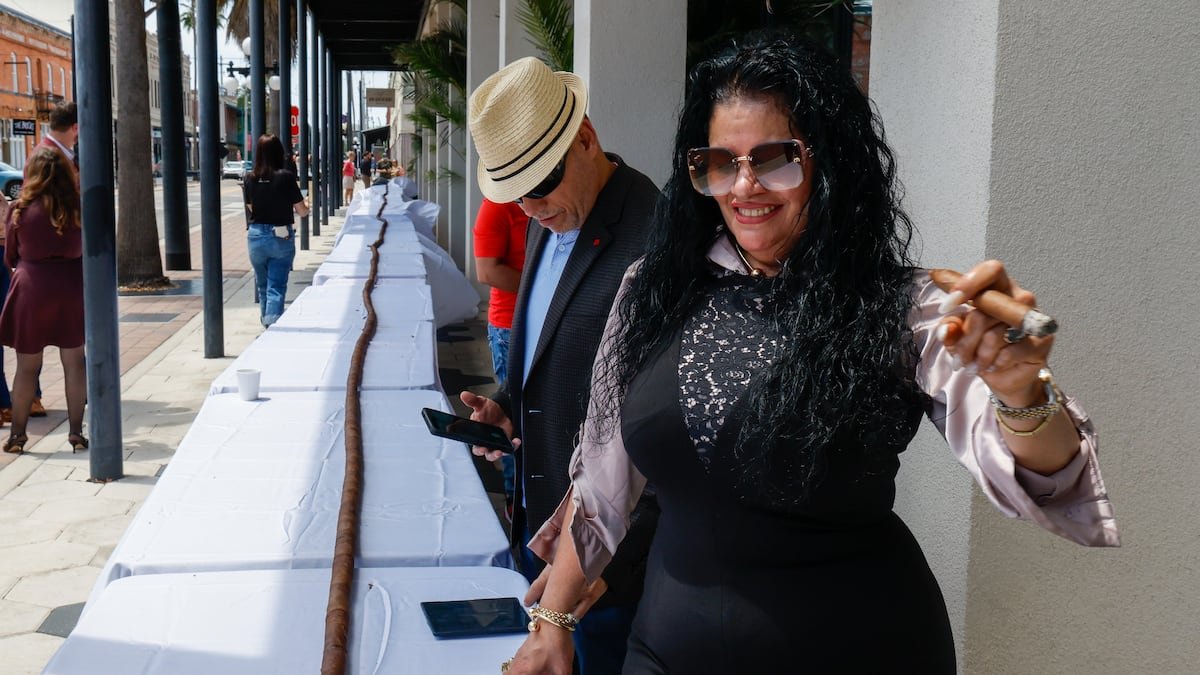
Across the street and 140 years later, this anniversary was celebrated with the ceremonial rolling of a 140-foot cigar.
About 300 people stopped by the hotel Monday to watch Odelma Matos, founder and owner of La Faraona Cigar Lounge, weave together dozens of pre-rolled segments into one giant tube of tobacco. A handful of helpers scurried around her as she worked, spraying the cigar with water, passing her damp leaves and chatting with the press so she could focus.
The spectacle stretched across two dozen 6-foot tables, swallowing up most of the block.
“She did this in four days,” said Rene Guerrero, general manager of La Faraona. “You could try to smoke it, but you might pass out.”

Matos just rolled her way into cigar history herself. In March, she broke the world record for the longest cigar with a 469-footer.
The 140-foot cigar may have gotten people to Ybor City’s birthday party, but it was hardly the only attraction.
Chefs from Flor Fina prepared at least 10 pans of free “Florida Man paella,” featuring alligator and lamb sausage, chicken thighs and frog legs.
BarrieHaus Beer Co. showed off its new double Dunkel pints specially formulated to complement cigars from J.C. Newman. Each can is decorated with historic photos, circa 1924 to 1957, from the Tampa-Hillsborough County Public Library System.
The Florida Museum of Photographic Arts promoted a new photography exhibit now on display from Zack Wittman, who shot 12,000 photos of old factories while making the book “Cigar City: The Legacy of Tampa’s Founding Industry.”
Meanwhile, J.C. Newman Cigar Co. led demos to help visitors roll their own (regular-sized) cigars. Even Mayor Jane Castor tried her hand at it after she gave a speech about the occasion.
“As it has gone through the changes and is continuing to do so, Ybor City has maintained its history, has maintained its roots, and I think that is so critically important, not just for Ybor City, but for our entire city, as we continue to grow very successfully,” she said. “We have to remember who built this city and make sure that we continue to be a city that is diverse and is very, very inclusive.”
Ybor City was named the cigar capital of the world in the late 1920s, said Max Herman, owner and guide of Ybor Walking Tours and the co-host of ”The Ybormuda Podcast.” By that point, the city was producing “over 1 million cigars a day.”
“There was this big idea of like, ‘OK, it doesn’t matter if you’re black, white, man, woman, as long as your elbow doesn’t hit mine and you can roll a good cigar, you can have a job here and thrive in America,’“ he said. ”So it became like this beacon for people that were coming here with nothing but the shirt on their back to make something of themselves.”



