
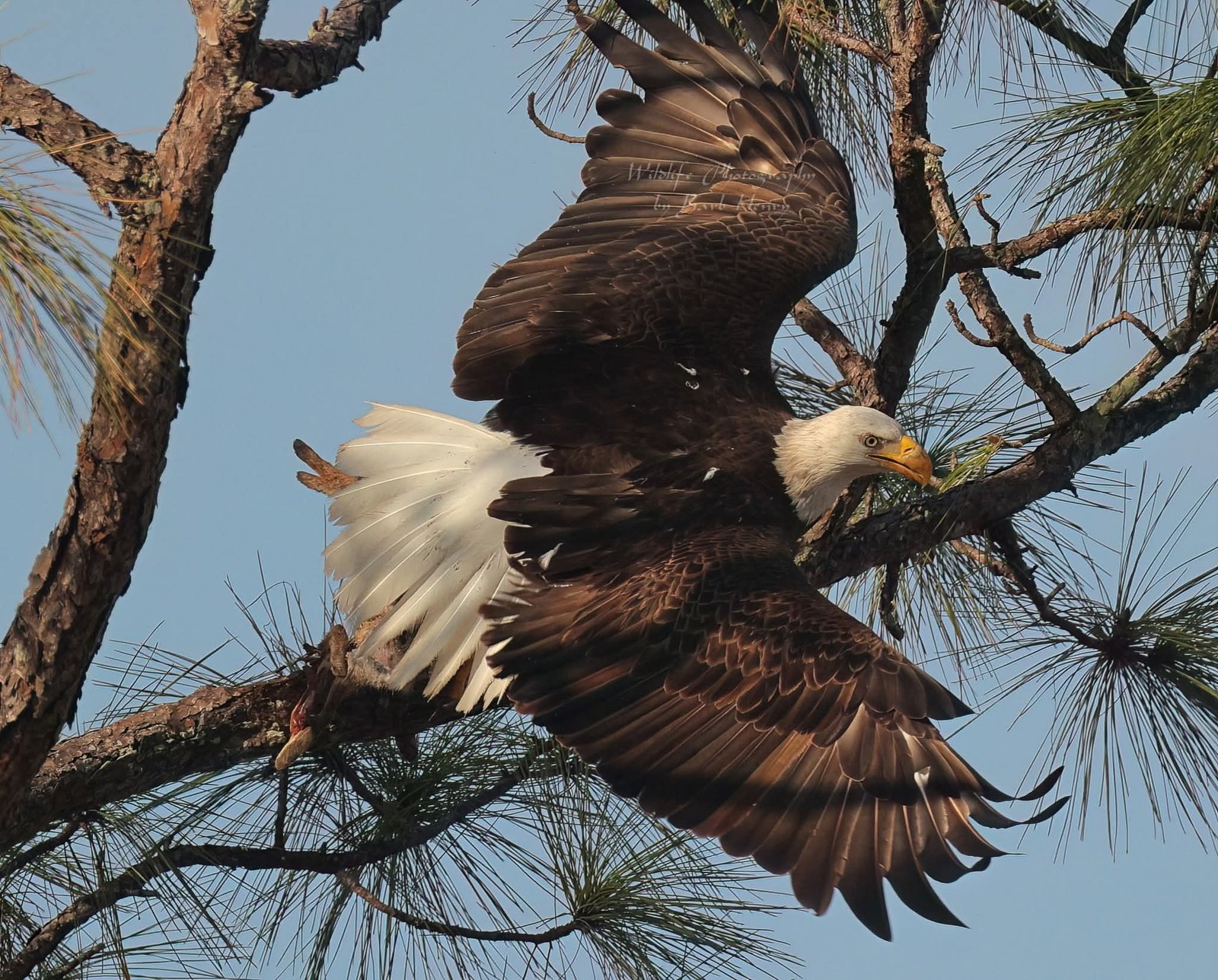
Florida is truly a land of mystery. Often, things aren’t what they seem. You may wind up with more questions than answers.
Why do we call that one Florida Keys span “Seven Mile Bridge” when it’s only six miles and change? Why do we sometimes see rain on one side of the road and not the other? Why is it, when our legislators all gather in Tallahassee, their collective IQ drops by 50 points?
I heard about another Florida mystery the other day, this one involving a well-known eagle.
In 2012, a family in Fort Myers mounted a camera on a tree, pointed it at a nest and launched the Southwest Florida Eagle Cam. Now they’ve got four cameras and even night vision for when the sun goes down. You can tune in any time of the day or night.
In the 14 years since the feed first went live, people all over the world have become hooked on this avian version of “The Truman Show.”
The livestream has been “bringing in 150 million viewers regularly to watch the daily activities of the two adult eagles as they repair their nest, fly in to feed two hungry youngsters and keep a watchful eye on what’s happening,” the Fort Myers News Press reported three years ago.
The feed’s sponsor, Dick Pritchett Real Estate, calls this “the world’s first live-streamed nature 360 immersive cam.”
Fans of this kind of unfiltered reality programming — far more wholesome than anything starring the Kardashians — have stuck with the show through hurricanes, aerial battles, domestic drama, sorrow, and triumph.
“That’s one of the best eagle cams in the country,” said Jack E. Davis, a University of Florida professor who wrote “The Bald Eagle: The Improbable Journey of America’s Bird.”
Now there’s been a new tragedy. Amid nesting season, one of the eagles died.
Outrage has erupted among eagle-cam fans over how Florida wildlife officials have handled the death. I got an earful from several.
Nature photographer Barbara Henry, who’s been snapping pictures of these eagles for more than a decade, told me she’s fielded angry calls from as far away as Germany.
“This whole thing.” she said, “was just bungled from the very beginning.”
Eagle eyed Florida man
They’re not as flashy as our flamboyant flamingos or roseate spoonbills, but Florida has a lot of eagles — and eagle lore.
At one point in the 1960s, Florida was the state with the most eagles. We were also the place where one eagle-eyed volunteer realized they were in trouble.

Charles Broley, a retired Canadian banker, bought a home in Tampa, and, beginning in 1938, became the nation’s most prolific distributor of bird bands for tracking eagles.
Broley would scale a rope ladder to the nests to slip bands on little eaglets, even when the nests were 90 feet high. Eventually he figured out that the population was dropping.
Broley concluded that DDT — a widely used pesticide in the 1940s, ’50s and ’60s — was to blame. The pesticide was poisoning the fish that the birds ate and ruining their eggs. He was one of the first to sound the alarm, and wound up being cited by Rachel Carson in her landmark 1962 book, “Silent Spring.”
After DDT was banned in 1972, scientists took healthy eggs from Florida eagle nests and transplanted the offspring to nests in other states where eagles had disappeared.

“Florida played an integral role in repopulating eagles’ nests across the southern states,” Davis told me. He’s such a fan of the birds, he arranged for an 850-pound steel statue of a nesting eagle pair in Alachua County as a salute.
By 2007, eagles had recovered sufficiently to be taken off the endangered list in the lower 48 states. They’re still protected from unlicensed killing, wounding, capturing, or disturbing under the Migratory Bird Treaty Act, the Bald and Golden Eagle Protection Act, and the Florida Eagle Rule.

These days, 700 volunteers for Audubon’s Eagle Watch program keep tabs on 1,300 eagle nests across 53 counties in Florida, according to Katie Gill Warner, director of Audubon’s Center for Birds of Prey.
“We now have the highest population of nesting pairs of eagles, next to Minnesota and Alaska,” she told me.
One such pair became the first stars of the Southwest Florida Eagle Cam.
Adventures of Ozzie and Harriet
In 2006, the original eagle pair to star on the eagle cam built a nest 60 feet up in a pine about a mile from the Caloosahatchee River. Six years later, the Pritchett cameras made them stars.
The birds were such an all-American pair, they were named Ozzie and Harriet. The names came from the blandly pleasant couple who starred in a long-running TV show that launched the musical career of Ricky Nelson.
Then, in 2015, the nature show took a dark turn. Another, younger male turned up and fought Ozzie for Harriet’s affections. Ozzie got his butt kicked.
Rescued by wildlife rehabbers, Ozzie spent 97 days recovering. After his release, he flew back to the nest for a rematch. This time he got beaten so badly that he died.
The new mate was designated M-15 for the year in which he appeared. He and Harriet settled into avian domestic bliss, laying eggs, hatching them, and teaching their young to fly. Harriet took charge.
“She was the boss,” livestream co-founder Ginnie Pritchett McSpadden told the News Press. “She just always was teaching (M-15) because he was much younger than her.”
Then, in 2023, with two new chicks in the nest, Harriet abruptly vanished. She flew away from the nest and never returned.
“The animal icon’s sudden disappearance has rocked the community, as well the nation,” the News Press reported. “Social media sites and Harriet fan-pages once filled with digital memorabilia of the eagle are now asking where she could be and what’s next for her family.”
M-15 finished raising their two fledglings alone that year. But then he attracted a new mate, who became known as F-23. For three years, they experienced a peaceful relationship.
Then, at the end of February, someone found F-23 dead.

Another bird down
The Pritchett eagle-cam team announced the news on its Facebook page.
“After receiving several credible reports of a deceased eagle found less than two miles from the nest, we are presuming that F-23 has passed,” they wrote. “Loss in the wild is never easy to witness. It is a sobering reminder that nature, while beautiful, can also be unforgiving.”
But it wasn’t nature that killed F-23. It was a human. The question is how.
“We have heard she was hit by a car. We have heard that she was shot,” one of the frustrated eagle-cam fans told me. “The eagles are supposed to be protected. Why has there not been an investigation as to the cause of F-23‘s death? We have emailed and called several agencies, and no one will get back to us.”
The death of legally protected wildlife in Florida falls under the purview of the Florida Fish and Wildlife Conservation Commission. The “conservation” part of the name seems misleading to me, given that this is the agency that just ignored science to hold a bear hunt.
Here’s what eagle-cam fans thought the FWC would do:
Confirm the dead bird was F-23. Send it to a laboratory for a necropsy, the animal version of an autopsy. Identify the cause of death. If it’s poaching, pursue the killer. As for the body, ship it to a federal facility that provides eagle feathers to Native American tribes for ceremonial purposes.
Here’s what the FWC did: None of that.
In fact, it seemed reluctant to even get involved.
Hazel Sky runs a Facebook fan page devoted to the eagle cam. She has 87,000 followers there. She was drawn into the controversy by the person who found F-23.
“The landowner contacted me approximately three days after they found her on the property as they were concerned about the (in)actions of the Florida wildlife commission,” Sky told me via email.
Sky and other fans bombarded the FWC with angry emails and calls.
“After increasing public pressure, six days after her disappearance, FWC released a preliminary statement saying that they collected her remains and performed a necropsy that showed extensive internal injuries that they credited to a potential vehicle strike,” Sky told me.
Except that wasn’t true.
The story changes
To begin with, the FWC insisted that there was no way to tell whether the dead bird was F-23, because the bird had never been banded. The FWC insisted there was absolutely no way to tell whether it was one of the most photographed, recorded, and observed animals in the world.
The agency did not bother to consult with Barbara Henry or any of the other nature photographers who’d snapped multiple pictures of F-23, Henry told me.
Then, in later FWC statements, the agency acknowledged there had been no necropsy after all.
Instead, the agency said, officers who responded to the report of a downed eagle simply examined the carcass and concluded that it had been killed by a car.
This despite “reports of a sound of a gunshot by local photographers at the nest site and by the landowner where the eagle was found, shortly after F-23 flew away from the nest,” Sky told me.
Everyone’s also skeptical of the roadkill finding, she said, because “her body was found at least 40+ feet from the road behind a chain link fence” in a yard that the eagles often frequented over the years. “She could not have made it that far after the impact with the car.”
You might think a photo of the body would help settle this. Turns out the FWC took only one.
It looks more like evidence for what didn’t happen than evidence for what did.
The photo “shows no external sign of a collision,” Sky told me. “Her wings are intact; her body is intact. There’s only blood coming from her nose and beak. There’s also a puncture wound on her neck that looks like a small caliber bullet hole.”
You don’t have to be a frequent viewer of TV’s “Forensic Files” to question the FWC’s investigative techniques.

The real endangered species
Then there’s question of what became of the body.
One thing is clear: It was not sent to the National Eagle Repository, a federal facility established in Colorado in the 1970s to provide Native Americans with the remains and feathers of golden and bald eagles for religious purposes.
Initially the FWC “stated that the National Repository was full so F-23’s remains will be cremated.” Sky said.
But then the story changed again.
“Due to the presence of Highly Pathogenic Avian Influenza (HPAI) in Florida, FWC guidelines for handling bird carcasses prioritize protecting people and wildlife, even when there are no apparent signs of illness,” the FWC said in a new statement that was sent out to everyone who inquired (including me).
“Testing to confirm the presence of HPAI in Florida wildlife is conducted by approved laboratories using samples collected during necropsies by the FWC and its partners,” the FWC statement said.
Except there was no necropsy, remember?
“Because laboratory capacity is limited, the FWC prioritizes which cases undergo further examination based on factors such as evidence of illness, potential violations, or broader wildlife health concerns,” the FWC statement says. “A necropsy was not warranted in this case because the eagle did not exhibit signs of illness or have injuries suggesting there was illegal activity.”
In other words, because the dead bird didn’t look sick, they wouldn’t bother to check on whether it really was sick.
But because of the chance that it COULD be sick, they didn’t send it to Colorado.
“Following the assessment, the carcass was deposited on a nearby wildlife management area,” the FWC statement said. “The FWC provides eagle carcasses to the National Eagle Repository only after a negative HPAI test to minimize the risk to people and wildlife.”
So, it wasn’t cremated or donated. It was just tossed out in the woods somewhere, never to be recovered.
“That sounds suspect,” Davis said when I told him what happened to F-23. “There are plenty of centers they could have sent the body to in order to be analyzed.”
Unlike the eagle-cam fans, I hesitate to call the FWC folks incompetents and liars. In years past, the FWC would spend an impressive amount of time on an elaborate investigation to nab gator poachers. Nowadays, though, the FWC’s priority is not wildlife. It’s immigration.
Or maybe the basic problem is that the FWC doesn’t look down on fabrication the way it used to. Its sitting chairman was OK with prevarication under oath to a legislative committee. And an FWC supervisor recently got dinged by a judge for lying.
Whatever the reason, it seems to me that the real endangered species these days is the truth.
Independent Journalism for All
As a nonprofit newsroom, our articles are free for everyone to access. Readers like you make that possible. Can you help sustain our watchdog reporting today?



