
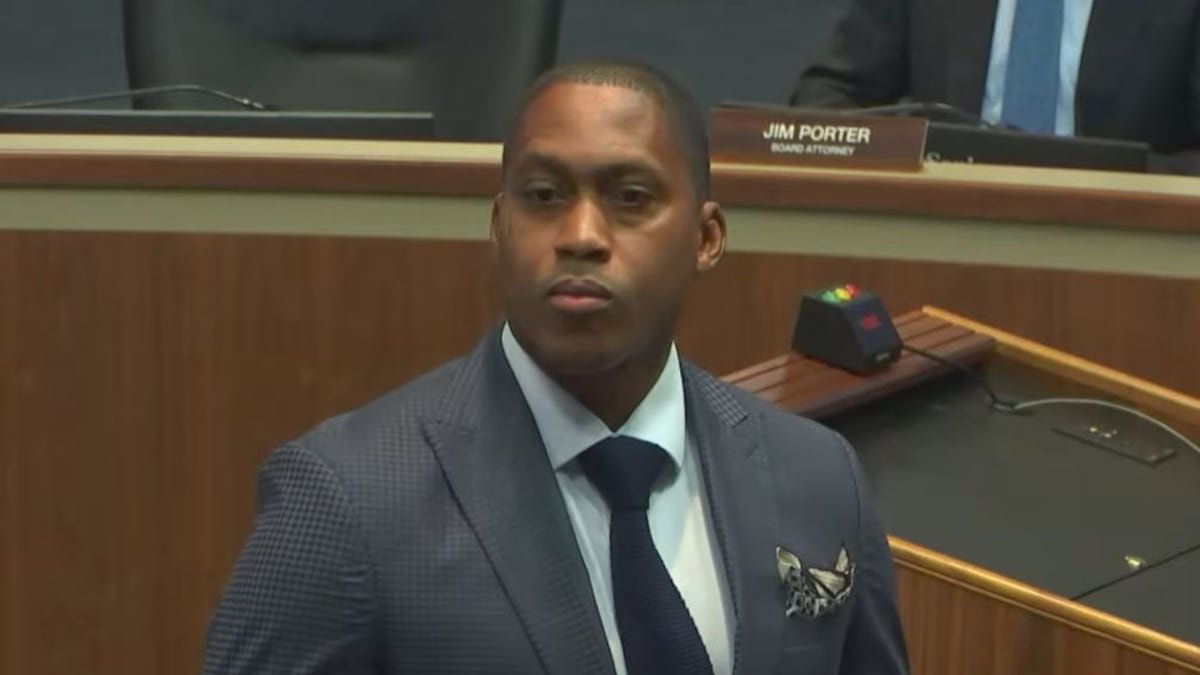
How does a disgraced former cop, tainted by an academic cheating scandal, go on to become the chief of security for one of the nation’s largest school districts?
For Anthony Collins, the answer appears to be rooted in deep ties to powerful community leaders and public officials, who were instrumental in keeping public scrutiny of his candidacy quiet while ensuring he got the job.
Hillsborough Schools Superintendent Van Ayres announced Tuesday that he’d selected Collins for the high-level position overseeing security and emergency management for the county’s more than 300 school facilities.
Ayres, introducing Collins in Tuesday’s school board meeting, called him a “highly respected law enforcement executive,” noting his more than two decades of experience with the sheriff’s office, including a stint as chief deputy. He did not mention that Collins’ service ended amid an investigation into claims that he’d paid someone to complete academic coursework for him while attending the prestigious FBI National Academy.
Given Collins’ high-profile and controversial exit from the sheriff’s office — and the abundance of available talent and experience — why would Ayres select him over 37 others who applied?
District officials did not respond to a request to interview Ayres about his decision. Ayres did not respond to a phone call or a text message seeking comment Friday.
But records the district released after the school board meeting — months after the Tampa Bay Times first requested them — show that Collins’ apparent edge came on the words of community leaders, several of whom wrote him glowing letters of recommendation.
Absent from the stack are words from Hillsborough County Sheriff Chad Chronister. He has not spoken publicly about Collins’ appointment, despite multiple requests for comment. But the sheriff’s office acknowledged he and Collins met privately in February.
Collins beat out several other former high-level cops. His salary for the job was not yet clear.
Although the superintendent appoints the district’s chiefs without input from the school board, none of the board members voiced concerns about Collins when they met. (Member Stacy Hahn and chairperson Karen Perez did not attend.)
Four of the seven board members either declined to comment publicly or did not respond to calls from the Times afterward.
Board member Lynn Gray said she wondered if the allegations would make Collins’ start difficult.
“I think he’s going to have to work on relationships, and I guess the one word is ‘trust,’” she said. “Our communities make our schools, and our schools make our community, so I hope that the community embraces him.”
Nadia Combs, the board’s vice chairperson, said she saw the security chief as the district’s most important role. Collins’ community support was significant, she said, but even more essential was his experience. She said she didn’t doubt Ayres considered “some of the personal challenges.”
“What makes me feel good about the process is that they took a long time looking for the person,” Combs said. “They did a national search. The position was marketed for so long. The process had multiple rounds of interviews.”
Board member Jessica Vaughn, in a statement, emphasized that the superintendent hires his Cabinet without a vote from the board. She said her top priority is to keep students safe.
“If Superintendent Ayers is willing to take the heat because he believes Mr. Collins is the best person to do that, then I have no choice but to trust that he made the right decision,” Vaughn said. “That’s what we hire him to do. I wish it wasn’t overshadowed by accusations of cheating, but again, I don’t have any input on the decision.”
How to overcome a scandal
The academic cheating allegations that precipitated Collins’ resignation last year were documented in a Hillsborough sheriff’s internal affairs investigation, first reported by the Times.
The report detailed allegations his wife made in emails to his colleagues that Collins enlisted a man named Robert Roush to complete his academic assignments while attending the prestigious FBI National Academy over 10 weeks in 2021. She attached screenshots of emails the men exchanged in which they appear to discuss assignments.
Their discussion at times appeared to be more of a collaboration than a traditional student-tutor relationship. Some messages appeared to show Roush sending attachments that included Collins’ class assignments. In one message, Roush wrote, “Here is our paper.”
When an investigator later interviewed Alexandra Collins in person, she claimed her husband had also paid Roush to complete assignments while Collins was attending Saint Leo University, where he received a master’s degree in criminal justice in 2018.
Whether that’s true is uncertain. The sheriff’s office investigation ended abruptly when Collins resigned.
In statements to the Times, Collins denied Roush wrote his assignments for him, saying he’d merely provided tutoring, editing and proofreading help. He stood by that explanation this week in a brief interview after the board meeting.
Chronister previously called that explanation a lie. He said Collins admitted to him that Roush wrote half his assignments at the FBI National Academy.

Subsequent reporting by the Times revealed that several other members of Chronister’s command staff had contact with Roush about academic and work-related assignments. The revelations led to the resignation and firing of five high-level commanders.
After Collins left the sheriff’s office, he went to work as a lobbyist for the Finley Group, a Tampa firm that focuses on federal lobbying on an array of issues, including defense, transportation and technology.
Collins’ biography on the firm’s website describes him as a “seasoned public affairs strategist and former law enforcement executive” with decades of experience “navigating complex government systems, building bipartisan relationships and building policy solutions that strengthen communities and enhance public safety.” The bio mentions his work with the sheriff’s office and that he is a graduate of the FBI National Academy.
His application states that he started with Finley in January and left in March. He completed his application for the school district job in early February.
He listed nine personal references, among them Tampa Mayor Jane Castor, Fire Chief Barbara Tripp, Temple Terrace Mayor Andy Ross, Hillsborough County Commissioner Gwen Myers and Hillsborough NAACP President Yvette Lewis.
Not long after Collins applied, he met privately with Chronister and Undersheriff Thomas St. John. The sheriff’s office confirmed the meeting happened in February but declined to say what transpired, calling it a “private discussion.”
Collins, likewise, declined to elaborate. “There is nothing that I need to divulge statutorily,” he said Tuesday.
Other local leaders began penning their letters of recommendation for Collins in February. They frequently mentioned his decades of service and leadership roles. None mentioned the scandal or circumstances clouding his departure from the sheriff’s office.
“He understands the importance of safe learning environments where students and educators can thrive,” wrote Plant City Mayor Nate Kilton.
“His advanced education in critical incident management and specialized training reflects a leader committed to continuous learning,” wrote State Rep. Danny Alvarez, a former high-level sheriff’s office employee and a close ally of Chronister’s. “His experience and education have taught him when to rely on protocol and when to adapt, and how to maintain security without sacrificing the educational environment.”
None of the recommendation letters released by the district were written by active law enforcement officers.
One person who did comment was Hillsborough State Attorney Suzy Lopez. Her chief of staff, Gary Weisman, a quiet but powerful player in local politics, was among Collins’ list of references.
Lopez, who added Collins to her office’s list of law enforcement officers who require a special disclosure if they surface as witnesses in court, was among Collins’ supporters at Tuesday’s meeting. She said afterward she had no concerns about his integrity.
“He was chosen because he is the most qualified person,” she said Tuesday. “That absolutely goes without saying.”
Other candidates had experience, talent
Among the other applicants for the job was former Hillsborough sheriff’s Col. Chris Rule, who likewise resigned last year after he was found to have emailed Roush about assignments for a senior leadership class through the Florida Department of Law Enforcement.
Unlike Collins, Rule did not advance beyond the first round of job interviews, the applicant list shows.
Collins was one of five finalists, district officials said. He was one of two who made it beyond a second interview.
The other top contender was Kert Rojka, a former Tampa police captain who retired in 2025 after 30 years with the agency. The bulk of his experience was in the police department’s school resource unit.
Promoted to captain in 2022, Rojka oversaw more than 100 police officers and 10 civilian personnel and managed an $8 million budget. He served as an acting major for several months in 2024. His community involvement includes service on the 13th Judicial Circuit’s Juvenile Justice Advisory Board and on the board of the Children’s Network of Hillsborough County.
Three other finalists already worked for the school district.
Elias Vazquez, a lieutenant in the department of security and emergency management, previously served as an assistant chief for the Tampa Police Department. He’s worked in law enforcement since 1988.
In 2023, he took a job as the police chief for the city of Reading, Pennsylvania, touting a 32% drop in crime during his two years there. His resume boasted service on the Tampa Mayor’s Hispanic Advisory Council, the Human Rights Board, Big Brothers Big Sisters and various policing associations.
Eric Collins, who is not related to Anthony Collins, has worked in the school district’s security department since 2019. As a school resource sergeant, he touted experience working with school administrators, teachers and students to promote safety and community trust.
Zamir Ode, a major in the department of security and emergency management, is a reserve sheriff’s deputy and Air Force veteran. He’s worked for the district since 1993, including stints as a school resource officer, criminal justice instructor and Professional Standards investigator. Since 2007, he’s overseen security and emergency management personnel across the district and served as acting head of security when the chief was away.
Hillsborough schools spokesperson Tanya Arja said in a statement that Anthony Collins “distinguished himself throughout a highly competitive national search process.”
“As a seasoned veteran of the Hillsborough County Sheriff’s Office, he brings both experience and a clear, thoughtful vision centered on maintaining safe and secure learning environments,” Arja wrote.
She noted Collins’ leadership experience, including roles overseeing large-scale security operations and school resource deputies, and highlighted the recommendations he received.
“We are grateful that he chose to apply and are confident that his leadership and experience align with our district’s needs,” Arja said.
A process kept secret
Word first circulated in the local law enforcement community in February that Collins had applied for the school security job. That month, the Times made a public records request for his application. A second request followed in April for the list of others who’d applied.
The district did not immediately turn over the records. When the Times followed up, district officials did not provide the records but said the interview process was ongoing.
As word spread May 20 that Collins had the job, the Times again followed up. Arja responded in a single-line email that they were still conducting interviews.
Collins’ name was not on the agenda for Tuesday’s regular school board meeting. Yet it was clear that many people knew beforehand that his hire would be announced.
Cheers erupted among a crowd of supporters as Ayres read his name.
Immediately afterward, the school district released printed copies of Collins’ resume and application for the job.
The apparent secrecy circumvented any public discussion or resistance that may have arisen about Collins’ hire.
The more than three months that elapsed between the Times’ request and the school district’s compliance were “far too long,” said David Cuillier, director of the Freedom of Information Project at the University of Florida. Such delays, he said, violate the law. Yet they are not uncommon.
Across the state, Cuillier said, records requests from citizens of all stripes are often ignored, delayed or met with exorbitant fees for processing.
“Florida used to be a really good state for government transparency,” Cuillier said. “Unfortunately, that’s not the case anymore. Our data shows Florida is one of the most secretive states in the country now.”
State Rep. Alex Andrade last year sponsored a bill that aimed to reform public records. Born out of stymied efforts to obtain records in the Hope Florida investigation, the bill would have required government agencies to respond to public records requests within three days by either releasing the records, explaining why they need more time or giving a time when they will be available.
The bill passed the House of Representatives unanimously. But a similar bill died in the Senate.
Bobby Block, the director of the First Amendment Foundation, said there is growing concern that the state’s public records laws are languishing.
“We all know from history that secret government does not aid the public,” Block said. “What it does aid is corruption and malfeasance.”



