
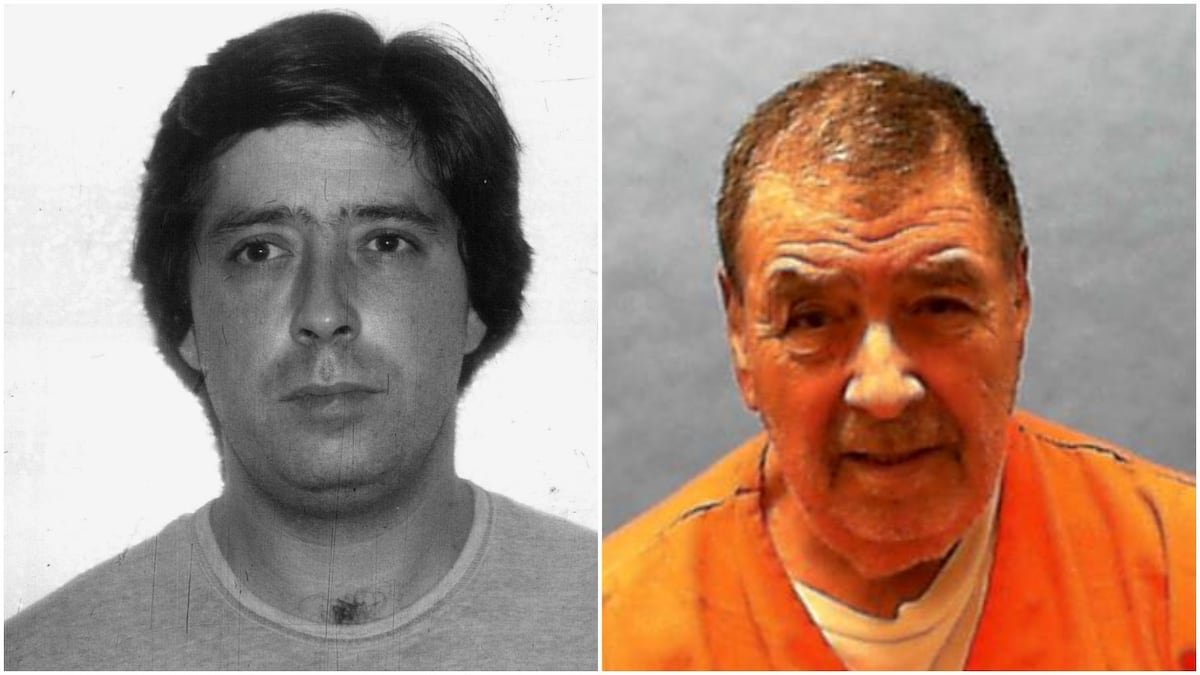
On Sundays, the adults hung homemade spaghetti from a kitchen clothesline to dry while the kids played in the yard. Men were served dinner first. Dominick Occhicone, the family patriarch, sat at the head of the table.
It was 1965, and the three-generation Catholic-Italian family lived in neighboring homes on a tree-lined block of rural Carmel, New York.
Occhicone, a well-respected city sanitation worker who immigrated from Italy, had three daughters and one son, who bore the same name.
On Tuesday, that son, Dominick Occhicone II, will become the oldest inmate put to death in Florida for the murders of his ex-fiancee’s parents. He turns 81 next month.
For the first time in modern history, Florida plans to execute another inmate the same day — a dramatic escalation in the state’s use of capital punishment.
Though the pace of executions has accelerated, legal proceedings for death row inmates tend to drag on for decades before an inmate becomes eligible for a death warrant.
In the 40 years Occhicone II has sat on death row, all of the Pasco County jurors who convicted him have died. His father and older sisters have, too. Lawyers arguing a final time to save him say executing a man his age would be “cruel and unjust.“
Long before Occhicone II headed to death row, his family says, they recognized a simmering rage — one that, like his name, was later passed down to his only son, now incarcerated as his father faces lethal injection.
‘He was a time bomb’
Lori Canfield called him “Uncle Jr.” She was born when Occhicone II was 14 years old.
She has vivid memories of her uncle fighting with other teenagers in the driveway, of his temper exploding at family gatherings.
Canfield’s parents, she said, would bet on how many stitches Occhicone II would come home with after brawling at the bar.
When she was 7 or 8, police cars swarmed the block. Occhicone II had failed to report for military service for the Vietnam War. She remembers the whole family driving to the military prison in Fort Dix, New Jersey, for the two years he was incarcerated.
Canfield, 66, said Occhicone II was a stark contrast from his father, who was soft-spoken, doted on his children and grandchildren, and never kept hard liquor in the house.
In 1977, Canfield and her parents moved to Florida, following the elder Occhicone and his wife in their retirement. Her uncle joined them.
In Holiday, Occhicone II met a woman named Sharon, and they had a son. Sharon died of cancer when Dominick Occhiccone III was 2 years old.
Soon after, Occhicone II met Anita Gerrety at a bar.
The pair entered a tumultuous four-year relationship rife with arguments, infidelity and violence, Canfield said. For a time, they had a wedding date set.
“No one trusted him,” Canfield said. “We knew he was a time bomb, but no one cared.”
Occhicone III, then 5, would stay with Canfield and her parents or grandparents while his father spent days and nights at the bar. Sometimes, he took his son with him, court records show.
His alcoholism worsened after Gerrety ended their engagement, his niece said. Occhicone II blamed the split on her parents, who didn’t approve of him.
Canfield said she’d warned Gerrety to stay away from her uncle when they first started dating. (Gerrety did not respond to interview requests.)
On June 10, 1986, Occhicone II, then 40, showed up at Gerrety’s parents’ home in the middle of the night and knocked on his ex’s window. She told him to go away. At 4 a.m., he came back with a gun.
He disabled the home’s phone lines, then pounded on doors and windows, according to court records. Gerrety woke her father. Raymond Artzner, wielding a broomstick, confronted him outside the garage. Occhicone II shot and killed him.
As Gerrety and her 10-year-old daughter fled, Occhicone II broke through a locked door. Inside, he shot Gerrety’s mother, Martha Artzner, four times.

His brown 1976 Corvette had a smoking battery, so he took off on foot, according to a police report. A sheriff’s office K-9 followed, and deputies arrested him. The gun was found a few days later by a 14-year-old boy mowing a neighboring lawn.
Canfield remembers getting a call from neighbors asking where “Little Dominick” was, worried that the killer’s son had witnessed the shooting. That’s how she and her family learned what happened. (The boy was with Canfield’s mother.)
A jury convicted Occhicone II in 1987. They voted 7-5 in favor of the death penalty. Such a vote today would result in life in prison; current Florida law requires a minimum of eight votes for a death sentence to be imposed.
A judge imposed a life sentence for Raymond Artzner’s murder and a death sentence for Martha Artzner’s.
Canfield believes the death penalty is appropriate. Still, she says, she wouldn’t be able to watch her uncle die.
“I loved him, he was my uncle,” she said, her voice breaking. “But what he did was unspeakable. To me, he died 40 years ago.”
He told bartenders his plans
During the trial in September 1987, five bartenders testified that Occhicone II had told them he wanted to kill Gerrety’s parents.
“He said he felt like shooting her father and making her watch, and her mother and making her watch, and shooting her kids and making her watch,” one bartender said. “He said he wanted to make her suffer by making her watch.”
The same bartender described how Occhicone II would frequent Shooter’s Bar in Elfers seven days a week. He would come in when the doors opened at 7 a.m. and knock back 10 to 15 vodka drinks before 11 a.m.
His disdain for Gerrety’s parents “seemed to be his favorite topic,” another bartender said at the trial.
“He said to me that he wanted to get back at her,” the bartender said. “But he didn’t want to kill her, he just wanted to wound her for life.”
The owner of Shooter’s, who died in 2019, testified that they had a memorable conversation about two weeks before the shooting.
“He said to me: ‘Maybe I should just blow them away,’” he said. “Well, he seemed serious, you know. I like Dominick and we became, I think, pretty close friends, and I said: ‘Dominick, you know, don’t talk like that, that’s crazy.’”
When Gerrety took the stand, she told jurors she’d “had enough of Dominick’s temper.” She described how he “threw my son up against a wall” and “smacked me a few times.” She stopped living with him, she said, after he kicked in a locked bedroom door and “came at me with a knife.”
About nine months before her parents’ murders, Gerrety went to his house to tell Occhicone II she wanted to break things off.
“When I tried to leave, Dominick smacked me upside the head, almost knocked me out,” she told the court. “As I was walking through the garage I heard a gun cock behind my head. When I stopped and turned around, he was pointing the gun at me.”
She went back inside at his instruction. She said she accused him of having a fake gun, and then he shot at the floor and the doorjamb.
As they argued, she said, he tried to hand her the gun to shoot him. She refused.
She testified that he tied her to the bed, handcuffed her and placed a noose around her neck. He taped her mouth shut.
Then, he told her that he had shot and killed his son, and the body was in his closet. She said she realized he was lying when he placed a bundle of pillows wrapped in a bedspread atop her.
He eventually untied her, she said, and they slept together before he let her drive home.
“As long as he had that loaded gun, I did whatever he asked that night,” she said.
When it came time for the state to rest its case, the attorneys had a private conversation with the judge in which the defense lawyers shared how they wanted to proceed.
They planned to argue that Occhicone II could not form the intent to murder the Artzners because of his alcoholism and suicidal tendencies. Four doctors were scheduled to testify.
Prosecutors sought to exclude the witnesses, but Judge Lawrence Keough allowed the defense to move forward.
When Keough asked defense attorney Bruce Boyer if he was ready to go, he responded, “No, defense is going to rest.”
“Say again?” the judge asked.
“The defense is going to rest.”
“Well, well,” Keough responded. “It’s not whether I like it or not, it’s surprising.”
The only testimony about the defendant’s state of mind came during the penalty phase, when jurors were tasked with deciding whether Occhicone II would spend life in prison or be sentenced to die.
Donald DelBeato, a clinical forensic psychologist, said Occhicone II was “in the throes of a disorganized and immature grief response” to the breakup.
“The way he drank and the way he lived his life was about as potent an instrument of self-destructing as you can get without blowing your brains out with a gun,” he said.
During the trial, one of the bartenders said Occhicone II and Gerrety had a special song.
The night of the murders, he went into Shooter’s and put money in the jukebox.
“Sad Songs (Say So Much)” by Elton John filled the air. When it ended, he asked the bartender to play it again.
And it feels so good to hurt so bad
And suffer just enough to sing the blues
So turn ‘em on, turn ‘em on
Turn on those sad songs
2 families forever altered
When Occhicone II went to death row, his aging father was beside himself.
Canfield said her grandfather made the family visit Occhicone II until the patriarch died a few years later.
She remembers the frightening clanging of the prison doors and being patted down by officers. They would sit with Occhicone II in a bleak room with metal picnic tables drilled into the ground. One time, she recalled, they sat next to Ted Bundy.
Canfield’s parents had taken in Occhicone III. The 6-year-old struggled to understand what had happened to his father. He had trouble in school and was bullied when newspaper articles about his dad surfaced, Canfield said.
He later developed aggressive tendencies and turned to alcohol and drugs, Canfield said. His criminal history, dating to the early 2000s, includes charges of burglary, obscene phone calls and probation violations, records show.
Four days after Gov. Ron DeSantis signed the death warrant for Occhicone II, his son faced a judge in Pasco County. He pleaded guilty to felony charges for the false imprisonment and battery of his girlfriend and was sentenced to 46 months in prison, where he will be when his father is executed.
Canfield attributes Occhicone III’s early childhood to how he turned out.
“His father didn’t raise him, but he became his father,” she said.
A 55-year-old New Port Richey woman is uniquely familiar with Occhicone II and his son. Fifteen years ago, she found out Occhicone II was her biological father.
The accidental admission from her mother — who had a brief relationship with Occhicone II in New York in the 1970s — brought feelings of anger and hurt, then eventually, relief to understand her origin.
The Tampa Bay Times is not naming her because she keeps her identity as Occhicone II’s daughter private.
She developed a relationship with her half-brother, who lived nearby, and took a trip to Florida State Prison to meet her father.
“I’m a murderer’s daughter, and I don’t even know how to describe how that made me feel,” she said. “But sitting and talking with him, I just felt sorry for him. I saw past the crime.”
Over the years, she said he’s sent her birthday and Christmas cards. He tells her stories about his life and the family members she’s never met. She’s taken her adult daughter to visit him, and the three play card games.
She said her father has spoken a lot about the grip alcohol and drugs had on him, and how he doesn’t fully remember the night of the murders. She visited him this week and plans to return Monday to say goodbye.
At 6 p.m. Tuesday, Occhicone II will be strapped to a gurney at Florida State Prison near Starke. An IV in his arm will deliver a three-drug injection to render him unconscious, then stop his heart.
Though she used to support the death penalty, his daughter said, she doesn’t anymore.
She said her half-brother told her from jail that he doesn’t know how to feel about their father being executed. “Tell him I love him,” she said he told her.
Canfield and Occhicone II’s daughter both live with the pain that comes with being tied to someone on death row.
“There are two sides of families hurting,” the daughter said.
“He destroyed two families that day,” Canfield said.



