
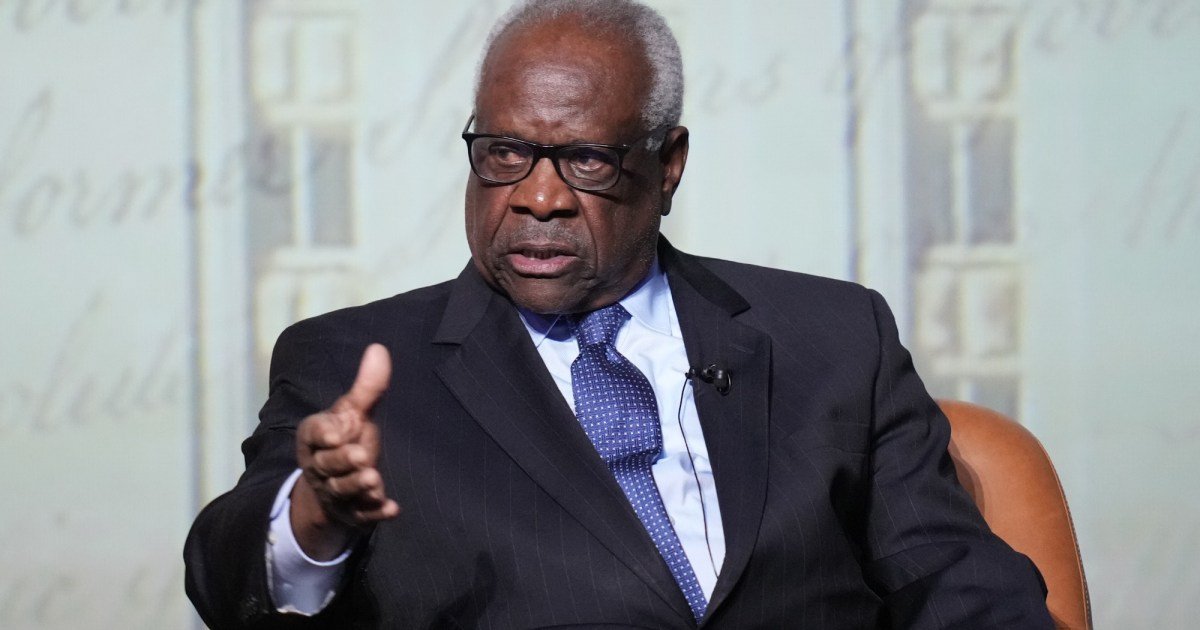
Thomas speaking at the University of Texas on April 15.Eric Gay/AP
Supreme Court Justice Clarence Thomas should be feeling optimistic. He’s a member of the 6-3 Republican-appointed majority on the highest court that is rapidly reshaping American law in a way Thomas has always wanted. To name a few of his recent victories, Thomas and his colleagues have ended the constitutional right to abortion, banned affirmative action in higher education, helped Donald Trump return to the White House, and this term are expected to toss out what’s left of the 1965 Voting Rights Act. For a reactionary like Thomas, things are going very well.
And yet, Thomas is worried. Maybe even mad. In a radical speech that drew headlines for its thinly-veiled animosity toward his fellow judges, fellow conservatives, and political opponents to his left, Thomas warned that the nation’s founding ethos that “all men are created equal” is under threat. His remarks, delivered at the University of Texas at Austin this week, pit the ideals of the Declaration of Independence against the scourge of “progressivism.” As Thomas warned, “It is not possible for the two to coexist forever.”
Press reports were rightly attuned to Thomas’ incendiary rhetoric and the fact that this was no ordinary speech for a Supreme Court justice. But the quick dispatches missed the critical historic and legal context of Thomas’ remarks—and just what they may foreshadow.
Thomas goes further than attacking agencies as undemocratic—to him, they are contrary to God.
Thomas’ speech, pegged to this year’s 250th anniversary of the Declaration of Independence, comes in three parts. First, Thomas framed the revolutionary document as evidence that American law is not grounded in a legal text but rather comes from a higher power: that people’s equality is “endowed by their Creator” and that their “unalienable” rights come from God. “The Constitution is the means of government,” Thomas said. “It is the Declaration that announces the ends of government.”
This is nothing new from Thomas, who has been a fan of this “natural law” theory—the idea that there’s a superior moral code through which the Constitution must be interpreted—for decades. The danger in this theological approach is that an adherent might replace the dictates of a statute or the Constitution with his theologically-informed preference. At Thomas’s confirmation hearing in 1991, then-Sen. Joe Biden pressed the nominee on his many endorsements of natural law theory. At the time, liberals and Democrats were most worried that Thomas would use a natural law approach to overturn Roe v. Wade. “I don’t see a role for the use of natural law in constitutional adjudication,” Thomas swore in the hearings.
Today, he’s no longer downplaying the theory. “Justice Thomas is engaging in some strong natural law thinking,” says Andrea Katz, a professor at Washington University School of Law. “In fact, it’s close to theology on the bench.”
Next, Thomas’ speech warns that Washington is full of people who pay “lip service” to conservative principles—“claiming a commitment to some righteous cause, to traditional morality, to national defense, to free enterprise, to religious piety, or to the original meaning of the Constitution”—but who falter in upholding those convictions. His screed against these right-leaning Judases is long, as he slams them for fearing criticism, exalting in flattery, and ultimately choosing to conform. “They water down their message, negotiate against themselves, vote against their principles, and hide in the tall grass,” he said. “They recast themselves as institutionalists, pragmatists, or thoughtful moderates, all as a way of justifying their failures to themselves, their consciences and their country.” Without devotion to our founding principles, which he has cast as the natural law that reigns over the Constitution, our nation is in peril.
Third, Thomas identifies what he sees as threatening the Declaration of Independence’s promise of equality. The answer is progressivism. But the furor over his remarks didn’t capture the nuance of who exactly Thomas was talking about and what he was really driving at. He wasn’t merely talking about today’s progressives as the political opponents of conservatives; he was talking about a rightwing fringe theory that the early 20th century’s Progressive Era ushered in an unconstitutional change in our government that must be rooted out.
Thomas’ grudge goes back to the late 19th and early 20th centuries when, as the nation’s economy and infrastructure became more advanced, Congress created new agencies to help manage modern American life. In 1913 and 1914, respectively, Federal Reserve Board to stabilize the banking system and the Federal Trade Commission were established to enforce anti-trust laws. During the New Deal era, Congress and President Franklin Roosevelt’s administration responded to the urgencies of the Great Depression with new agencies to modernize government and tackle the problems highlighted by the crisis, including the Federal Deposit Insurance Commission, Securities and Exchange Commission, National Labor Relations Board, and the Federal Communications Commission. This is a partial list, but they are all independent agencies, which Congress attempted to insulate from presidential control by placing them in the hands of bipartisan boards whose members can only be fired by the president for good reason.
The conservative legal movement has long been opposed to these agencies. With the notable exception of the Federal Reserve Board, which they concede is essential to the stability of the economy, far-right judges and academics decry such agencies as an unaccountable “fourth branch” of government. More broadly, the right looks skeptically on all agencies, even those that are not technically independent from the president, as an undemocratic administrative state.
Perhaps Thomas’ mood is because he thinks other GOP-appointees are chickening out.
One radical theory, affiliated with Columbia University law professor Philip Hamburger, is that the administrative state is un-American and therefore unconstitutional. According to this narrative, President Woodrow Wilson, in the thrall of German-style bureaucratic managementand opposed to democracy, fought for an administrative state to hijack the government and ignore the will of the people. “The Germanic trope is the fever dream of right wing members of the conservative legal movement who want to discredit the modern administrative state,” Nicholas Bagley, a professor of administrative law at the University of Michigan, told me in 2024; by that point the theory had wound its way from conservative books, blogs, and conferences to form the basis of an appeals court opinion. The “Germanic trope” ignores the fact that independent agencies were actually created in the United States’ earliest years, establishing plenty of American antecedents for today’s agencies.
Yet in Austin, Thomas clearly embraced this theory. “Progressivism was not native to America,” he argued. “Wilson and the progressives candidly admitted that they took it from Otto von Bismarck’s Germany.” But Thomas goes further than saying agencies are undemocratic—to him, they are contrary to God. He argues that the progressive vision of an administrative state transforms our system of government from one dedicated to unalienable rights of individuals to one where the government and its administrators are supreme: “Progressivism seeks to replace the basic premises of the Declaration of Independence and hence our form of government… It holds that our rights and our dignities come not from God but from government. It requires of the people a subservience and weakness incompatible with a constitution premised on the transcendent origin of our rights.”
This is not normal. The idea that all people have inherent dignity is not incompatible with, say, a functioning Federal Trade Commission. Nor does the Constitution anywhere state that its prescriptions are based on theological conviction. “This critique is denying the premise of a written constitution,” says Katz. “Our rights come from our Constitution. They don’t come from God. That’s the premise of the US Constitution; we have to write down the rights that we have. That’s quite a statement from a judge whose job is to enforce the text.”
It’s impossible to know why Thomas sounded so stern this week. Perhaps this speech was something he’s been mulling for a long time. But there’s a chance that it reflects a current frustration with his colleagues. Right now the court is deliberating a case, Trump v. Slaughter, on the constitutionality of independent agencies. The court appears poised to strike down a seminal 1935 precedent that upheld the independence of these Progressive and New Deal era agencies. Why is Thomas so upset at the Progressive Era’s staying power and the conservative cowards who don’t live up to their promises if the court is about to strike a fatal blow to the administrative state?
Perhaps Thomas’ mood is linked to the possibility that he thinks his fellow GOP-appointees are chickening out. Based on the court’s recent actions and the oral arguments in Slaughter, it’s highly unlikely that Humphrey’s Executor will stand. But it is quite possible that the justices are crafting a compromise by which some agencies may remain independent. This almost certainly includes the Federal Reserve Board. And it may mean that rather than ending independence in one fell swoop, the justices will decide other agencies may qualify for independence from presidential control, possibly on a case by case basis.
Such a ruling would not be a victory for progressivism, good government, or democracy. But for Thomas, it would nonetheless be proof that his conservative colleagues had fallen short. His holy war, perhaps, is not yet won.



