
Published April 20, 2026 06:00AM
These triathletes remind us of …
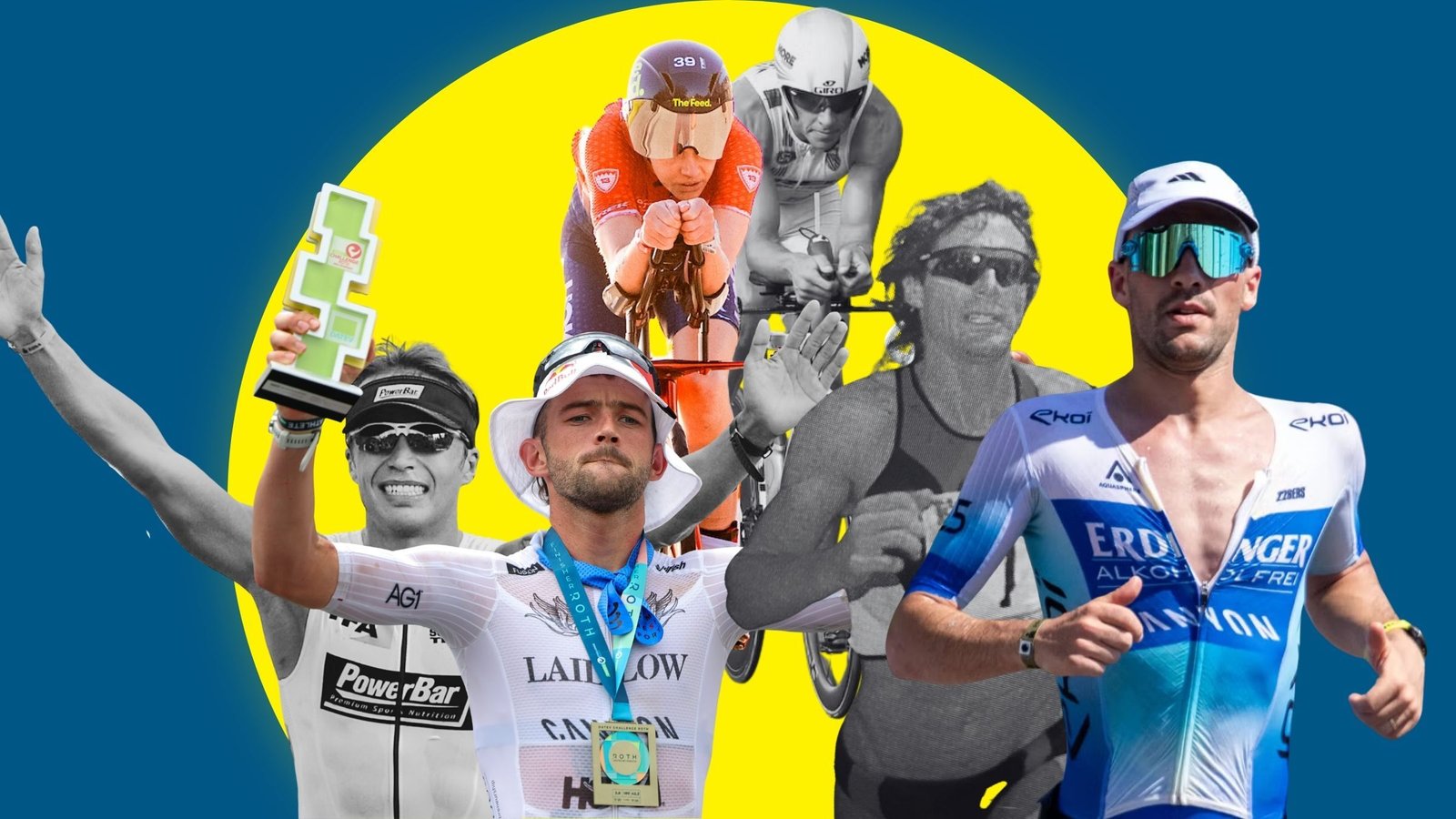
Whenever you watch a triathlete demolish a bike course, unleash a big finishing kick, or sit in a pack with the cool certainty of someone who already knows how this will end, there’s always that, “Gee, this reminds me of someone.” It’s a natural impulse, even if not always a fair one.
Simple comparisons can flatten complex personalities into single traits, compress decades into soundbites, and often compare athletes who are still writing their stories to those who can look back on a long and successful career. The great athletes of the past didn’t just have a signature weapon – they had a whole career’s worth of wrong turns, breakthroughs, and accumulated wisdom, but are often reduced over time to a single iconic moment rather than the decade of hard work behind it. A long-term view is crucial for legends-in-the-making who don’t yet own a headline – triathlon and especially the Ironman World Championship have made their legends wait.
Mark Allen (USA) attempted the race six times before finally breaking through in 1989; Chris McCormack (AUS) endured a humbling 59th place, two DNFs, and four attempts before his bravado finally met reality with a title in 2007; even Lucy Charles-Barclay (GBR) stood on that runner-up podium four times before the win finally came in 2023.
For athletes still racing, a missing highlight can be “not yet” rather than “never.” With that warning firmly in place and occasionally (cheerfully, for our amusement) ignored, here are 11 athletes racing in 2026 who send us back to the record books to find a twin. And in one case, we have an athlete who forces us to admit that the record books don’t quite have an answer.
#1 Patrick Lange & Mark Allen
When you talk about active triathletes who remind you of the sport’s all-time greats, Patrick Lange (DEU) is the only place to start – because in one crucial sense, he already is one. Three Ironman World Championship titles (2017, 2018, 2024) make him the only currently active athlete to have won multiple titles on the Big Island.
Comparing today’s field to Paula Newby-Fraser’s (ZWE) eight wins, Natascha Badmann’s (CHE) six, or Chrissie Wellington’s (GBR) four feels like a stretch too far – but Lange? He earns his seat at that table.
And sure, the Dave Scott (USA) echo is hard to miss: Like the six-time champion, Lange has an uncanny ability to race Kona at his very best regardless of what the rest of his season looked like. But the Allen comparison is unmistakable: Allen owned the Kona run course record for more than 25 years until Lange broke it in 2016 and then the German came back the next year to win the whole thing. Patient, calculated, and then absolutely lethal when the lava fields heat up, Lange races like he’s read every page of Allen’s playbook – and then updated it for today’s racing.
#2 Kat Matthews & Andreas Raelert

Andreas Raelert’s (DEU) career is defined by how close he came to winning the Ironman World Championship. Some careers are built on titles; his is defined by near-misses: five Kona podiums in seven years, three runner-up finishes, a decade of excellence on the Big Island – and not a single winner’s lei to show for it.
None of those near-misses stung more than 2010, when he closed the gap to McCormack on the marathon, and they ran shoulder-to-shoulder after the Energy Lab, a race instantly dubbed the Iron War of the 21st century. In the final miles, Macca found another gear to pull away from Raelert, winning by less than two minutes.
A generation later, Kat Matthews (GBR) is writing a strikingly similar chapter. In 2025, she ran a course-record marathon of 2:47 in sweltering Kona heat, hauling back over 14 minutes only to see Solveig Løvseth (NOR) take the tape just 35 seconds ahead of her. This was the second-closest finish in women’s Kona history and even closer than Raelert’s agonizing 2010 defeat.
Matthews’ second places at the Ironman World Championship in St. George (2022) and Nice (2024), plus consecutive runner-up finishes at 70.3 worlds in 2023 and 2024, paint a portrait of sustained excellence. And still: A Kona win for her feels increasingly inevitable.
#3 Taylor Knibb & Chris Lieto

Chris Lieto (USA) was, for a time, the most feared cyclist in Ironman racing. He would exit T2 with a lead so enormous it looked like theft, all too aware that the faster runners would come for him. At Ironman Canada 2005 he broke Thomas Hellriegel’s (DEU) nine-year-old bike course record on his way to the win, admitting afterward he “paid for it on the run” but still held on to break the tape.
In Kona 2009, his best performance came agonizingly close: He led by over five minutes off the bike, ran elbow-to-elbow with Craig Alexander (AUS) deep into the marathon, only for Crowie to finally pull away at mile 21 and win by two minutes. A 70.3 worlds runner-up in 2011 rounded out his career highlights, but Kona always had the final word.
Taylor Knibb (USA) is writing a strikingly similar story on the bike, but obviously with bigger titles already banked. Three consecutive 70.3 World Championship crowns, an undefeated T100 season in 2024, and a 4:19:46 bike split at Ironman Texas 2025 – the fastest women’s bike leg in Ironman history – announce her as something the sport hasn’t seen before.
In Kona 2025, she led on the bike, only for the brutal Hawaiian heat to claim her dramatically in the closing miles. But here is where the Lieto comparison earns an important caveat: Knibb is still learning the distance while Lieto never quite cracked the code. The smart money says Knibb still will.
#4 Magnus Ditlev & Torbjørn Sindballe

When Denmark produces a top triathlete, it apparently goes all in on the bike. Torbjørn Sindballe, nicknamed “Thunderbear,” stood 6-feet-3-inches and approached racing with the legs of a locomotive and the mind of a scientist.
In 2005, he broke Hellriegel’s nine-year-old Kona bike course record with a 4:21, only to walk the last 11 miles of the marathon and finish 48th. Undeterred, he analyzed his heat problem, estimating that he loses at least 10 minutes on the run due to Kona’s humidity.
Racing in 2007, he wore a long-sleeved white top to maximize cooling by evaporation, and he ran the marathon with a surgical glove packed with ice to trick his body into feeling not as hot. The result was a career-best third-place finish. A congenital heart condition forced him into retirement in 2009, leaving that Kona win out of reach.
Magnus Ditlev is Denmark’s next great cycling phenomenon, and probably a more complete athlete than Sindballe had the chance to become. Ditlev already has three consecutive Challenge Roth titles, with course records in 2023 and 2024 that rewrote what was thought possible at the iron distance. At Kona 2024 he dragged himself from a near-DNF in T2, sitting in transition for four minutes, convinced his race was over, to finish second in one of the gutsiest performances the sport has seen. Illness denied him a good result in Nice 2025, but Ditlev is working hard for his Kona moment still to come.
#5 Sam Laidlow & Normann Stadler

Normann Stadler (DEU), nicknamed “The Norminator,” wrote one of Kona’s most compelling “uber-biker” storylines across the mid-2000s. He podiumed in 2000 and finished fourth in both 2001 and 2003. The 2004 race saw a day of savage 30 mph winds, and Stadler simply rode away from the rest of the field, building a 24-minute lead into T2 to claim his first title.
In 2005, Stadler’s defense famously unraveled in the lava fields in one of Kona’s most memorable meltdowns. Underestimated again in 2006, he set a new bike course record of 4:18:23 and won his second title by just over a minute, winning the mind-duel with a furious Macca.
Sam Laidlow (FRA) seems to be cut from the same cloth. After leading on the bike but getting caught by Gustav Iden (NOR) in the final miles of the marathon in Kona 2022, the Frenchman regrouped and won the 2023 Ironman World Championship in Nice on the back of another stunning bike leg. He raced Kona in 2024, going even harder and posting a jaw-dropping 3:57:22 bike split – a new Kona course record – only for the run to unravel spectacularly as Patrick Lange hunted him down and erased a nine-minute deficit.
The Kona blueprint has not changed since Stadler’s era: The bike can put you in a great position, but it cannot finish the job alone. Laidlow has learned this the hard way. Does he have the resilience, like Stadler, to come back, get the balance right, and win Kona in 2026?
#6 Laura Philipp & Lori Bowden

An Ironman can’t be won in the swim, but plenty of athletes have lost one in the first leg. Lori Bowden (CAN) spent her entire career refusing to be one of them. The two-time Kona champion (1999 and 2003) absorbed whatever deficit the water handed her, then systematically took it back on the bike and run.
In an era dominated by Badmann’s machine-like precision, Bowden held a podium place at Kona every single year between 1997 and 2003, winning twice and finishing second three times. The ocean could slow her down, but nobody else could.
Laura Philipp (DEU) has taken that same blueprint and added a remarkable detail: She learned to swim properly only at the age of 24, after watching friends race a relay event and deciding she wanted in.
More than a decade later, she exited the Nice water over four minutes behind the leaders at the 2024 Ironman World Championship, produced the fastest bike split of the day, and ran a stunning 2:44:59 marathon, taking the title with a new World Championship run record. It is one of the sport’s great stories of perseverance: a triathlete who isn’t a swimmer, winning the world’s toughest race with her sheer bike and run brilliance.
#7 Alex Yee & Simon Whitfield

Some athletes are built for the final surge, the moment when the race narrows to a single burning question: Who wants it more? Simon Whitfield (CAN) was the embodiment of that question in the early part of this century.
At Sydney 2000, having survived a crash-interrupted bike leg, he ran his way through the field and passed Stephan Vuckovic (DEU) 200 meters before the finish line to win triathlon’s first-ever Olympic gold medal. Eight years later in Beijing, he came agonizingly close to doing it again, sitting patiently before unleashing his finishing kick for silver.
He never raced beyond Olympic distance as a professional, though Alexander once said he’d have been a multiple Kona winner had he tried. His own verdict was simpler: “I love going fast.”
Alex Yee (GBR) is cut from a similar cloth, with a second place in Tokyo 2021 before taking the Olympic gold medal in Paris 2024: cool in the bike pack, devastating on the run.
As a side project, Yee clocked an incredible 2:06:38 marathon in Valencia in December 2025 to become the second-fastest British marathoner in history. He’s likely heading back to triathlon for the L.A. 2028 cycle. Once again, long-course’s loss is the Olympic start line’s gain.
#8 Hayden Wilde & Vanessa Fernandes

The careers of Portuguese Vanessa Fernandes and New Zealand’s Hayden Wilde might be 20 years apart, but their similarities are more striking than they appear at first glance.
Both are Olympic silver medalists with devastating run speed as their primary weapon. Both also faced serious adversity away from racing: Fernandes through prolonged health struggles that curtailed her career, Wilde through a near-fatal training crash in 2025.
Where the comparison diverges is in what came after their Olympic medals. Fernandes, the 2007 ITU World Champion and holder of a record 20 ITU World Cup wins, never got to fully explore what the longer distances might have held. She only dipped a toe into middle distance with a single 70.3 win at her home race in Cascais in 2017, overcoming an 8-minute bike deficit with a blistering 1:21 half marathon.
Wilde was able to go further. He survived a truck collision that broke ribs, punctured a lung, and shattered his scapula, then made one of the sport’s most remarkable comebacks to claim the 2025 T100 World title with six wins and a perfect score. Will he go back to short-course and upgrade his Paris Olympic silver for the Gold medal at LA 2028?
#9 Ashleigh Gentle & Javier Gomez

Javier Gomez (ESP) is one of the most decorated triathletes in history – five ITU World Championships, an Olympic silver medal in London 2012, and two 70.3 World Championship titles (2014 and 2017), both sealed with a blistering run that made rivals feel the race had already been decided before they put on their run shoes.
And yet, for all that brilliance, Olympic gold remained out of reach, and a Kona title never arrived either. He won at the long distance in Malaysia in 2019, but Kona always had the final word.
Ashleigh Gentle (AUS) is the modern echo of that story. Her PTO Tour wins earned her the nickname “100K Queen.” She was consistently ranked one of the best at middle distance, built around a run that remains one of the most destructive weapons in women’s long-course racing.
But like Gomez, her short-course record is decorated but tinged with Olympic frustration – 26th in Rio, lapped out in Tokyo – making her middle-distance reinvention one of the most compelling second acts in the sport. And like Gomez, the full Ironman distance remains a question mark. Whether she chooses to answer after taking a break for her first baby is entirely another matter.
#10 The Norwegians & The Big Four

When people talk about the Norwegians dominating modern triathlon, the comparison that keeps surfacing isn’t a single athlete, it’s a collective: The Big Four.
Americans Dave Scott, Allen, Scott Tinley, and Scott Molina did not just win races in the 1980s; they built the sport, turned triathlon from a curiosity into a spectacle, and Kona from an eccentric Hawaiian event into the most iconic one-day endurance race on earth. They pushed each other to heights that a generation of rivals found simply unreachable.
Between them, they won Kona 15 times from 1980 to 1995, pushed the sport onto television screens and into popular consciousness, and created a competitive intensity storyline that made every race feel like a test of human limits.
What makes the Norwegian triumvirate of Gustav Iden, Kristian Blummenfelt, and Casper Stornes so compelling is how closely they echo that spirit – but with one crucial twist. Where the Big Four were often rivals, sometimes barely on speaking terms, the Norwegians train together, push each other daily, and have turned collective excellence into a shared project that includes Olympic gold, multiple 70.3 World Championship titles, and Ironman World Championships between the three of them. They have found success on every distance the sport offers, and while today is a different era, with different methods, the phenomenon is unmistakable: a small group of athletes who push each other and make everyone else feel like they are racing for scraps.
#11 Lucy Charles-Barclay & ?

Finally, there is Lucy Charles-Barclay (GBR). Who’s the most fitting mirror image for her? Let’s try Andy Potts (USA): A former U.S. national swimmer who led out of the water in practically all his races, racked up seven Kona top-10s, but never once stood on the podium. The dominant swimmer who can’t quite close the deal on the Big Island is a well-worn archetype. Charles-Barclay demolished it.
Try Wellington: Britain’s greatest female triathlete, four Kona titles, a force of nature. But she won her Kona debut and never had to endure four consecutive runner-up finishes before finally winning.
Try the patient breakthrough narratives from above, such as Allen or McCormack, but even they don’t fully capture what four consecutive silvers on the world’s most brutal stage actually costs an athlete.
The truth is that Charles-Barclay exists in a category the sport hasn’t seen before: The athlete who dominated all her Kona swims, rebuilt herself into a complete long-course racer, and absorbed four heartbreaking near-misses with extraordinary grace.
When her moment finally came in 2023, she set a new course record in a wire-to-wire win, something that hasn’t been done in 40 years. Some athletes remind you of the greats. Charles-Barclay reminds you why we watch.



