
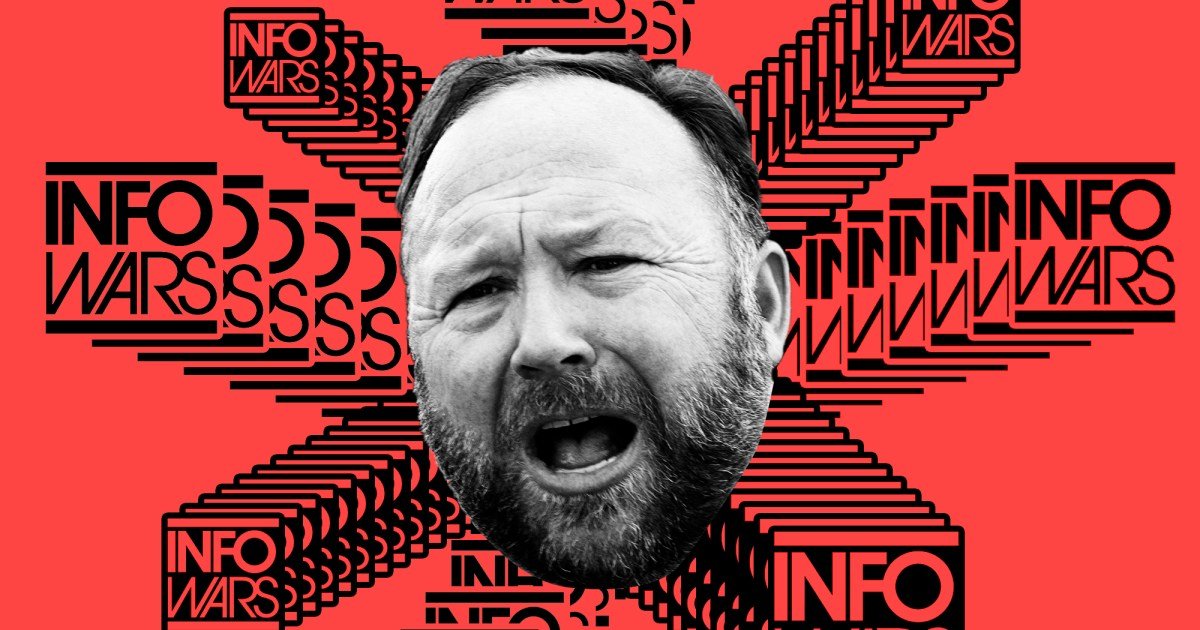
Mother Jones illustration; Jose Luis Magana/AP
“I thought we’d be shut down last year,” Alex Jones marveled on-air in January. “I thought we’d be shut down last month,” he continues, exhorting his audience to consider buying one of the fundraiser items he was hawking to keep the lights on, which at the time included a $111 collectible coin and posters of Jones and Donald Trump.
“You guys have got us out of this over, and over, and over again,” Jones declared, as he once again asked his fans to give him money.
He struck the same note in March when, Jones, slurring his words, told right-wing streamer Tim Pool that his Infowars company was “getting shut down.”
“We’ve beaten so many attacks,” he added. “But now we’re shutting down in the middle of next month.”
During Infowars’ years in bankruptcy, Jones still found opportunities to create chaos and raise funds.
At the time, Jones didn’t elaborate on what “shutting down” Infowars come April might mean. But on Monday, one version became clear when the satirical news site The Onion said it had reached a deal with the bankruptcy receiver overseeing Infowars to take over the site. The deal, which still has to be approved by a judge, would represent a serious and perhaps final blow to Jones’ time at the company. A leasing agreement would allow The Onion‘s parent company, Global Tetrahedron, to assume control of Infowars’ website and studio for the next six to twelve months and transform the site into a parody of itself. In a mockup shared by Onion CEO Ben Collins, parody ads blared over Infowars’ style-content: “TURN YOUR PISS INTO GOLD,” a particularly funny one read. “TURN YOUR GOLD INTO PISS,” another countered.
It’s been a long few years for Jones, the bilious figurehead of Infowars, the conspiracy website he founded in 1999. Over the last two decades, the site has grown beyond anyone’s wildest expectations in terms of money, reach, and infamy, making Jones something of a household name—certainly in households concerned with claims about black helicopters, FEMA camps, and chemicals that are “turning the frogs gay,” as Jones infamously put it.
But eventually the infamy caught up with him: Jones was sued in both Texas and Connecticut for claiming on-air that the 2012 murders at Sandy Hook Elementary School, where a gunman killed 20 children and six adults, were a “massive hoax” and a false flag. It’s been years since Jones lost three related defamation lawsuits by default and had more than $1 billion in judgments rendered against him and Infowars.
To many, the court losses appeared like an immediate death sentence for the company. But Jones and Infowars continued—and continued, and continued—in large part by using the judicial system to his advantage. Both Infowars and Jones personally filed for Chapter 7 bankruptcy protection in 2022, setting the stage for an endless series of proceedings in a Texas bankruptcy court. Thus far, the Sandy Hook families have not seen a dime of what’s owed to them.
The proceedings were often almost bizarrely anticlimactic: in December 2024, for instance, bankruptcy Judge Christopher M. Lopez rejected the results of an auction that would have then sold Infowars outright to The Onion. In June of 2025, the federal bankruptcy trustee tasked with overseeing Infowars during the process accused Jones of going to “extraordinary lengths” to hide funds and make fraudulent transfers to his family to the tune of $5 million. It took until August for Texas district court judge Maya Guerra Gamble—who also oversaw the original Texas Sandy Hook lawsuits against Jones—to order that Infowars’ assets be turned over to a receiver, paving the way for them to be sold to pay what Jones owes. Since then, some of Jones’ personal property has been sold off: court records show that 14 watches, for instance, and a Ford Expedition together brought in $20,720 in October. A rental house with what court documents called “deferred maintenance issues” also sold for $332,770. The same month, the US Supreme Court declined to hear Jones’ appeal seeking to void the judgements against him, putting an end to one of Jones’ most loudly-expressed wishes.
During the roughly four years that Infowars was winding its way through the bankruptcy system, Jones still found time and opportunity to create chaos and raise funds, as he repeatedly vowed to stay on-air no matter what and railed against the process—even as it often worked in his favor. Over time, the agonizingly drawn-out proceedings led to split opinions among victims’ families and lawyers about the best way forward: some wanted to find a way to shut down Infowars immediately, while others favored letting the company continue operating in some form so that value remained to pay the judgments they are owed—essentially turning Jones into their employee.
“There was false comfort in the deplatforming.”
In late 2024, Jones began directing his viewers to visit a new website, Real Alex Jones, which sold his longstanding favored product category: boldly capitalized supplements, including a $250 “special offer” where a selection of pills come with a Faraday bag and a “trench tactical” knife. For years,Jones has made it clear that whenever the lights go off at Infowars, he intends to immediately start broadcasting at another new site, the Alex Jones Network, which for now just relays Infowars content.
“There was false comfort in the deplatforming and the trial judgements,” says Josh Owens, referring to both the lawsuits and the decisions made by major tech platforms—including Facebook, Spotify, YouTube, and eventually Twitter—to ban Jones’ accounts. Owens is the author of The Madness of Believing, a new memoir detailing the four years he worked at Infowars before quitting in 2017. (Full disclosure: I read an advance copy of the book and wrote a blurb recommending it.)
In this “current phase” of legal proceedings, Owens adds, “there’s false comfort he’ll go away.” In the unlikely event Jones actually does, according to Owens, any sense of relief would be undermined by the reach Jones and people like him have already achieved: “His ideas and what he built are so ubiquitous now. It’s been in the White House for two terms. You have all these young people picking up the torch. It’s getting far worse. The damage is done”
“There’s a reality here, which is that the legal system works slowly,” says Chris Mattei, one of the attorneys who sued Jones in Connecticut. “And when you have a corrupt and bad-faith litigant like Jones, he’s inevitably going to take advantage of the pace.” After initially securing their judgments for the Sandy Hook families, attorneys in both Texas and Connecticut sought to defend their clients’ interests where they could, seeking sanctions and protective orders against Jones and Infowars. But that took time, he says, and Jones was able to “exploit those delays to gain more attention and essentially fund his defense.”
To be clear, Mattei argues that “this hasn’t been a positive experience for Alex Jones. It’s been overwhelmingly negative and devastating for him.”
“Anybody who has watched this has seen that from the day we filed our lawsuit until the day Infowars shuts down, Jones has been on a desperate downward trajectory,” Mattei says, pointing to Jones’ “public statements about the litigation, his increasing lashing out, the fact that he’s had to spend hundreds of thousands—if not millions—of dollars on legal defense.”
”For years,” Mattei explains, Jones “has not controlled Infowars, has not controlled personnel decisions, hasn’t had access to Infowars cash, and has had his personal belongings and one, or maybe two, houses have to be sold. He’s now on the verge of losing all the IP that he spent 20 years building up. That’s not just the Infowars logo: that’s the video inventory, all of his customer data. All of that has been under the control of the bankruptcy trustee, and now the receiver, for years.”
“Every bit of personal income he generates for the rest of his life,” Mattei adds, “is going to go towards paying off this debt” thanks to a Texas bankruptcy court’s holding “that his debts are nondischargeable because he acted with such intent and malice towards our clients.”
While the legal process wound on and Jones kept blustering on air, Lenny Pozner did the same thing he does every day: woke up and set to work removing vicious lies about his dead son.
Pozner and his former wife Veronique De La Rosa are the parents of Noah, a six-year old boy who was the youngest victim at Sandy Hook. The two also faced some of the most vicious and direct harassment from deniers of the shooting, who have claimed that Noah was an actor who has gone on to “die” in other disasters around the world. Pozner has been hounded for years with demands to exhume Noah’s body, claims that he wasn’t really Noah’s father, and accusations that Noah never even existed.
In response, Pozner has been involved in an ongoing crusade against the people he calls “hoaxers.” Pozner has successfully sued the co-authors of a book claiming that no one died at Sandy Hook for defamation, and has founded the HONR Network, which works to protect survivors and victims’ family members from online harassment and abuse—not just those scarred by Sandy Hook, but the endlessly multiplying number of people affected by mass shootings and other major acts of violence. A primary tool is using copyright takedown requests to remove false or harassing material that makes unauthorized use of his photos of Noah, or of other families’ photos of their murdered relatives.
“Jones has benefited from the whole process.”
The work is ongoing; like noxious weeds, hoaxer content can sprout again, even years later. Pozner says “the massive media attention” generated by the trials and the bankruptcy process “has made the hoax topic worse. Just look at Twitter—people who had forgotten or never knew about this are suddenly aware again. There’s a clear resurgence of attention”
“Just today,” Pozner told me recently, “I took down six or seven images of Noah that said ‘victim dies again,’ this time supposedly in Pakistan or Iraq. It’s spreading across every country in the Middle East.”
Pozner and De La Rosa’s own Texas court case against Jones remains open. While Jones, as he did with the two larger plaintiffs’ groups, lost the case by default, he and Infowars filed for bankruptcy protection before it went to trial and damages could be determined; the bankruptcy process must conclude before it can be argued. It’s unclear when or if their suit will ever be heard and provide Pozner and De La Rosa a forum to describe how he and other Sandy Hook deniers affected their lives.
“I believe Jones has benefited from the whole process,” says Pozner. “It’s approaching eight years since this all began, and that’s a lot of time for him to keep getting attention.”
Pozner also believes Jones when he says any ban or shutdown will prompt him to simply leave the Infowars studio and immediately start over. “Picture Jones walking out of one door with cameras rolling—background reading ‘Infowars’—straight into another door labeled ‘Alex Jones Wars’ or something similar,” he says. “If he’s already announcing he has another studio ready to go, what does being ‘shut down’ actually mean?”
“My only purpose is to protect Noah’s memory as best I can,” Pozner says. “I’m not interested in promoting myself or tying my name to Jones any further.”
Pozner still hopes, somehow, that he’ll get his day in court, seeing it as a crucial step to moving on. “The lack of any real conclusion or closure has been deeply unpleasant,” he says.



