
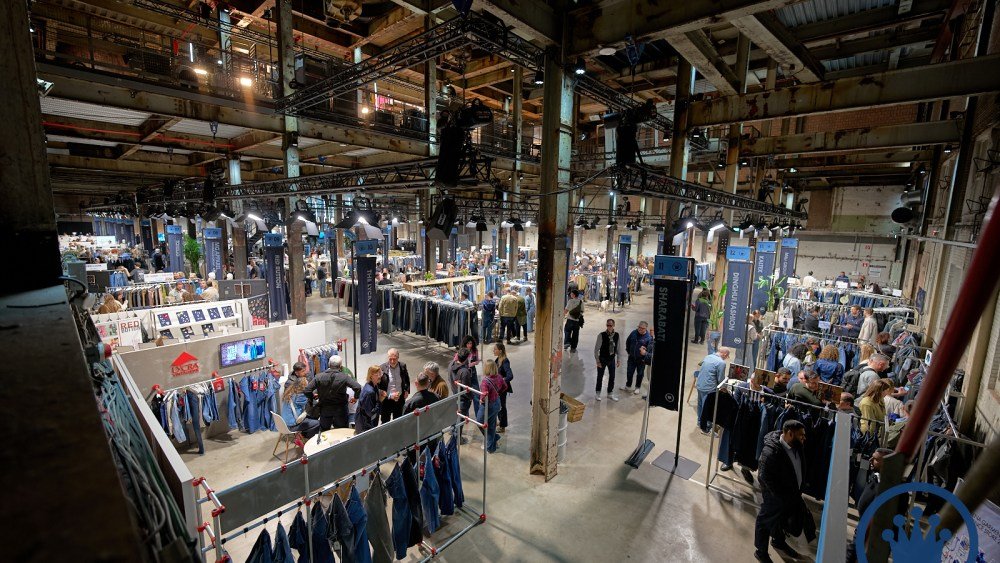
Despite persistent economic headwinds and ongoing global conflicts affecting trade and transportation, the mood among exhibitors and attendees at Kingpins Amsterdam last week was notably more optimistic than at the previous two editions.
Companies presented Fall/Winter 2027-2028 concepts and collections grounded in efficiency and practicality as well as cost and resource savings.
Approximately 80 percent of Italian chemical producer Soko Chimica’s business comes from “production-friendly” solutions that speed up or consolidate processes, while the other 20 percent comes from fashion-focused technologies. The popularity of the company’s Hydrogel, a “one product, one process” that transforms water into a high-viscosity gel to achieve stonewash effects, is evidence of this. Hydrogel consolidates an eight-step process into just one, saving up to 85 percent of water consumption.
While companies have always prioritized saving time—one of a brand’s most valuable resources—Luca Braschi, Soko’s marketing and technology manager, noted that energy is becoming an equally pressing concern, particularly as rising oil prices drive up costs. Hydrogel requires one heat cycle compared to the three required by conventional methods.
Soko Shadow
However, Soko’s latest fashion innovations are also rooted in efficiency and sustainability. The company’s new Soko Shadow dye technique gives garments unique, multi-tone depth while eliminating the discharge of hazardous chemicals. Applied before the main dyeing process, Soko Shadow has dye-resist and migration properties, allowing color to absorb in certain areas and not in others. This produces a naturally faded effect without the need for harmful treatments.
Soko Shadow can be applied to a wide range of fabrics and use one or two colors.
Dystar debuted Zero, a fast-bleaching agent that eliminates potassium permanganate, pumice stone, sodium hypochloride and water and energy waste, while maintaining the yarn integrity. Additionally, unlike traditional bleaching which tends to give fabrics a flat look, Zero allows marbling.

Dystar Zero
The direction of each season at Copen United Ltd. is largely guided by the market. While the pocketing company develops its own seasonal prints, a representative explained that it closely tracks trends in the denim category—particularly shifts in fiber composition—to inform its decisions.
When selecting pocketing materials, brands typically start with fibers that align with their sustainability goals and the story they want to communicate to consumers. Common choices include organic cotton, recycled cotton, BCI cotton and hemp, according to the company representative. Regenerative cotton is also an option, though its higher cost remains a barrier for most companies.
Beyond materials, the rep noted that Copen’s global manufacturing abilities is increasingly appealing to brands looking for speed to market options.
Denim mills also focused on tighter collections and concepts that promote efficiency.
Soorty partnered with finishing technology company Jeanologia on Easy Wash, a capsule collection built on a less-is-more philosophy. The partners worked on pairing fibers and constructions with wash techniques that do not require heavy water and chemical resources. Some garments were dry finished.
Bhaskar’s F/W 27-28 collection focused on three areas of “clear and responsible” innovation. The vertically intergraded denim mill based in India presented Revive M, a fabric family made with recycled cotton and cellulosic fibers from Birla; Altag, a range of fabrics made with food crop waste like banana peels; and Circular Reinvented, a line of 100 percent recycled cotton and recycled polyester fabrics with no added dye.
AGI Denim introduced SEFF hemp into its collection. The fiber producer’s patented Nano-Pulse uses controlled electric discharges in water to gently dissolve the glue binding hemp fibers together. This helps maintain the strength of the fiber, allowing mills like AGI to increase the percentages of hemp it uses in blends. For F/W 27-28, AGI offers a fabric made with 52 percent SEFF hemp and 48 percent cotton.
Isko offered fabrics that maintain their qualities. With We’Raw, the mill applies a finish to fabrics to create a permanent raw look even after home laundering. With Wondersoft, Isko offers fabrics with a special silk-like feel. The permanent natural softness is achieved through a special cotton yarn technique.
Mexico-based Kaltex debuted fabrics made with 100 percent recycled cotton. The collection is the result of the mill’s 20-plus years of experience recycling cotton in house. Fabrics span 9.5 to 14 oz. fabrics and are available in indigo and black.
The circular collection adds another incentive for brands to consider Mexico as a sourcing destination. Eric Goldstein, executive vice president of apparel at Kaltex America, said interest in the country is rising as brands seek to diversify their supply chains with reliable, stable partners. Having production “just a truck drive away” is an added advantage.
Archroma presented FiberColors, a range of dyes that are synthesized with a minimum of 50 percent wool waste, specifically fleeces that sheep farmers would otherwise pay to dispose of. By upcycling this unwanted material, the patented Archroma technology replaces petroleum-based raw materials without compromising performance, water or energy consumption, or waste generation in the dye manufacturing process.
The wool waste naturally makes a brown color, but it can be mixed with other Archroma colors to make colors like maroon and ochre. A rep said 1 kg of wool waste equals 10 kg of dye, which can dye approximately 400 garments.
Denim mills are also relying on the latest innovations from trusted fiber producers with consumer name recognition like Lenzing and The Lycra Company to inject newness to their collections.
Sharabati Denim introduced a new Lycra DualFX fabric that has 55 percent elasticity with 2 percent growth. In comparison, Dilek Erik, global marketing manager at Sharabati Denim, said most fabrics would have 3-5 percent growth.
Neela by Sapphire Fibers’ utilizes Lycra Vintage FX in its “price friendly” B-Logic 2.0 fabric collection. The technology allows brands to offer consumers comfort stretch styles with an authentic denim look.
Advance presented fabrics made with The Lycra Company’s Vintage FX technology and FitSense, a innovation that allows targeted sculpting zones.
Advance Denim also showcased fabrics made with Lenzing’s Tencel Lyocell – HV100 fiber, a product that uses Variocut technology to create variable fiber lengths. The result is soft Tencel fibers with irregularities that replicate the authentic texture of cotton and have a matte appearance. The mill blends it with linen.
Lenzing displayed the first jeans in the market made with Tencel Lyocell – HV100, a 49.95 euro straight leg jeans from Zara.
Dennis Hiu, global business development manager for denim at Lenzing, said the network of denim mills offering HV100 fiber is growing. The roster now includes Advance, AFM, Atlas, Black Peony, Blue Diamond, CBL, Cone Denim, Dynmaic Denim, Envoy Textiles, Freedom Denim, Indigo Textiles, Kassim, Maritas, Panther, Prosperity, Saitex, SM Denim Mills, Twin Dragon, XDD Denim and Yuanji Denim. Up next, Lenzing will add mills from Japan and South Asia.



