
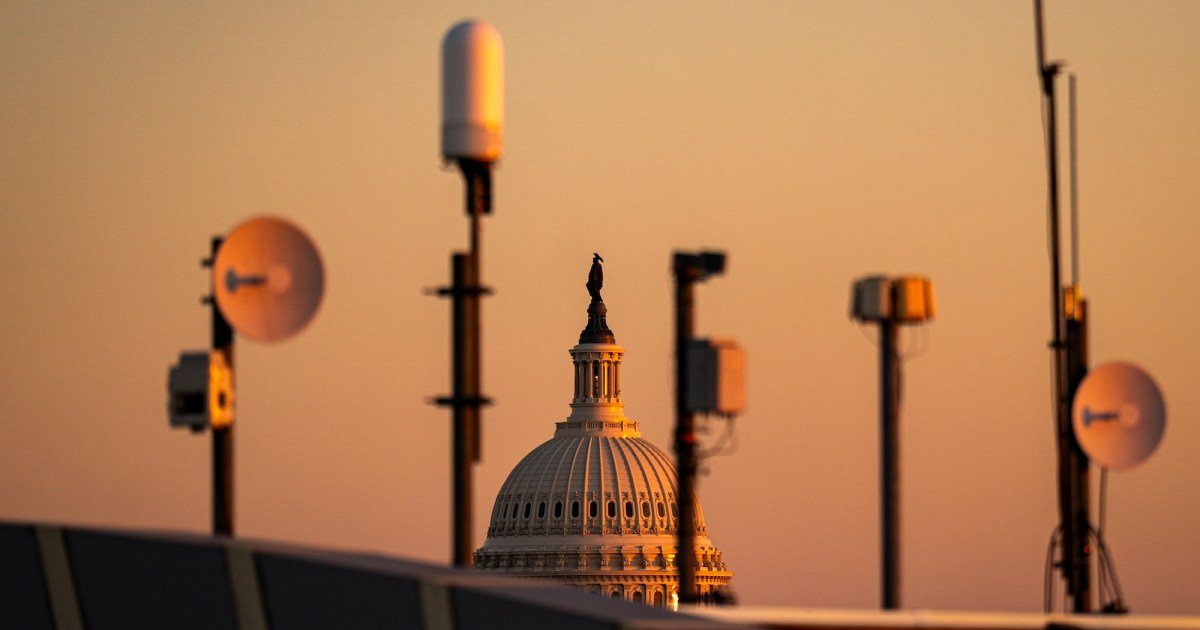
Critics say the FBI’s “backdoor searches” of Section 702 data violate Americans’ privacy rights.Al Drago/Getty
Increasingly desperate negotiations. A plea from the president himself. An eleventh-hour sleight of hand, followed by a surprise vote in the dead of night.
Over the past month, chaos has unfolded on Capitol Hill as House Republicans fracture over a central question: Should the federal government need a warrant to spy on US citizens?
According to most interpretations of the Fourth Amendment, the answer is a simple yes. But for nearly two decades, Section 702 of the Foreign Intelligence Surveillance Act (FISA) has created a nifty loophole. The law authorizes warrantless surveillance of foreign nationals abroad, but in practice, it allows intelligence agencies to scoop up the electronic communications of US citizens, too. Agents can then perform “backdoor searches” on records that would normally require a warrant to obtain—querying databases for Americans’ phone calls, text messages, and emails.
Privacy hawks and civil libertarians have long warned that the program undermines Americans’ constitutional right to privacy. Yet when Congress last reauthorized the program in 2024, Democrats were largely in favor. Joe Biden signed it into law with minor reforms; Donald Trump urged Republicans to “KILL” it.
But much has changed in the past two years, and FISA reform advocates say the 2024 changes have failed to stymie abuses. The rapid rise of artificial intelligence has collided with an unprecedented push by the Trump administration to expand government spy powers. ICE is spending hundreds of millions of dollars on new surveillance technology while the FBI buys up Americans’ cell phone location data from commercial brokers. Shortly after returning to office, Trump fired all three Democrats on the Privacy and Civil Liberties Oversight Board, an independent body tasked with advising the executive branch and reviewing programs like Section 702. And in May, the FBI shuttered an internal office that audits for Section 702 abuses.
Now that Trump stands to benefit from the spy program himself, he’s demanding that Republicans pass a “clean” reauthorization, pushing a bill through without any amendments. The law is set to expire Thursday, and despite the bill clearing a procedural vote in the House today, deep divisions remain in the Republican Party. GOP privacy hardliners have insisted that any reauthorization of Section 702 must include a warrant requirement for government searches of Americans’ communications.
Meanwhile, all but four House Democrats are opposing a clean reauthorization, as the abuses of Trump’s second term have crystallized the dangers of handing warrantless surveillance powers to an aspiring authoritarian. Administration officials have publicly labeled anti-ICE protesters “domestic terrorists,” ICE agents have collected biometric data from activists, and Trump has used the Justice Department to go after his political enemies.
Congressional staffers familiar with the negotiations told me that the growing bipartisan opposition to Section 702 marks a significant opportunity to reform America’s outdated surveillance laws. “It’s very clear that the presidency being in a different hand has totally changed the dynamic,” said one Democratic staffer, granted anonymity to speak candidly. “While AI is part of that new opportunity, I really think it’s because people are cognizant of how dangerous it is to have a federal government with someone like Stephen Miller actively going around talking about domestic terrorists.”
Earlier this month, the Lever and the American Prospect reported that the Democratic-led Congressional Black Caucus planned to support a clean reauthorization of the program, despite its use in federal surveillance of Black Lives Matter activists in 2020. A few days later, facing media scrutiny, the caucus came out against a clean reauthorization and called for a judicial warrant requirement and a ban on backdoor searches.
“As it stands, the Trump Administration has already committed serious violations that undermine democratic norms. We cannot allow federal law enforcement officers to have unfettered and unregulated access to information to persecute political opponents or intimidate American citizens,” CBC members wrote in a statement.
In fact, FBI searches of US citizens’ data under Section 702 rose 35 percent last year to more than 7,000 queries, according to a letter the agency sent to Congress in March. An April report by the Privacy and Civil Liberties Oversight Board found that the FBI also conducted 839 “sensitive” searches in 2025—queries related to journalists, elected officials, political candidates, and religious groups—up more than 200 percent from 2024.
Critics say that those findings underscore that the 2024 reforms—which included a requirement that the deputy director of the FBI approve “sensitive” searches—did not go far enough.
“Until two months ago, the Deputy Director was Dan Bongino, a longtime conspiracy theorist who has frequently called for baseless investigations of his political opponents. His replacement, Andrew Bailey, is a highly partisan election denier who recently directed a raid on a Georgia election office to justify Donald Trump’s conspiracy theories,” Sen. Ron Wyden (D-Ore.) wrote in a “Dear Colleague” letter on April 13.
Wyden also deposited a classified Dear Colleague letter with House Security, detailing a secret legal interpretation of Section 702 that “directly affects the privacy rights of Americans.” That letter has made a splash in Washington, DC, two staffers told me, even though it’s largely been absent from mainstream media coverage. In other words, the public doesn’t know the full scope of the spy law that Congress is battling over.
“I strongly believe that this matter can and should be declassified and that Congress needs to debate it openly before Section 702 is reauthorized,” Wyden said in a Senate floor speech last month. “In fact, when it is eventually declassified, the American people will be stunned that it took so long and that Congress has been debating this authority with insufficient information.”
Some reporting has incorrectly conflated Wyden’s warning with a classified March 17 opinion from the Foreign Intelligence Surveillance Court. That ruling found compliance issues with how intelligence agencies used “filtering tools” to query Section 702 data, winnowing down the results without specifically searching for a target, and therefore evading oversight. Wyden’s warning is about a different classified opinion, sources told me.
“Senator Wyden does not cry wolf,” said Elizabeth Goitein, senior director for liberty and national security at the Brennan Center for Justice. “In the past, when he has said that there’s a secret legal interpretation that will shock Americans, he has been right.” Goitein pointed to Edward Snowden’s leaks of classified documents revealing a massive, indiscriminate global surveillance operation by the National Security Agency and its allies. Two years before the leaks, Wyden had warned the public of a secret intelligence court interpretation of Section 215 of the PATRIOT Act.
“Through the Snowden disclosure, we found out what that was. And that was that the NSA was collecting Americans’ phone records in bulk, and it was doing it based on a legal interpretation that the phone records of every American in the country were relevant to specific foreign intelligence investigations,” said Goitein. “That’s not a plausible interpretation of the law.”



