
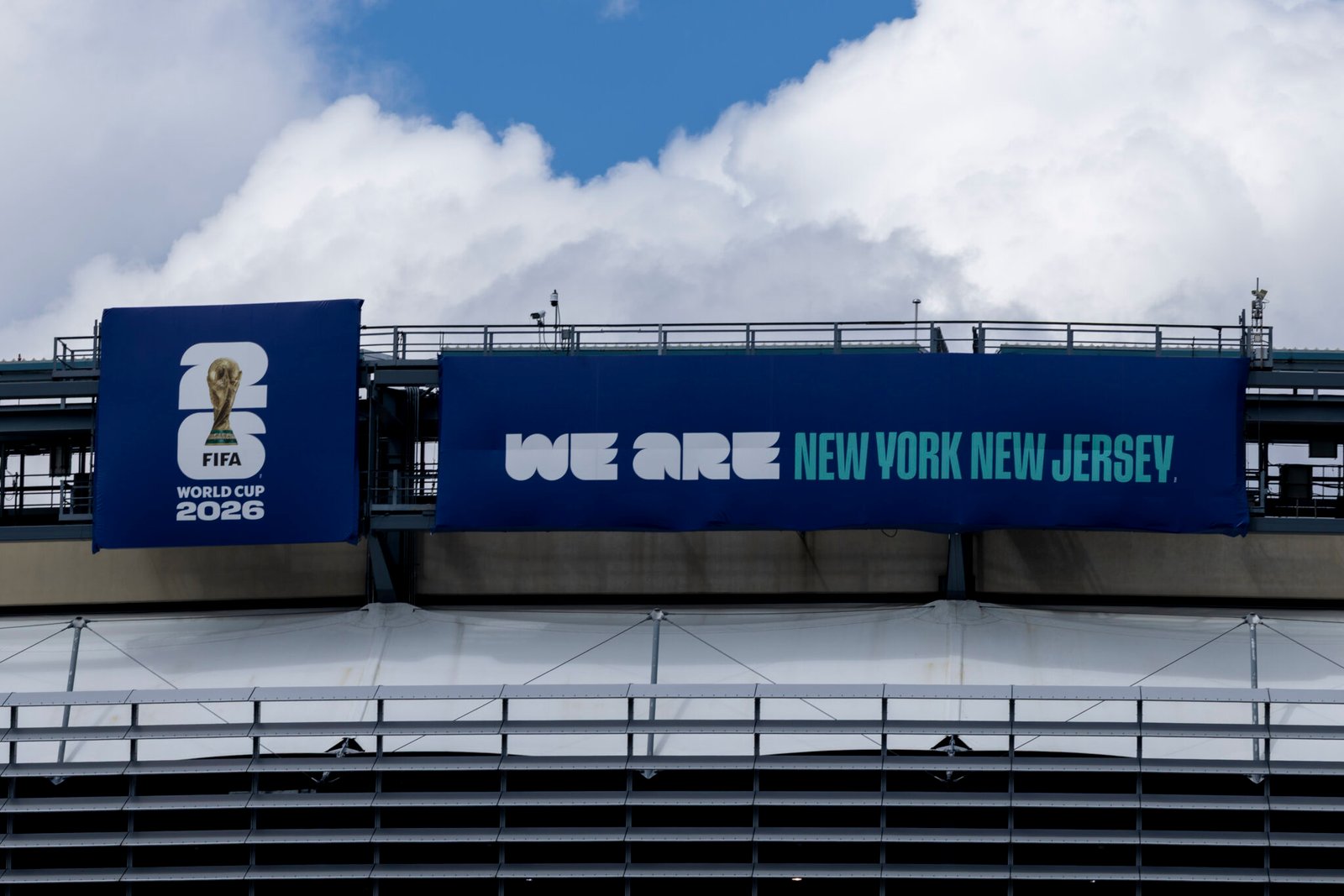
New Jersey officials said they are working to protect against infectious disease, food poisoning, heat stroke, and other public health concerns in advance of the upcoming World Cup matches in the Meadowlands.
State Department of Health officials have been meeting with emergency management leaders, local health officials, hospital officials, and others since early last year, Health Commissioner Raynard Washington told the New Jersey Monitor.
“I do think that we are today in a great place, with all the right partners at the table, with the connections across state and local government that are, I would say, highly functional and working to be as prepared as possible,” Washington said. “Everybody is in the room, at the table, and talking.”
Washington said his primary concern is infectious disease, given the global draw of World Cup events, which include matches, practices, fan events, unofficial parties, and more, stretched over six weeks in the United States, Canada, and Mexico. Eight matches, including the final, will be held at Met Life Stadium in East Rutherford in June and July, and each one is expected to attract up to 80,000 fans, plus staff and volunteers.
While much of the public attention has focused on the expected traffic and transit disruption, security concerns, and higher taxes and fees, healthcare experts want to emphasize the importance of public health planning, given the risks involved.
To help keep people safe, Washington said plans are in place to increase the frequency of disease surveillance during these gatherings, with experts downloading data from hospital emergency rooms in near real time, instead of on a daily or weekly basis. The department is also prepared to exchange data with New York and Philadelphia if regional monitoring is needed.
Last year, health officials in New Jersey reported some 350,000 cases of a communicable disease, like COVID-19, influenza, hepatitis, Lyme disease, and sexually transmitted diseases. Of these, 2,500 prompted an investigation, according to budget documents.
Like most public health work, much of this will take place out of public view, Washington said. People might see state or local public health teams inspecting temporary food vendors at a stadium or a fan-fest event, “but in general, that work usually happens in the background, but people get to enjoy the benefits of it by getting to eat food and not getting sick after it,” he said.
Much of this work falls to the 100-plus local public health offices, municipal, county, or regional units responsible for restaurant inspections, community vaccination programs, and disease tracking, among other tasks.
Public health leaders have held multiple trainings, table-top exercises, and planning calls over the past year, refreshing their skills on food-and-water-borne illness scenarios and developing clear lines of communication, according to Stephanie Gorman, president of the New Jersey Association of County and City Health Officers, which has taken a lead in the preparations.
Planning has also engaged emergency responders, hospital systems, and outpatient clinics, Gorman told the New Jersey Monitor, and public health leaders have connected with team doctors to brief them on the protocol if a player develops a communicable disease. Local health officials have also signed mutual aid agreements with neighboring municipalities and county governments to smooth the way for a multi-level response if there is a large emergency, she said.
Gorman said some of this work, like the potential need to track an infectious disease exposure that involves fans in multiple cities and maybe even relatives in other countries, could continue long after the tournament ends in mid-July. Disease monitoring “does not just end when people leave the state,” she said.
“Public health is still going to be focused on what happens when that final whistle blows and that’s the game,” Gorman said.
While the 2014 Super Bowl, also held in East Rutherford, provides some guidance, “now we need to amplify and build on it, because it’s not just one localized event,” Gorman said.
Washington — whose background is in public health — has described the event as a complex “public-health marathon” that presents unique challenges for state and local officials.
“After COVID, we’re not usually activating for that long in terms of an emergency response. So it’s a fairly intense opportunity,” he said.

The National Special Pathogen System, a federally funded network of experts that trains healthcare providers on how to safely respond to new and evolving communicable diseases, is also taking steps to help emergency and medical responders prepare for the World Cup. It held a training in this region for some 500 partners in January 2025 and is planning a similar event in June, according to the system’s director, Dr. Laura Evans, a professor at the University of Washington.
The group was also part of a live drill designed to mimic a potential World Cup emergency with actors depicting Canadian tourists infected with a made-up disease unknown in America. In January, the group paid for special pathogen training and equipment at dozens of hospitals nationwide, including Cooper University Hospital in Camden and Robert Wood Johnson University Hospital in New Brunswick, in addition to facilities in Philadelphia and New York.
Evans said while responders are well prepared, dealing with unknown pathogens is always a challenge, especially when there are so many agencies involved. She said there have not been reports of major outbreaks at past World Cup events, but there is always a concern with international gatherings like this or the Hajj, the annual pilgrimage made by millions of Muslims to Saudi Arabia.
Attendees at the Hajj, which also involves extreme temperatures, must have certain vaccinations and adhere to other public health protocols.
“We have to bear in mind that the World Cup is happening in North America in June and July, so we could have big weather events, a heat wave, and so people have to prepare for that contingency as well,” Evans said.
Gorman said local responders will also be busy with July 4th celebrations and related events for the nation’s 250th anniversary. She expects the cost of overtime could soar, especially if there is a disease exposure that requires close tracking and immediate reporting to state and federal monitors.
Washington said the state has leveraged funding sources and has the resources it needs to safely prepare for World Cup events, including money to offset some of the local public health costs related to the tournament.
“Public health never had enough money for our work,” he said. “But we are putting it all together and making it happen.”
Gorman agreed that local officials have sufficient funding now, but she worries about what will happen later in the year, after the expiration of the remaining federal COVID-19 pandemic relief dollars that have supported local public health programs in recent years. She worries about her colleagues’ capacity in the future.
“We’ve really had an opportunity to build and strengthen the current system. It’s going to be, ‘what happens next,’ when all of that funding ends later this year,” she said. “It’s coming at a critical point.”
GET THE MORNING HEADLINES.



