
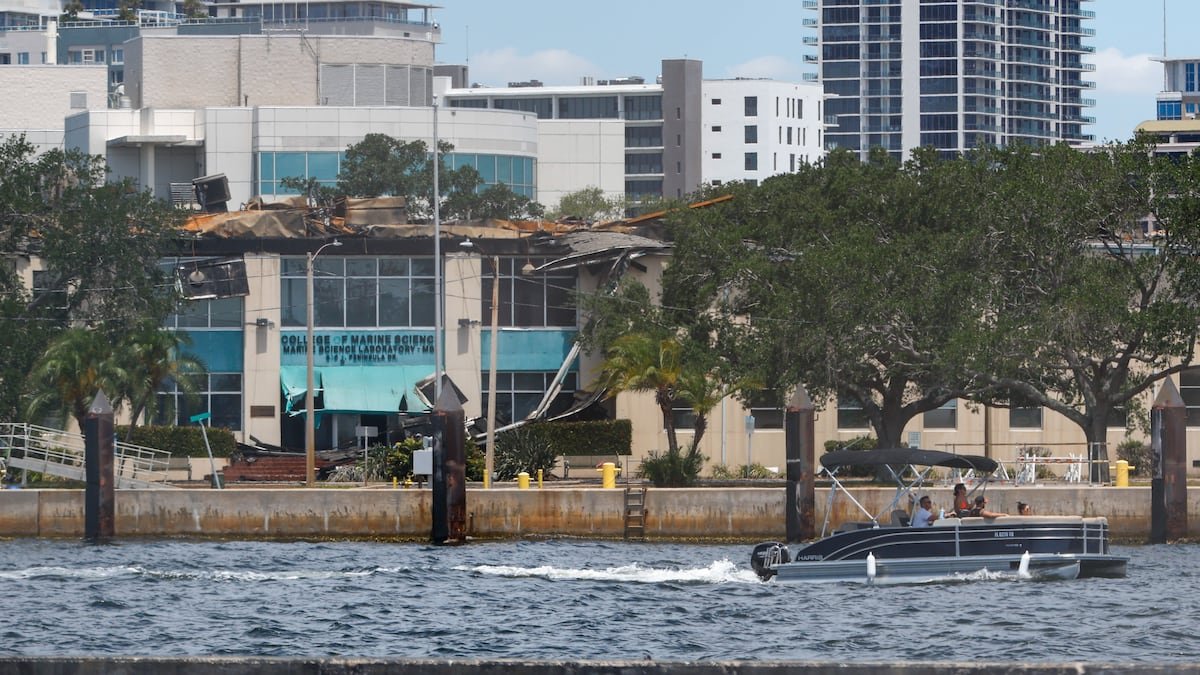
The day after the University of South Florida’s world-renowned Marine Science Lab went up in flames, students and faculty struggled to calculate what felt like an unfathomable loss.
There will now be a scramble to find office and lab space for professors and students. Then there is the question of how summer research and doctoral degrees will stay on track.
But the biggest uncertainty is whether the university’s freezers are safe, not just from the fire but the heavy smoke and water damage that authorities say likely rendered the building a total loss. The College of Marine Science’s dean, Thomas Frazer, said faculty haven’t been cleared to enter.
Inside the freezers were samples gathered from around the world, specimens drawn from ocean floors and from aquatic life large and small. Sediments gathered on painstaking research trips, frozen in tubes, were stowed carefully to let scientists glimpse what conditions were like thousands or even millions of years ago.
The freezers function like museums of the past. And if those samples are lost, that door vanishes — along with critical materials some students need to keep their research on track for graduation.
“It’s the work of many people and many generations of students and researchers,” said oceanography professor Frank Muller-Karger.
That collective knowledge helps us understand how nature works, he said.
The College of Marine Science offers tight-knit graduate-level programs, leading vital work on issues important to Florida and researchers globally. The college has scientists studying storm surge, harmful algae blooms and forever chemicals.
On Sunday, cleanup workers milled about as USF police blocked the area where a hose snaked from a still-dripping fire hydrant. Much of the lab’s long roof appeared caved in. The inferno drew as many as 200 firefighters late Saturday, including specialized teams to respond to hazardous materials inside the lab. It remains unclear what chemicals might have burned, but a St. Petersburg Fire Rescue official said air monitoring indicated the area was safe for neighbors. As of Saturday night, the fire department said, no injuries had been reported.
Professor emeritus Al Hine said the building includes some expensive laboratories, which took hundreds of thousands, if not millions of dollars, to create. Those labs need special ventilation, electricity and lighting. But the worst loss would be whatever is still in the freezers.
“You’d have to send people out to sea again,” he said. “It would take years to reproduce that.”
The fire broke out Saturday evening, sending plumes of smoke billowing over downtown. Its cause remains under investigation, but meteorologists have said it was likely sparked by a lightning strike.
“It was just like the loudest boom I think I’ve ever heard from thunder,” said Cheryl Hapke, a part-time research professor who lives nearby and felt sure she heard the strike that caused the blaze.
The coastal geographer called the loss stunning.
“This could really set back a budding young research career in a way that is just probably the most tragic thing I can imagine,” she said.

Elizabeth Bonert, a freelance scientific illustrator who had just returned from a trip at sea, was in tears when she saw news coverage of the fire.
She thought about how, on Thursday night, researchers had docked back in St. Petersburg and unloaded all their materials into the lab, now charred and off-limits.
“I just spent 10 days watching these people work really hard,” Bonert said.
“And then you can’t even come back to work on Monday to have another moment.”
For many students and staff, the building had been a site of celebration just a day before.
Isabella Iannotta and her classmates attended end-of-year festivities Friday on the peninsula outside the Marine Science building.
On Saturday night, the masters student watched the building burn.
“It’s really emotional to see pictures of us standing there, 24 hours before the fire broke out,” she said.
Chuanmin Hu, an oceanography professor, got a text about the fire from a colleague while he was eating dinner Saturday.
It was a photo of his lab building up in flames. He drove over to see for himself.
Hu has spent most of his life working in the lab building. He researches harmful oil spills, coastal water quality degradation, coastal wetlands and global ocean changes.
The physical losses like the expensive instruments and lab rooms can be replaced, Hu said. But people’s time, memories and effort cannot.
Students spend months preparing samples and writing computer codes, he said. If they were planning to graduate in the fall or spring, he said, they’ll likely have to postpone.
“If the total building, their offices, their labs, are gone, where do they continue their research?” he said.
Hu has been studying sargassum, a type of seaweed that stretches from the Caribbean Sea to Florida.
“Over the years, my lab has collected a lot of seaweed samples, which are all stored in that building, in the freezers,” he said. “Now I’m very concerned those samples are gone. I cannot go back to history to recollect those samples.”
Almost immediately, officials began grappling with what was salvageable and how to keep research on track.
“We are obviously going to have to relocate all of those people and provide them with functional office space and laboratory space,” Frazer, the dean, told the Tampa Bay Times by phone Sunday.
The College of Marine Science is comprised of three buildings on the USF St. Petersburg campus. The building affected by the fire was the largest, at about 80,000 square feet, Frazer said.
About 50 researchers, 50 graduate students and 25 staffers call it home, he said. Its annual research expenditures reach $20 million a year.
Gov. Ron DeSantis vetoed $75 million for a new main building for the college in 2022. The Legislature did successfully pass roughly $34.3 million in subsequent sessions, said university spokesperson Dyllan Furness. The project had been at the top of the university’s wishlist for the legislative session. Former Florida House speaker Chris Sprowls had called the marine science program a “crowning jewel.”
USF had still been restoring the lab from hurricane damage when the blaze broke out, Frazer said.
Some faculty and students will need to restart research, he said. The college will do everything possible to make sure students can wrap up their course requirements in the least stressful environment possible, Frazer said.
“We will certainly build things back, and we’ll build them back better,” he said. “If I have one thing to say about the folks here, they are resilient.”



