
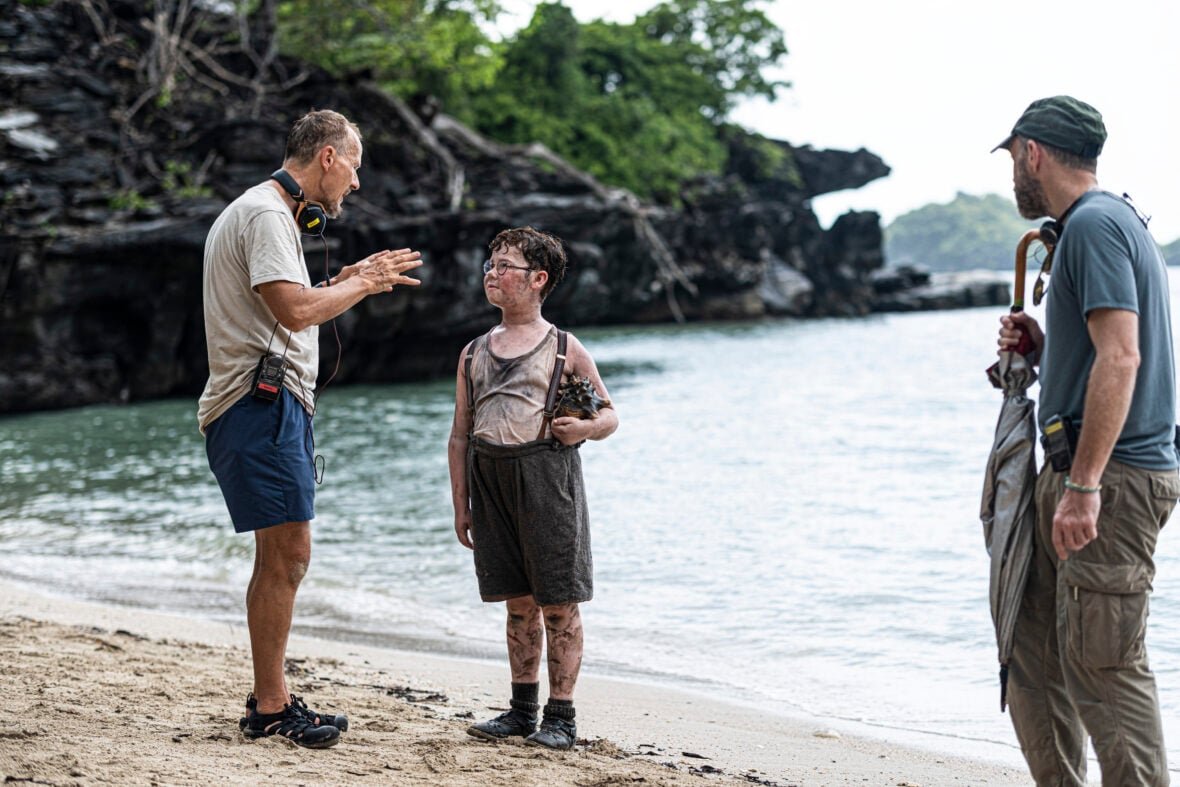
There are complex shoots, and then there’s Lord of the Flies. Director Marc Munden spent 17 weeks shooting in a Malaysian jungle, leading a cast of 40 boys, all 12 and under, most of whom had never been onscreen before. The actors had chaperones, tutors and parents present, all monitoring the production. And the shoot lost four days to bad weather in its first two weeks alone.
“In big crowd scenes, when you get more than four or five boys on the set, it was always chaos. There’s always someone looking at a camera,” Munden laughs.
In spite of everything, Munden nailed it. The miniseries – the latest adaptation of William Golding’s stunning 1954 novel about boys trapped on an island after a plane crash — feels as sharply relevant as ever. The story uses the island as a metaphor for the savagery of our supposedly civilized society.
Any hope that the boys might turn their new home into a utopia collapses in the first minutes of the first episode: Jack (Lox Pratt), calls a smart but vulnerable boy (David McKenna) by the name “Fatty,” and the affable Ralph (Winston Sawyers) proffers what he sees as a slightly less insulting nickname, “Piggy.”
The name is accepted and a dynamic established: The intellectual Piggy is made to seem foolish; Jack is a bully; and Ralph tries to contain Jack, rather than confronting him. Within hours, the island is on fire.
“It was a steep learning curve for them, I think. But they were serious about the work in the best possible ways, and really learned pretty quickly,” Munden recalls. “I always rehearse. So we rehearsed in a rehearsal room, and we experimented with stuff, and we tried stuff out, and I always tried to treat them like adults and talk to them straight. And they responded to that. And very soon they learned from each other as well. They were very, very observant.
Munden notes that Lord of the Flies is writer Jack Thorne’s followup to the award-winning Adolescence, which shows how manosphere influencers miseducate a 13-year-old boy in horrible ways.
Lord of the Flies is set in the 1950s, when there’s no social media to blame — just the darkness of human nature.
“They’re not adolescents. Their children,” Munden says.
Bullying Is the Tool of the Lord of the Flies
But being children gave his actors a deep understanding of the core story.
“Those boys came to the table understanding what bullying is,” Munden says. “It’s really about society breaking down because the bullies aren’t challenged.”
The long runtime — like Adolescence, Lord of the Flies plays out over four episodes — allowed Munden to bring more depth to the four main characters, and what they represent, than past screen incarnations have. The novel was previously made into a 1963 black-and-white film by Peter Brook and a 1990 version by Harry Hook, and Munden believes Brook’s version influenced Francis Ford Coppola’s 1979 Apocalypse Now.
“I think Peter Brook and Coppola must have talked about it sometime in the ’60s,” Munden says. “There’s footage of Peter Brook being at Coppola’s home and things like that.”
His own take on Lord of the Flies pays homage to Apocalypse Now in a scene in the fourth episode, he notes. And while many pop culture phenomena of recent years have also borrowed from Golding — including Lost and Yellowjackets — Munden didn’t borrow back from those hits.
His main influences included Lindsay Anderson’s 1968 British public school satire If…, the 1971 Nicolas Roeg survival film Walkabout, the 2008 Jean-Stéphane Sauvaire film Johnny Mad Dog, and the 2019 Alejandro Landes film Monos. The latter two are about child soldiers.
“Lots of stuff that I was swirling around in my head as we were filming,” he says. “Trying to grasp the chaos.”
Lord of the Flies is now streaming on Netflix.
Main image: Marc Mundsen directs David McKenna in Lord of the Flies. Photo courtesy of Sony Pictures Television.



