
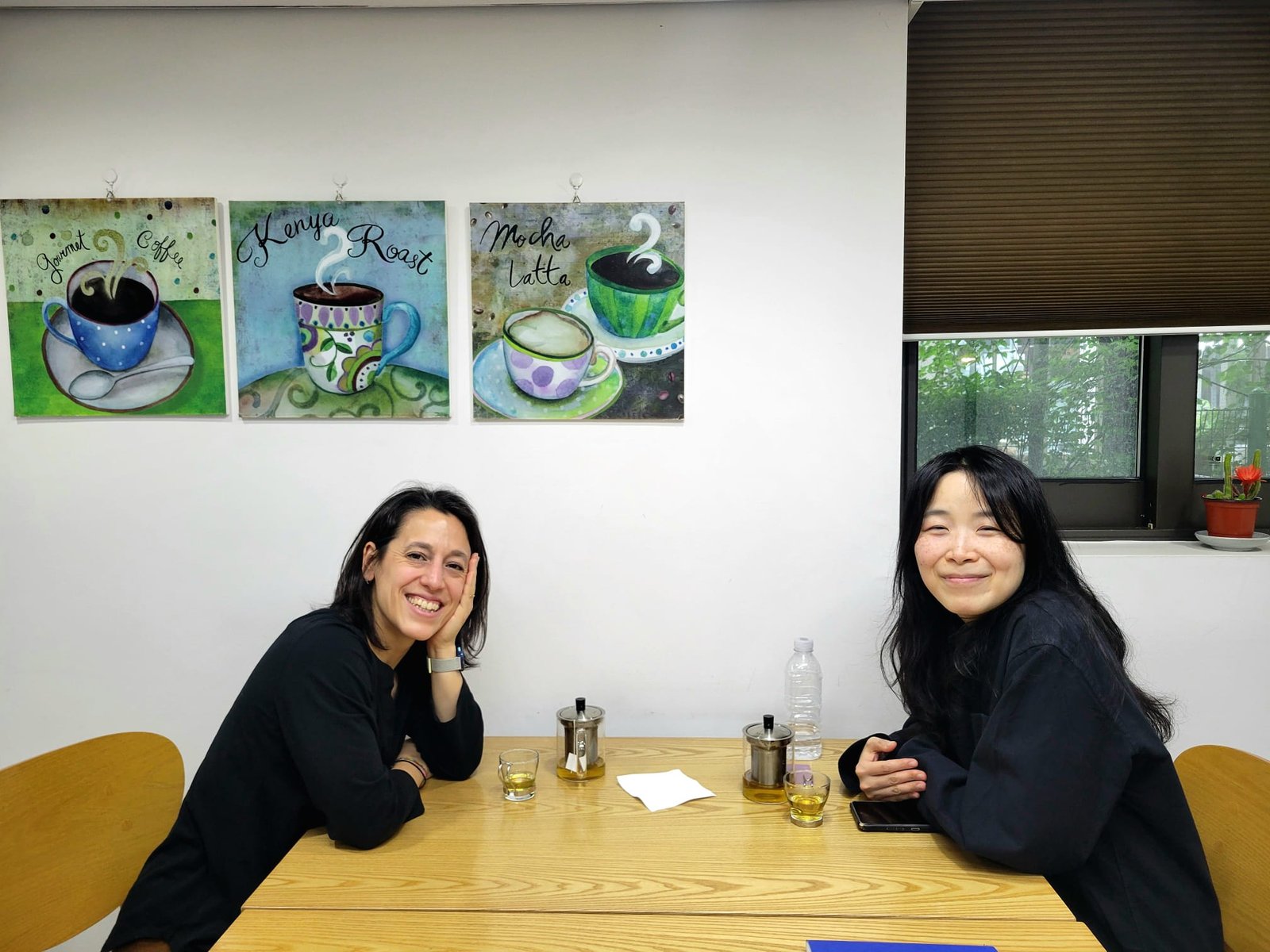
by Rita Andreetti
“Ideal and Weird Family” is the debut feature of director Kim Ji-hyun: a queer family comedy with a light touch and a vividly colourful visual palette. The director presented her film in the Korean Cinema section of the Jeonju International Film Festival, which continues to be a welcoming home for first-time filmmakers. We sat down with this debut artist to talk about her film, commercial cinema, and queerness
Your film is partly a comedy, partly a road movie, but above all a queer film. How challenging was it to develop the screenplay, and how difficult is it in general in Korea to address these themes, which still spark strong social tensions?
I think it is still not easy to deal with these subjects in commercial content. Commercial films tend to aim for a kind of balance in order to reach a wider audience, and that often becomes a very mechanical middle ground. In independent cinema, there are many films that explore queer themes, so in that context it is not unusual. But commercially, it is still difficult, and there are audiences who feel uncomfortable or avoid these topics. Because of that, mainstream media often tries to stay in a safe middle position.
I understand that tendency, but at the same time I believe content needs a sense of freshness to have vitality. That’s why I would like to see more variety in how these themes are approached, even in commercial media.
The subjects in my film (such as the divorce of a queer couple or pregnancy through sperm donation) can feel unfamiliar or heavy. I didn’t want to present them in a heavy or overly serious way. Instead, I wanted to approach them through everyday life, focusing on the characters and their immediate, ordinary problems. That’s why I chose to work with comedy as well.
Who do you think is more hesitant to approach these topics—the industry or the audience?
In my opinion, it’s the industry that doesn’t want to take the risk. Commercial projects involve a lot of money, and it feels like the industry is constantly looking for a position that won’t get them in trouble with anyone. Viewers do want something new, but not all of them, so the industry ends up searching for that mechanical middle ground. The commercial industry, in particular, just wants to stay in that middle zone, not push toward either pole. They see audiences who are interested in new themes, but also audiences who still avoid queer or LGBTQ titles, and they try to accommodate both.
How important do you think cinema is in raising awareness about these issues and in keeping the conversation open?
I don’t think a single film can completely change someone’s thinking. But cinema is more emotional than logical. Through emotion, it can help people understand others who might have felt unfamiliar to them before. Those kinds of experiences can be meaningful in someone’s life. That’s why I think it’s important for these kinds of stories to be shared more widely, little by little.
Do you see yourself reflected in all of them, or is there one you feel particularly close to?
When I was writing this story, I gave a part of myself to Da-sun, Hee-soo, and Sol. Like Da-sun, I have a desire to live freely and break free from any shackles. I have a bit of a rebellious temperament. But like Hee-soo, I can also be timid and fearful of taking a step forward. And when I was a teenager, I was rather pessimistic, like Sol. So I spread myself a little across each of them.
I also love my family deeply, and that’s something I gave to Da-sun. Once I gave her that quality, I found I could write her very freely. And actually, when I finished the film, I found myself thinking: I’d like to live a life as cool as Da-sun’s. In a way, I sometimes wonder if I created her because I wanted to live like her.
At a certain point, we discover that the two women exchanged their daughters. Could you explain the implications of this choice?
I’ve heard people say that couples without children may find it easier to separate. When there is a child, it can make people hesitate, because of the responsibility and emotional weight. In the film, Heesoo is the one who proposes the exchange. I see her as a very anxious person. Since the children are not biologically connected to both mothers, I think that created a sense of instability for her.
In a situation where there is no legal system protecting this kind of family, she may have wanted to create a stronger bond in her own way, something that would help them remain a family. I’ve never heard of a real case like this, but I thought of it almost like a kind of emotional “insurance.” Not in a literal sense, but as something that could make the relationship feel more secure, something that might hold the family together.
Do you think something like this could realistically happen in Korea today?
I’ve never actually heard of a case where this was done intentionally. But I thought of it as a kind of insurance for Hee-soo. Not so much thinking ‘how can I change things as a mother’, but more: if we want to be one family, maybe we need this kind of insurance.
Our cinematographer, who doesn’t have children, told me after reading the script that he and her wife had taken out a very expensive life insurance policy together. Whenever they had an argument and wanted to walk away, they’d remind themselves: we already have that insurance, we need to calm down. That’s what the swap is for Hee-soo. It’s her insurance for the family.
Your film seems to connect the weight of the family home to themes of inheritance and the expectations placed on daughters. Could you elaborate about this?
In traditional Korean society, people often lived in villages made up of relatives sharing the same family name, with the ancestors’ graves nearby. When a woman married and left her home, a person with a different family name entered the village. She became an outsider, responsible for caring for elders, her husband, her children, and in that structure, it was very difficult for her to be at the centre of inheritance. I personally believe that the preference for sons in patriarchal societies functioned as a practical means of preserving property and lineage, regardless of whether it was right or wrong. It may have been a practical choice in that historical context.
But the world changes and the form of the family changes with it. When those changes are not allowed to happen naturally, that’s when tradition becomes harmful. I wanted to explore the changing shape of the family in this film.
Da-sun’s mother is the only one left to protect the family home, while her neighbour lives in an apartment and is renting her place out on Airbnb. That house was once a living space; now it’s becoming a kind of tourist destination. I wanted to explore that transformation through the house itself.
How long did it take from the initial idea to having the film ready for Jeonju?
The first time I pitched it was in 2021, at the pitching session at the Seoul International Women’s Film Festival. At that point, the story was at an early development stage: in fact the script was more focused on the children, not the mothers. After that I received production support, and then shot the film.
The post-production took three years, mainly because I edited for a very long time on my own. It was only when I started working with an editing director that things started moving faster. So from that first pitch to now, it’s been about three to four years.
What’s the next step for the movie after Jeonju?
I really want this film to have a proper release. But it’s not easy for an independent film to reach theatres. I need a lot of support from distributors. Commercially releasing it in South Korea will be challenging, but we’re working on it.
Is the film going to any other festivals?
Nothing is confirmed yet. We were very focused on preparing for Jeonju, since this is the premiere. We’re planning submissions now.



