
by Rita Andreetti
A welcome discovery at the Jeonju International Film Festival, where it was presented in the Korean Cinema section, “Ideal and Weird Family” marks the debut of a young director who chooses to portray a same-sex family with the right lightness for popular cinema. It is precisely in this breezy approach, never aggressive, never too loud, in the way it addresses both audience and subject, that the film finds its strength: it plays, and in doing so, it is heard.
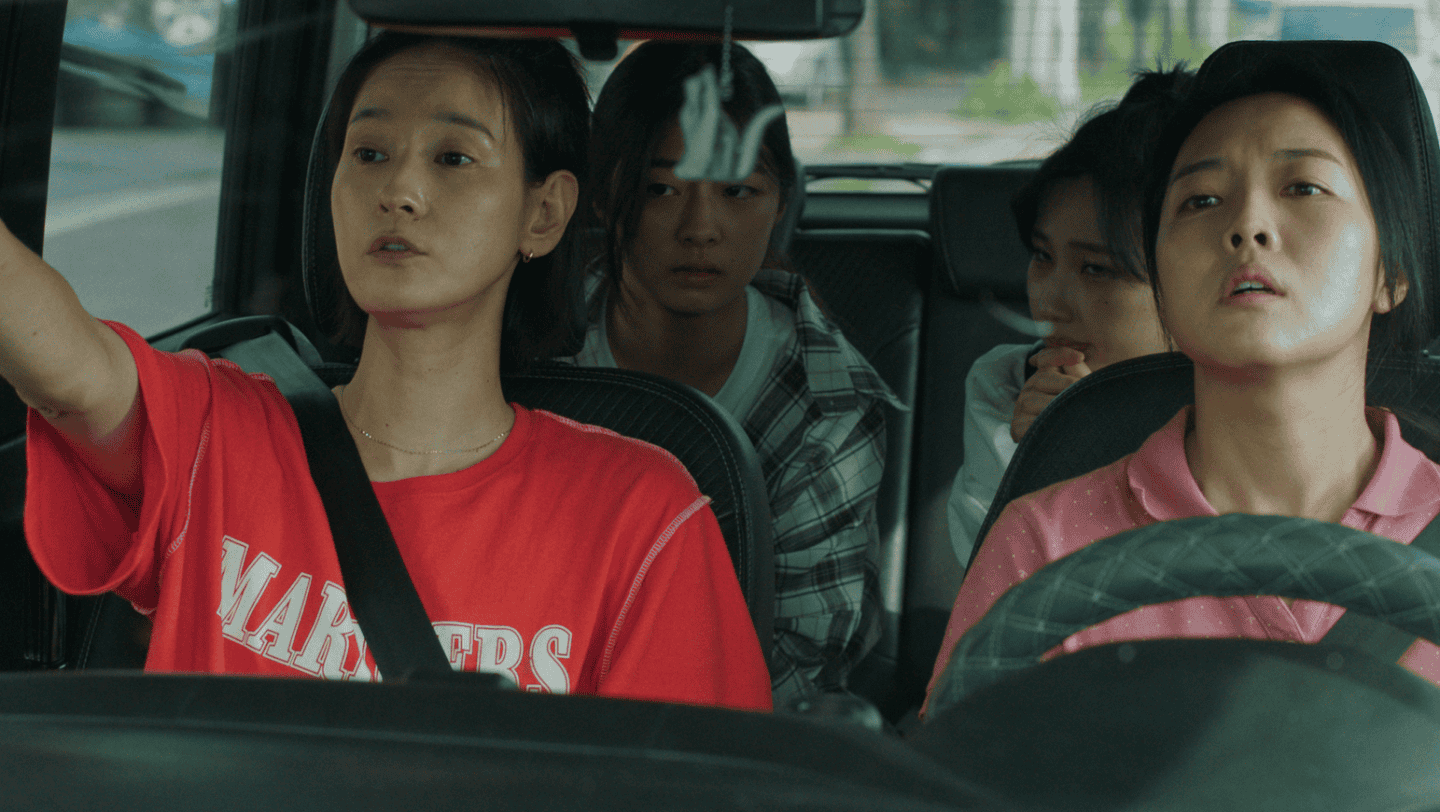
A family of four women (Rie Young-zin, Kang Jina, Jeon Chae-eun, Kim Rei) sets off by car to attend the wedding of an aunt they have not seen in some time. They are in the midst of a crisis: each harbors resentment toward the others, and the two mothers are on the verge of divorce. Yet it seems important for the aunt that they all be there… or at least, that is how it appears, and so the road trip begins. In the film’s early moments, the family’s peculiarity is not immediately clear. Gradually, however, it is revealed that, beyond being an eccentric group, they are indeed centered around two mothers caught in a collapsing relationship.
On their way to the ceremony, they stop at the ancestral home of the Jang family, where they are forced to confront a deeply traditional grandmother. The daughter, Da-sun, is a writer in creative limbo, still haunted by the ghosts of the past: nearly disowned by her father, and treated by her mother as little more than a subject of gossip with the neighbor. And yet, the relief of having once seen her in a happy marriage is still evident. The journey becomes a space for confrontation, conflict, and growth, as the road movie genre demands, especially when a wedding awaits, and a fractured lesbian couple is bound to arrive.
With her debut, Kim Ji-hyun adopts a compelling strategy to approach the persistent taboos surrounding same-sex couples in Korea. Wo has been rejected from an idol-training school precisely because she is the daughter of a lesbian couple; meanwhile, the distress experienced by the other daughter, Chun-sol, finds no support within institutions that should, first and foremost, protect vulnerable youth. It becomes clear that the fault lies with the system, not with the two girls or their dreams.
The ironic lightness with which such weighty, dramatic themes are brought to the screen leaves the impression that the story may at times be almost overly simplified. Yet it is equally clear that this form of accessible cinema has no intention of delving too deeply into denunciation or moralizing. Rather, it consciously gestures toward reality, maintaining a certain restraint, moving through the lightness and irony of the family comedy. In doing so, it allows the audience to engage with a new kind of story, perhaps even to laugh, while speaking about it and reflecting on it. In this sense, Kim Ji-hyun’s film succeeds.
The four women are drawn with coherent characterization, without excessive narrative emphasis, but through a balance that supports the film’s progression. One crisis flows into another without rupture, in a smooth movement that naturally culminates in the final confrontation at the wedding. The almost invisible editing of Yang Dongyeop sustains this continuity, allowing events to unfold without pause. Pauses that are not granted even at night, when rest would be expected.
Each personality, Da-sun, Hee-soo, Wo, and Chun-sol, is also reflected in their distinct outfits, explicitly highlighted throughout the film. A single shot of the shoes placed at the entrance of the ancestral house establishes an immediate connection: each pair unmistakably belongs to one of them. The color palette, equally individualized, works in harmony with the restrained cinematography by Kim Hae-in, resulting in a playful visual composition that occasionally leans toward the sugary, but remains pleasing.
Although not flawless in all its dimensions, the film is nonetheless a project marked by care and gentleness, crafted for its audience with candor. It also reflects the current temperature of Korean popular cinema: while the industry voices concerns over an ongoing production crisis, it continues to produce small-scale films with unconventional ideas (at least within Korean society) that nourish their audiences.
Sitting in the theater, one might realize that perhaps it is neither audiences nor festivals that are “not ready” to engage with stories of homosexuality. It helps mentioning the success of last year’s winner at the same Jeonju International Film Festival, the bold “3670”. “Ideal and Weird Family”, certainly less provocative, moves instead within the realm of comedy, gently reminding us that this otherness exists, and with it, the people who embody it.



