
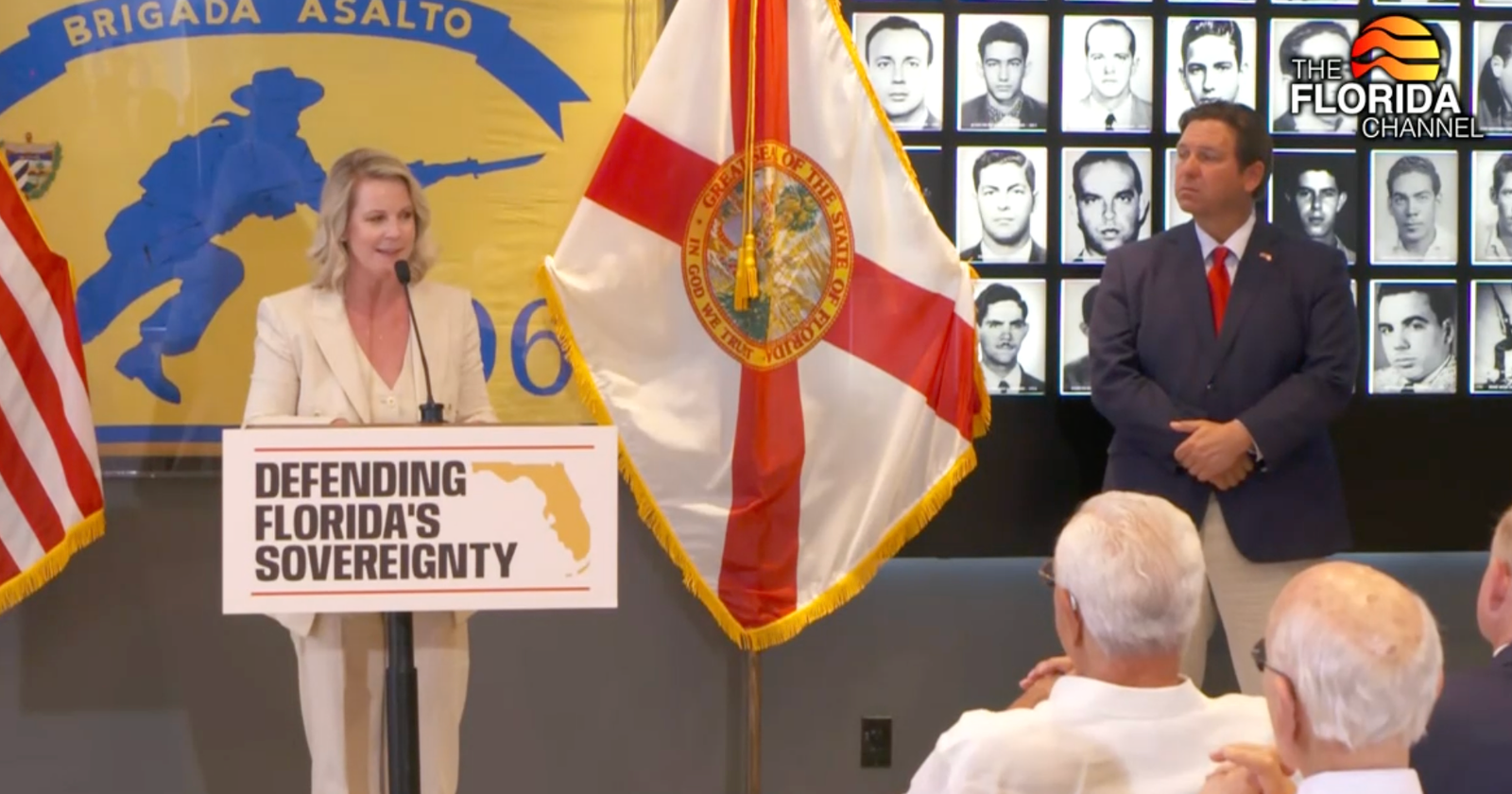
Gov. Ron DeSantis signed into law on Friday restrictions on government contact with what the state lists as foreign “countries of concern” and prohibits public employees and officials from accepting gifts from those countries.
The governor signed the measure (HB 905) into law at the Bay of Pigs Museum & Library in Miami, an appropriate site in that it also spells out support for a “free and independent Cuba.”
The bill says that if the federal government changes Cuba’s diplomatic status, the governor can issue a temporary executive order suspending restrictions on business with the island. It also authorizes a local government or tax collector to revoke any business tax receipt of an individual or enterprise doing business with Cuba in violation of federal law.
After U.S. Special Forces extricated Venezuelan President Nicolás Maduro in January, President Trump made repeated threats that “Cuba is next” but has not engaged in any military action there.
The Trump administration did impose new sanctions on Cuba Thursday. The U.S. State Department said in a statement that the sanctions “are part of the Trump Administration’s comprehensive campaign to address the pressing national security threats posed by Cuba’s communist regime and hold accountable the regime and those who provide it material or financial support.”
(United Nations experts said this week that Trump’s executive order in January imposing a fuel blockade on Cuba amounts to “energy starvation,” the Reuters news agency reported).
The seven countries of concern listed in the legislation — the People’s Republic of China, Russia, Iran, North Korea, Cuba, Syria, and “the Venezuelan regime of Nicolás Maduro” (as listed in the bill) — are already subject to strict regulations in Florida, from limits on pension fund investments to bans on land ownership, government contracts, and academic partnerships.
The bill also bans preplanned adoption agreements and gestational surrogacy contracts if a party is a citizen or resident of one of the seven listed foreign countries of concern.
That issue is related to the concept of birthright citizenship. President Donald Trump issued an executive order on Jan. 20, 2025, claiming that the 14th Amendment grants U.S. citizenship to children born in the United States on depending on the citizenship or immigration status of their parents. That issue went before the U.S. Supreme Court last month.
“I know we’re hoping that the Supreme Court is going to interpret the 14th Amendment, so that we can put a stop to some of the people coming here for a month, having birth, and then going back to China,” DeSantis said. “That’s part of an operation. Why would we let that happen, and grant citizenship under those circumstances?”
The bill was sponsored by Rep. Jenna Persons-Mulicka, R-Fort Myers. She hailed the legislation as about celebrating freedom.
“We know our foreign adversaries are targeting state and local governments,” she said. “And this bill gives local governments additional tools to push back against foreign influence and interference operations.”
No update on ‘Alligator Alcatraz’
The governor weighed in again on a report that federal and state officials are in preliminary talks about closing the immigrant detention center in the Everglades known as “Alligator Alcatraz.”
“We don’t choose who goes there, they send and then they’re staged and then they’re repatriated to their own country,” he said. “And that’s been 22,000 illegal aliens have done that, and if we didn’t have that, presumably many of them would have been released back into Florida communities.”
DeSantis sees some conflict within the Trump administration about needing to close down the facility.
“I think there’s certainly a view, at least some view in the administration, that they still need the beds, but if they tell us that they’re not going to send any more there, then, obviously, we’re not going to just do it just to do it,” he said. “I mean, it was there to serve a purpose. It was never meant to be permanent. And I hope that they have the resources to be able to handle it themselves.”
The cost of operating the facility has been reported in the hundreds of millions of dollars, a sum the feds have yet to reimburse to Florida taxpayers. DeSantis said he isn’t worried about the state being compensated, calling that a “manufactured narrative.”
He questioned the cost of not helping the federal government by opening the facility.
“People don’t usually talk about that,” he said. “They’ll hit the Trump administration, ‘Oh, they’re spending money in here or there to do this, to enforce the law.’ But they don’t really want to talk about what are the costs when you don’t enforce the law. And there are definitely costs to taxpayers with respect to illegal immigration.”
Taking on a potential Democratic presidential candidate?
DeSantis boasted about how tough on crime Florida has been under his tenure and then took a seemingly random verbal shot at Illinois Gov. J.B. Pritzker, a potential Democratic candidate for president in 2028.
“I’ve got the governor of Illinois. He’s chirping now. He eliminated cash bail in Illinois. That makes the people less safe, not more safe.”
He said that during the Covid-19 crisis, Pritzker “locked down Illinois, tight as a tick, and his family was living down in Wellington, living in the free state of Florida. How does that make sense that that would be allowed to happen? And I know a lot of people were very upset about that.”
When Pritzker was asked in April 2020 about a report that his wife and daughter were in Florida when an Illinois stay-at-home order was in effect, he called the question “inappropriate,” according to NBC Chicago.
However, in May 2020, he said his family members had been in Florida before that stay-at-home order went into effect, and then sheltered in place in Florida as directed.
Independent Journalism for All
As a nonprofit newsroom, our articles are free for everyone to access. Readers like you make that possible. Can you help sustain our watchdog reporting today?



