
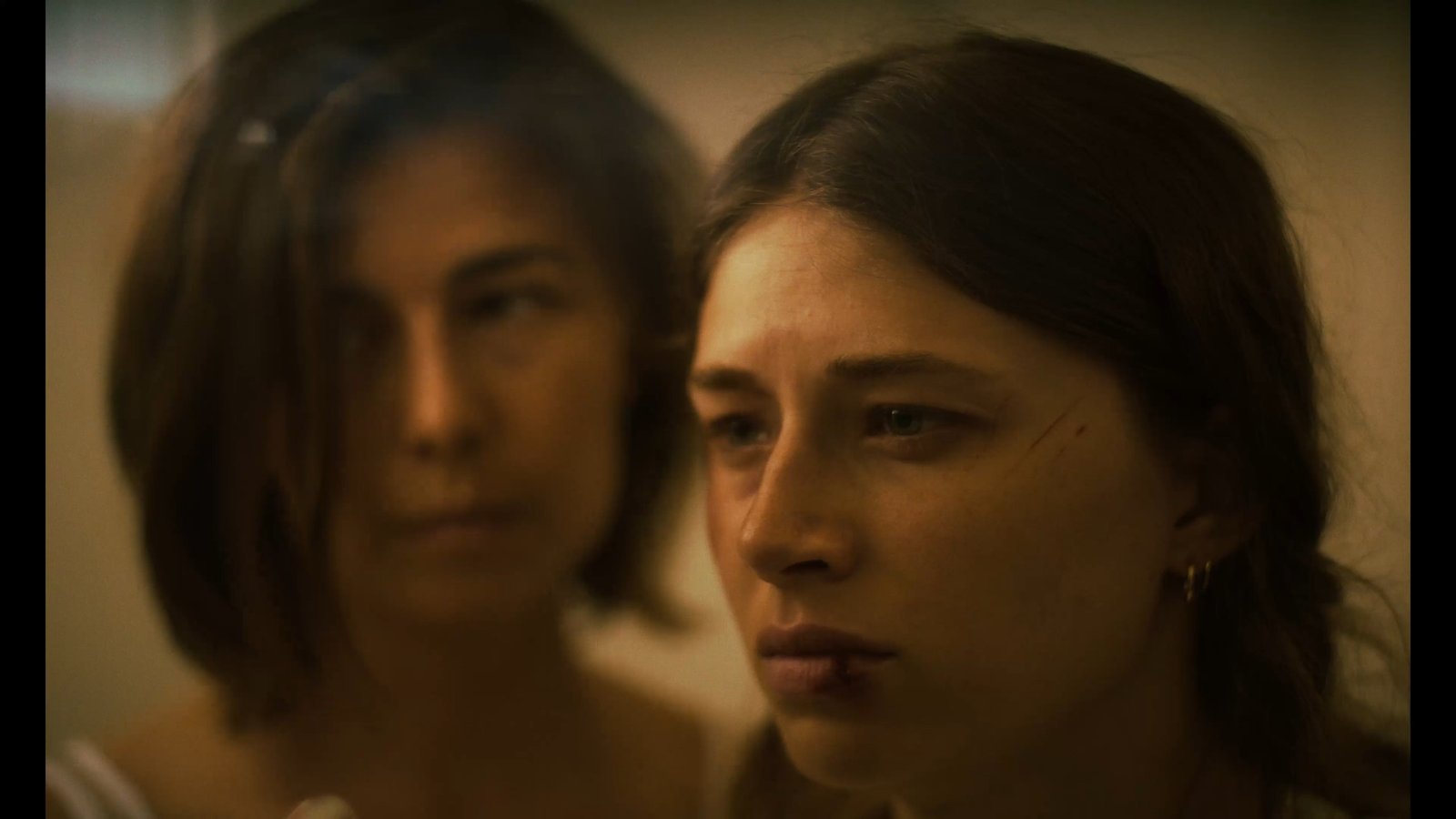
Ari Groobman’s interest in stories about mental health, identity, and culturally diverse experiences is also evident here. In the director’s statement, he explains that his goal was to create the sensation of a dream or nightmare, built around chaos, anxiety, disorientation, and rage. Inspired by works such as “The Evil Dead”, “The Evil Dead II”, “The Lighthouse”, “Watcher”, “The Texas Chain Saw Massacre”, “X”, “Gerald’s Game”, “Possessor”, and “Perfect Blue”, as well as German Expressionism, “Projection” uses framing, editing, color, sound, music, and practical effects in order to visualize the emotional consequences of abuse and the breaking point that follows when someone can no longer keep everything inside. The project was a quarterfinalist at the Vail Screenplay Competition and had its premiere at Screamfest, often described as “The Sundance of Horror”
The movie begins in darkness, with the sound of yelling and fighting, before it cuts to a window in a block of flats and a woman, Katie, watching it from the ground. It seems the sounds come from her past, but her memories are interrupted by Joy, her new landlord, who is not exactly happy that Katie has brought her dog with her. As she goes to see the house, Katie checks out her neighbors, who are also not exactly ideal, with the sound adding to the sense of danger. A tattooed man in work clothes, who watches her intently, completes the “collection”.
Next, Katie tries to convince her sister, Haley, that the place is ok, although the latter acts like a spoiled brat, although not without a reason, as it is soon revealed. A phone call with her father highlights some sort of friction with her mother, with him being apologetic about his wife’s behavior. The progression of the phone call and the next scene, with Katie taking care of Haley’s wounds, showcase a case of abuse. Later on, though, they realize that someone is too eager to welcome them to the neighborhood and that safety is not exactly a given.
The way Groobman combines the family drama with horror works particularly well here, both contextually and cinematically. Regarding the former, the way the interior danger, this time coming from a violent, abusive mother and not a father as is usually the case, becomes an exterior one in home-invasion style, sends a comment about how getting away is not always the solution, and how danger can come from all over.
Stylistically, the way Groobman, through his own editing, ups the ante of the threat, building into more and more dire situations as time passes, emerges as one of the best traits of the movie. At the same time, the fact that the person who seemed the most dangerous ends up helping also makes a comment about how appearances can be deceiving, in a message that could also be perceived as anti-racist.
The excellent job in the sound throughout is another of the 12-minute short’s traits, with the jump scares in the end and the frantic editing adding to the horror atmosphere that eventually takes over. Marc Parroquin’s cinematography works well for the duality of the movie, being more realistic in the first part and more extreme in the last, although there are moments when the low budget becomes evident.
Mikey Gray as Katie is quite convincing both as a victim and a protector, while Preslea Elliott as Haley highlights her justified difficulty nicely. Ian McPherson as the Intruder is as frantic as such a character should be.
“Projection” is a very competent short, showcasing how horror and family drama can be combined, even in low-budget, short form.



