
by Rita Andreetti
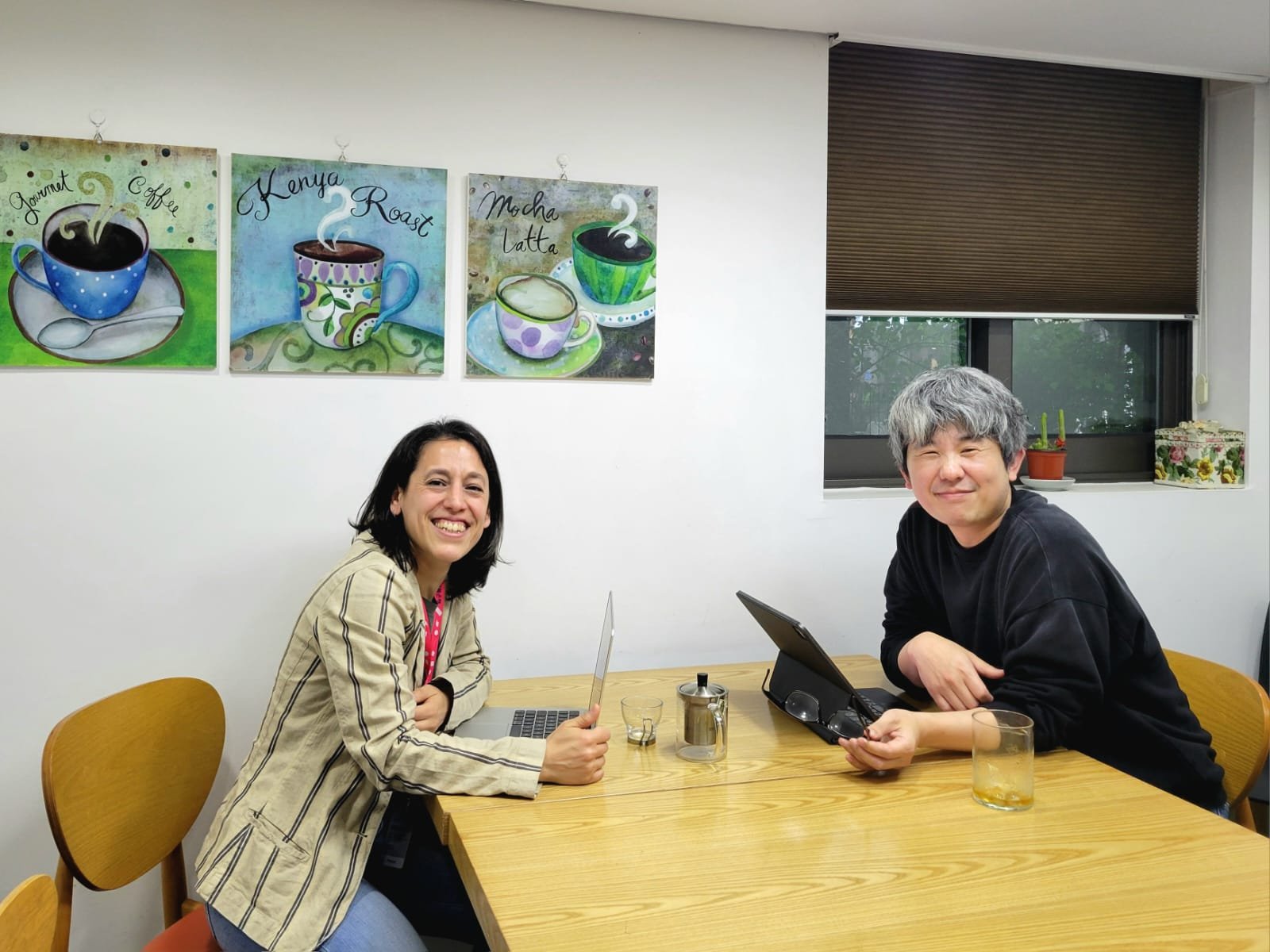
In the ever-stimulating context for auteur cinema that is the Jeonju International Film Festival, we had the opportunity to meet a director who is deeply beloved in his home country: Kim Jong-kwan. His work spans more than two decades, moving quietly but with a careful eye for emotion. His latest film, “Frosted Window”, which premiered at Jeonju ahead of its theatrical release, did not disappoint. At the same festival, Kim Jong-kwan also presented “Worst Woman”, a 2016 film that offered us a natural thread of connection.
Some of his most celebrated works are his recent collaboration with directors Roh Deok, Lee Myung-se and Chang Hang-jun on the anthology film “The Killers”; the earlier “The Table” (2016); and his Korean remake of Isshin Inudo’s “Josee, the Tiger and the Fish”, titled “Josée”, starring Han Ji-min and Nam Joo-hyuk.
The festival was the perfect occasion to sit down with Kim Jong-kwan and trace his narrative arc, following the screening of “Frosted Window”, and being gifted with a sneak peek at his next film, “Day and Night” (working title), which is expected to be released later this year.
This year, the Jeonju Film Festival is screening not only your latest film, “Frosted Window”, but also “Worst Woman”. What kind of dialogue do you think exists between them?
Both films are set in the same place, Seochon, and both use a one-day story structure. There is a ten-year gap between them. I feel like “Frosted Window” is a kind of novel written by the protagonist of “Worst Woman”. Or rather, I felt like I was remaking the themes I had explored in that earlier film, revisiting them, taking them somewhere new.
One of the aspects I admired most in “Frosted Window” is the screenplay’s structure. Could you tell us how you conceived this episodic structure and what is the role played by the changing seasons?
I gave myself one rule: each episode had to take place within a single day. That constraint was the starting point, and the episodes grew from there. I wanted to write about people wandering through Seochon with no clear destination, just drifting, making mistakes. I didn’t want to judge them by any standard, I just wanted to let them be imperfect, and let the audience observe and feel something for themselves.
The seasons are not what drive the episodes, what matters is that each story happens in one day. The work is still structured around the idea that something may feel huge at first, but when you step back, it is rather quite small. Spring came first as an introduction, then autumn, but the emotional weight always comes back to the intimacy of a single day.
You mentioned this film was made after the pandemic. Does that experience shape what is in it?
This is actually the first film I both filmed and released after the pandemic, what came out before was shot earlier. The pandemic changed a lot in me. I wanted to hold two things at the same time in this film: the quietness and dailiness of ordinary life, and the awareness of everything we lost. Both are true. We still have to keep going.
Check the review of the film
I noticed that you were also involved in the set design. How do you construct this relationship between environment, composition, and emotion?
Because the film is so minimal in structure and style, I ended up taking responsibility for almost everything. I shot the opening sequence myself, handled the set design, and was deeply involved in the editing. It’s a more independent film than anything I’d made before, in a way that felt like a new challenge.
I live in Seochon, the neighbourhood where the film is set. I know these streets very well, I walk them every day, I have my coffee in those cafés. I didn’t decorate or alter the spaces at all. I just tried to match each space to the character of its episode. The advantage of knowing a place so intimately is that I could decide on location while shooting, rather than planning everything too rigidly in advance. So I did not have a very detailed plan. I had more of a sketch in mind, and then I adjusted the space and the character together as the film progressed.
So I would not say I was “designing” the space in a conventional sense. I was more interested in using the space naturally, episode by episode.
So did the location inspire the episode, or did you write the episode first and then find the location?
It depends on the case. But for this film, the first decision was simply: I want to write about Seochon. From that point, the locations appeared naturally as I wrote. I wasn’t consciously choosing them, they were just there. What I didn’t decide in advance was casting. I didn’t have any actor in mind while writing. I just worked with rough sketch images, and the rest came during the shoot.
Many of your films feature female characters with striking emotional depth. Even in your more ensemble-driven works, women often carry the emotional core of the narrative. What continues to draw you toward these characters, and how do you develop that emotional intimacy together with your actresses?
I think it’s because the literature, novels, and films that have shaped me tend to tell stories from a female perspective. That’s just what I’ve gravitated toward and been influenced by, and it became the natural way I work. When I make films, I rely a lot on the actors. My scripts do not contain a lot of detailed acting directions. I write the dialogue, but I do not overdescribe facial expressions or gestures.
I want the actors to understand the characters and analyze them for themselves. For example, if a character says “yes,” I do not specify whether that is a smiling yes, a sad yes, or a neutral yes. That means the actor has to imagine the character, study the role, and interpret it. In that sense, the character is created together by the director and the actor.
Do you rehearse a lot before shooting, or is it more spontaneous?
It depends on the project. Sometimes I need very detailed rehearsals, almost like preparing a short play. But sometimes I do not. For “Frosted Window”, we did not rehearse much. We met on set, had a short conversation before shooting, and then started.
One exception was Bora, Jeon So-young, who appears in the second episode. It was her first acting role, so of course she needed more preparation. She was still very new at the time, but now she is famous! We spent time talking about the character and helping her understand it. Rather than rehearsing in a formal way, we focused on helping her enter the character.
Your new film, “Day and Night”, seems to have connection with these we mentioned. Could you tell us a little about it?
It is a very simple film, centered on one café and one conversation. It is a different style, closer to a short play. The English title is “Day and Night”, although it is not confirmed. In Korean, the title means something like “Day and night for each other.” It is another one-location story, but with a different structure.
This brings to mind Jim Jarmusch. I can see traces of his sensibility in your work. “Coffee and Cigarettes”, am I right?
Yes, I love him. I can understand the comparison. It is a very similar kind of project in some ways. I was also inspired by “Broken Flowers”. Of course, the way I make films is very different from Jarmusch’s, but I think there are a few similar elements.
Still, I think the most important thing is to find your own way. If you love something, the best approach is to pay tribute to it while still discovering your own path.
“Frosted Window” revisits a theme that appears throughout your filmography and that international audiences have recently become more familiar with, thanks to “Past Lives” by Celine Song: the concept of inyeon (인연). It feels like one of those words that resists direct translation. What does inyeon represent for you, both personally and cinematically?
Even for Koreans, inyeon is very hard to explain in words. You just feel it.
I didn’t use a conventional narrative structure in this film: I wanted to make something closer to poetry. In a poem, a single word can carry many layers of meaning at once, and I wanted my film to work the same way: the same event, understood differently by each viewer.
The title itself works like that. A frosted window may not give you a perfectly clear image right away, but the closer you look, the more layers you can discover. Inyeon is the same kind of word. It’s layered and resistant to clarity. Very poetic. I like to make films that way, open enough that each person can bring their own understanding to them.
I feel that your cinema often focuses less on dramatic climaxes and more on fleeting gestures, silences, and emotional transitions. Can you relate to that? As a director, what kind of human moment are you most interested in capturing?
I wanted to capture the very small moment when a character finds something within themselves, a kind of self-recognition, or likeness. In Seochon, these people are just wandering around. I’m not interested in how they overcome their problems or change. I just want to observe how they encounter themselves, and I want the audience to observe alongside them and form their own interaction with what they see. I like it when the audience feels invited to participate, almost as if they are putting together a puzzle. And I also think it is important that my approach to the characters is never judgmental.
Looking back at your body of work today, would you say you follow a thread from one film to the next, or does each project feel like starting from scratch?
I’m not a person who is drawn to dramatic change. From the outside, it might look like I’m always doing similar things. But inside, I struggle deeply with every film. When I finish one, a new question appears, and I follow that question. For example: while making “The Table”, I became curious not about the conversation itself, but about how people listen to a conversation. That curiosity became the next film, “Shades of the Heart”. One question leads to the next.
In personal work like this, I can follow those questions freely. In more commercial work, there are other goals and complexities. But in my own films, the journey is simply: ask, follow, discover, and begin again.
So what specific question came out of “Frosted Window”? What’s next?
After “Frosted Window”, I’ve been working on two things. One is a Japanese film, I went to Japan to shoot it, and it’s a continuation of my curiosity as a creator. The other is a new seasonal film, picking up from summer through to autumn. I’d like this kind of seasonal project to become something of a signature for me, a series I can return to and keep building.



