
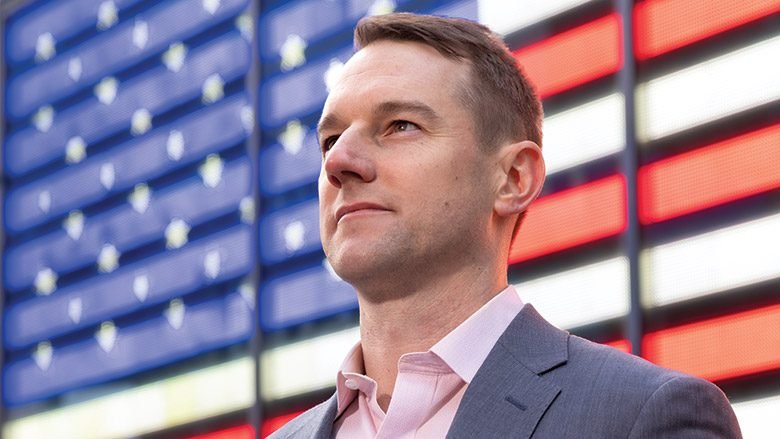
Christopher Hoffman
38, Co-Business Unit Leader, D.C.-Baltimore
DPR Construction
Reston, Va.
Overseeing more than $3 billion in backlog, Hoffman is steering one of the firm’s fastest growing business units. In the role since 2023, he has driven a dramatic increase in revenue, workforce expansion and operational discipline, supported by systems he helped develop across DPR’s Northeast operations. Hoffman previously served as Northeast preconstruction leader, scaling the team from 17 to 70 professionals and implementing lean estimating, target value design and early trade engagement that consistently kept projects within 5% of original budgets.
His leadership on major health care programs—including Children’s Hospital of Richmond at Virginia Commonwealth University and Baystate Medical Center—demonstrates his ability to deliver complex work with precision and innovation. A board member of the ACE Mentor Program of Greater Washington, he champions mentorship and community service, reflecting a people-centered leadership style that shapes DPR’s culture as much as its project outcomes.
How did you break into the industry?
As a sophomore at Brown University, I realized I was drawn to both the science behind buildings and the craft required to bring them to life. Growing up in a family connected to steel and specialized metals, I developed an early respect for the trades and the skilled hands that physically shape our built environment.
I pursued civil and structural engineering because I wanted a deep understanding of how forces move through a structure, how materials behave, and how design decisions translate into performance. But I was equally fascinated by construction itself. To me, construction is where engineering theory meets reality. I wanted to understand not only how a building was designed, but how that design survives real-world constraints including site conditions, budgets, schedules, and the human complexity of bringing dozens of disciplines together.
In 2008, I earned an internship at DPR Construction in Washington, D.C., as a rising senior. That experience showed me how deeply technical and collaborative construction could be from preconstruction strategy to field execution to craft expertise. I’ve remained with DPR in the same office ever since, growing from intern to Business Unit Leader.
What is one challenge that you’ve overcome in your career. How did you overcome it?
Challenges in construction are constant, what defines you is how you respond. Two moments stand out in my career: delivering certainty during the volatility of a global pandemic and leading our business through a temporary downturn.
Looking for quick answers on construction and engineering topics?
Try Ask ENR, our new smart AI search tool.
Ask ENR →
While leading our Northeast Preconstruction team from 2017-2022, we were finalizing the Guaranteed Maximum Price for the VCU Health Children’s Hospital of Richmond at VCU just as COVID disrupted global supply chains. In the span of months, we saw material shortages, labor constraints, extreme weather events, and international instability drive unprecedented cost escalation. Our responsibility wasn’t just to produce a number—it was to give the owner confidence to move forward with a much-needed children’s hospital for the Richmond community. We leaned heavily into data, early trade engagement, scenario modeling, and disciplined target value design. Despite seven months of market disruption between early planning and GMP delivery, the final estimate came within 1% of the completed project cost. That experience reinforced for me that transparency, rigor, and collaboration can bring predictability even in uncertain conditions.
In 2023, my first full year as Business Unit Leader, our DC/Baltimore offices faced a 16% revenue shortfall due to project delays. We had strong backlog for the following year, but the immediate slowdown tested morale. As a self-performing contractor, our people are our greatest asset. Rather than react defensively, we doubled down on communication, training, and preparation for the next growth cycle. Our attrition remained well below industry averages, and we retained our team for a record-breaking 2024 and 2025, surpassing $1 billion in revenue. For me, leadership in difficult seasons is about protecting people, maintaining trust, and building long-term resilience.
What is your favorite project and what challenges did you overcome on it?
Arizona State University Foundation Barrett and O’Connor Center
1800 I Street NW in Washington, DC.
The project was a complex historic renovation that blends preservation with modern functionality in one of the city’s most dynamic urban cores. The project involved completely demolishing and rebuilding the interior structure of a century-old building, while preserving its historic three existing exterior façades, a technically intricate task that required deep coordination between design, engineering and construction teams. The team had to underpin adjacent structures, excavate for a new basement level, install micropiles, and construct a new concrete frame attaching to the existing facade, all while managing extremely tight logistics at a site constrained by heavy pedestrian activity, White House security zones, and limited laydown space.
One of the biggest surprises we faced was the discovery of undocumented conditions in the façade and subgrade while excavation was already underway. To avoid delays, we worked collaboratively with engineers and the design team to engage a structural façade consultant mid-stream and refine our shoring and monitoring strategy, ensuring stability and continuity without impacting adjacent properties. Our approach relied on advanced clash-detection modeling, laser scanning of the exterior shell, robust vibration monitoring and a 4D phasing plan to manage sequencing and schedule with precision.
The outcome is a revitalized eight-story building that preserves historic character while delivering modern office, classroom and conference spaces for ASU’s academic and institutional mission. It stands as a testament to what can be achieved when engineering discipline, construction innovation and collaborative problem-solving converge — and it continues to be a meaningful example of how thoughtful design and execution can honor history while serving contemporary needs. https://www.dpr.com/projects/asu-foundation-barrett-and-oconnor-center
How do you maintain a work-life balance?
I’ve known my wife, Anna, for more than 25 years, and I’ve worked alongside my co-Business Unit Lead (and DPR partner), Adrienne Rosenbaum, for more than 15. Those long-term relationships have shaped how I think about balance. It’s built on trust, accountability, and shared values both at home and at work.
Family life is extremely important to me. Growing up, my parents never missed a sporting event, always prioritized education, and we had dinner together almost every night. Anna and I have tried to create that same foundation for our family. Most evenings, we sit down with our children and talk through our “rose, thorn, and bud”—the highlight of the day, a challenge, and something we’re looking forward to. That rhythm keeps us connected and grounded, and it’s something we’re not willing to sacrifice.
At the same time, construction leadership is demanding. There are early mornings, late nights, and moments that require flexibility. Adrienne and I support and hold each other accountable, ensuring that when one of us needs to prioritize family, the other steps in. She also challenges me to focus my time where it creates the greatest impact driving strategy, supporting our teams, and maintaining clarity in decision-making. For me, balance isn’t about fewer hours; it’s about intentionality, being fully present wherever I am and building systems at work that allow our people to do the same.
What’s your career advice for other young professionals in the industry?
If you want to grow in this industry, say “yes”—especially early in your career. Say yes to the stretch assignment, the unfamiliar scope, or the project that feels just outside your comfort zone. Construction is built on experience, and the fastest way to develop is by taking on responsibility, learning from the field, and exposing yourself to different parts of the business. Many of my biggest growth moments came from stepping into roles before I felt fully ready.
Just as important is staying curious and humble. I’ve learned as much from mentors and trade partners as I have from formal training. Growth comes from observing, asking questions, reflecting on mistakes, and continuously improving. Respect the science behind what we build, but also respect the craft — the best builders never stop learning from the people around them.
Source: www.enr.com



