
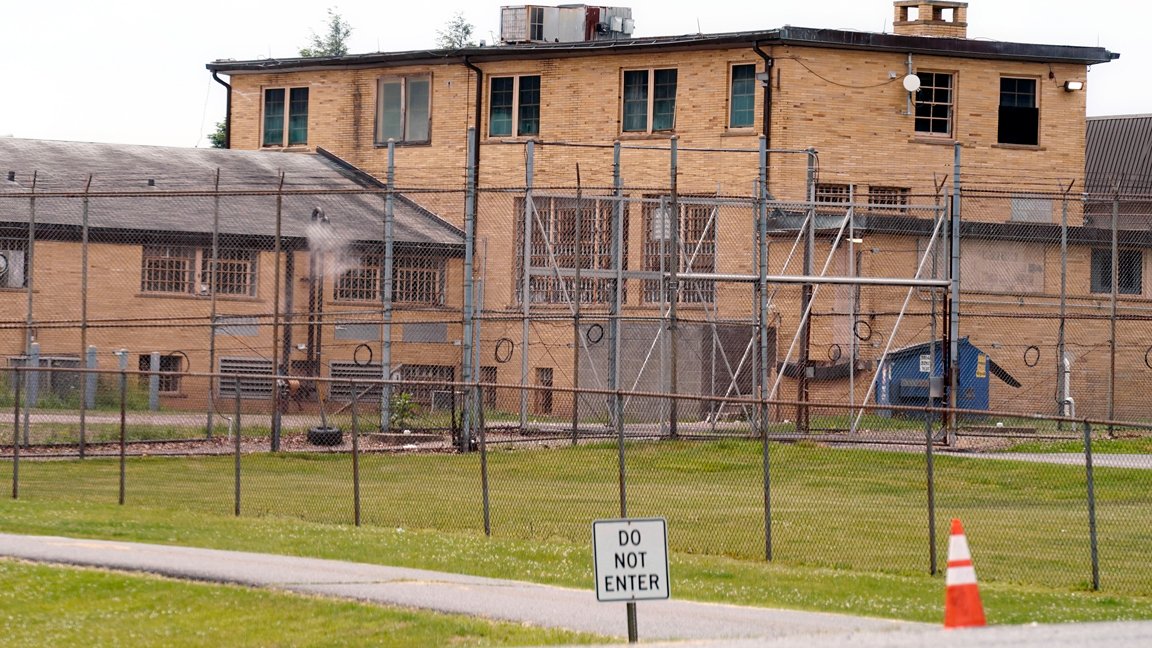
 In October, New Jersey officials had a ceremonial groundbreaking for the replacement of Edna Mahan Women’s Correctional Facility, the now mostly closed women’s prison that became synonymous with sexual assaults and other abuse. The construction’s start, though, is at least seven months away.
Victoria Kuhn, commissioner of the state Department of Corrections, told the Assembly Budget Committee on Monday that the $312 million project should open in spring 2029.
That’s as much as a year later than officials had estimated at the groundbreaking. It’s short, though, of the roughly 2031 opening estimated when then-Gov. Phil Murphy called for demolishing Edna Mahan. The prison opened in 1913 in Union Township, Hunterdon County.

The design was completed last month for the 420-bed prison in Chesterfield, about 34 miles northeast of Philadelphia in Burlington County. In a budget document, corrections officials stated they were working on cost estimates “to ensure fiscal responsibility.” Contracts are expected to be awarded early next year for construction on 33 acres next to the former Albert C. Wagner Youth Correctional Facility, which was closed in 2020.
“There will be pieces of construction that are completed in 2028,” Kuhn said. “Spring of 2029 is the projected timeframe for the actual opening of the entire facility.”
Secure campus-like grounds will enable women able to go from housing units to a dining hall, medical unit, educational and vocational classes and other programming. It will include space for women to visit with family, including any of their children, and to plan for reentry.
Prisoner safety was key to design, as assaults occurred at Edna Mahan for decades. In 2021 the state agreed to federal monitoring of the prison, resulting in an operating consent decree with the U.S. Department of Justice. In all, 70% of the agreement’s requirements have been satisfied, including body-worn cameras for officers, gender-informed training and a revised process for reporting abuse.
Maximum-security prisoners remain at Edna Mahan. About 190 minimum- and medium-security inmates were moved to the former William Fauver Youth Correctional Facility in Clinton. The new women’s prison will include all security levels.
Democratic and Republican Assembly members questioned whether the state may need more facilities. The west compound of New Jersey State Prison in Trenton, which is almost 200 years old, was recommended for demolition in 1918 and more recently by the state’s Corrections ombudsman. Cells get hot in the summer, and are so small that inmates can touch opposite walls with their arms extended.
“Why aren’t we doing anything about that?” Assemblyman Brian Rumpf (R-Ocean) asked. “Do we need to put that on our radar rather than continue to expend a lot of money for a prison that’s literally hundreds of years old and requires significant maintenance?”
Kuhn said that compound houses some of the most challenging and dangerous inmates, and the department was “just trying to be realists” with an estimated $1 billion replacement cost.
“If there was an appetite for building a new maximum-security facility, I would love for folks to work in a state-of-the-art facility — we would appreciate folks living in a state-of-the-art facility,” Kuhn said.
A plan to close East Jersey State Prison is on hold, as New Jersey didn’t enact a parole reform bill that backers had estimated would reduce the prison population by 1,000.
At a Senate Budget Committee hearing last week in Trenton, Sen. Michael Testa (R-Cumberland) asked whether an Edna Mahan replacement is necessary. Women no longer are housed in buildings whose issues included temperature control, leaks and mold. Fixing that old prison would cost about $170 million, Corrections officials said.
“When the announcement that the prison would be closed was made, it was at a time when the state was so flush with cash,” Testa said. About $222 million of the new project’s cost is coming from a fund created to pay upfront rather than borrow.
Testa also questioned the new prison’s size, as a recent law accommodates lighter sentences for domestic violence or abuse victims who have committed crimes. That legislation’s impact won’t be known for years, Kuhn said, and the building is designed to foster rehabilitation and to meet women’s needs.
“I can tell you that I have not been advised to take my foot off the gas in terms of proceeding with the construction of the new facility,” Kuhn said.
This story is made possible in part by the Corporation for Public Broadcasting, a private corporation funded by the American people.



