
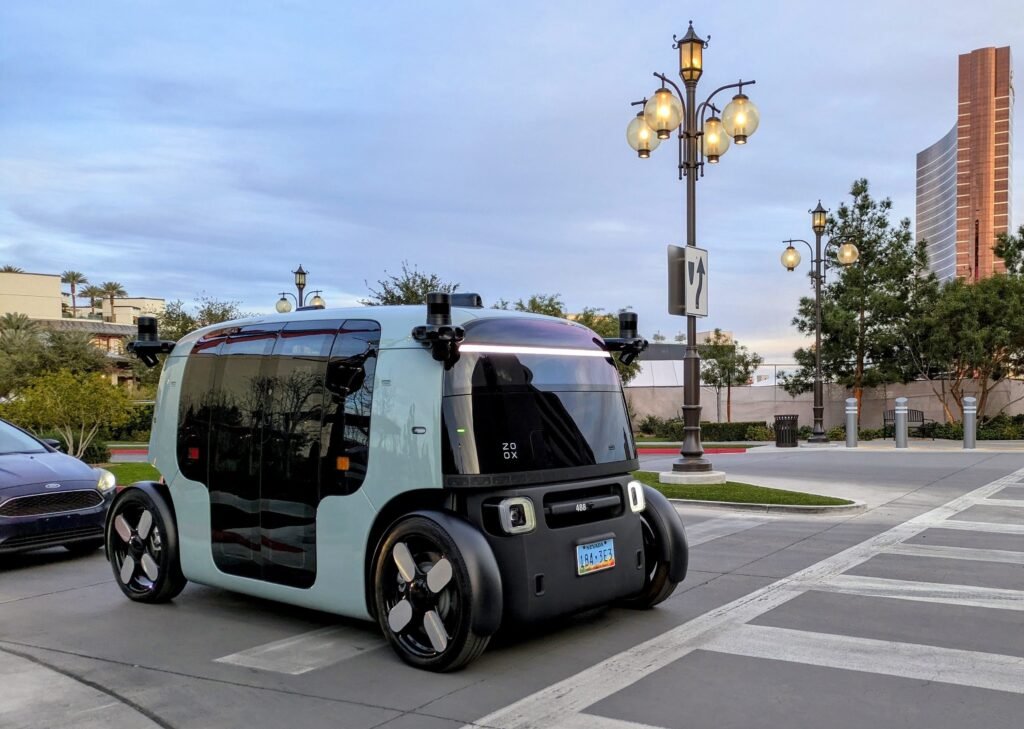
Driverless cars like this one seen in Las Vegas could soon be legal in New Jersey. A new bill would create a three-year pilot program for New Jersey to test driverless cars to ensure road safety before widespread public use. (Photo by April Corbin Girnus/Nevada Current)
Driverless cars could soon be zipping around New Jersey roadways under a proposed three-year pilot program intended to give testers time to ensure the vehicles’ safety.
The Senate transportation committee on Monday unanimously advanced a bill that would also create a task force to help state transportation officials establish protocols on autonomous vehicle crashes, cyberattacks, operational disruptions, liability, and guidelines to ensure the safety of pedestrians and others.
If the discussion sparked déjà vu, that’s because New Jersey has been here before.
Legislators in 2019 passed a law that also created a task force with a similar mission. But that task force issued its report the same day in March 2020 that New Jersey confirmed its first case of COVID-19. In the ensuing pandemic and shutdowns, the report was largely ignored and forgotten.
Sen. Andrew Zwicker (D-Middlesex) was a chief sponsor of both the 2019 law and the current bill.
“100% of our attention was on trying to keep people alive and find medical equipment,” Zwicker said of the forgotten 2019 report.
But autonomous vehicle technology and safety have advanced quite a bit in the six years since the first task force made its recommendations, and driverless cars also have become more widely accepted by the public, Zwicker said. That makes now the right time to get them on Garden State roads, he added.
“We’re talking about a transformative way to transport people and goods in the densest state in the country,” he said.

His current bill has embraced some of the recommendations in the task force’s 2020 report, including requiring the vehicles to be road-tested before the state allows widespread public use and enacting protections against potential cyberattacks.
It also rejects some recommendations. The state Department of Transportation would be the lead agency overseeing testing, instead of the Motor Vehicle Commission as the task force recommended. The task force recommended testing be done with a person in the self-driving car, while Zwicker’s bill requires a human driver for the first phase of testing but allows driverless testing once that phase is completed without incident.
Zwicker also said the new task force his bill would create has a narrower mission centered more on safety than the broad industry study the first task force undertook. It would have to report monthly to state transportation officials on the pilot program’s progress and solicit public feedback.

This is the second time Zwicker has introduced the bill. In the last legislative session, the bill made it through the Senate’s transportation committee in November but stalled over industry and safety concerns, including a five-year timeline for testing.
Zwicker reintroduced it in January and added amendments that shorten testing to three years, require crash reporting, bar self-driving trucks and vehicles larger than a personal car from the roads, and prohibit driverless cars in school and construction zones and high-pedestrian areas, among other changes.
Those changes seemed to do the trick, because all nine people who testified Monday before the Senate’s transportation committee supported the bill. Supporters included business and industry officials, transportation safety groups, a disability rights group, and a representative from Waymo, an industry leader whose driverless “robotaxis” provide 500,000 paid rides a week in Phoenix, San Francisco, Los Angeles, and other cities.
Linda Melendez, president of the National Federation of the Blind of New Jersey, told the panel that driverless cars would be a “game changer” for blind and disabled residents who rely on public transit, ride-shares, and friends to get around.
“Have any of you been denied a ride because of your disability or a guide dog? Have any of you been denied access to something because you can’t get there or no one can help you there?” Melendez said. “Autonomous vehicles represent unprecedented freedom, independence, and reliable point-to-point mobility for the blind, low-vision, and transit-dependent individuals. AVs could reduce dependence on unreliable transportation systems and eliminate discrimination (and) ride denials.”

Shua Sanchez, national campaign director of Safe Autonomous Vehicles Everywhere in the United States, applauded the bill’s safety protections, especially a provision requiring public reporting on driverless car crashes in New Jersey.
“If we pass this bill as it’s currently written, New Jersey will have the strongest safety regulations on autonomous vehicles in the whole country,” Sanchez said. “Having strong safety regulations does not block technological development. It makes sure that unsafe companies don’t have their vehicles unsupervised on the roads and don’t hurt people.”
Some supporters, though, pushed back on specific provisions in the bill, including a $5 million per vehicle insurance requirement.
Jack Ramirez of the New Jersey Business & Industry Association said that requirement would “inflate the cost of doing business in the state.” He suggested lawmakers lower that amount or apply it to a fleet rather than a single vehicle.
“It’s really going to limit the opportunity, the amount of organizations, that can really front that cost,” Ramirez said.
Barring driverless cars from pedestrian-heavy areas could keep them out of cities, raising equity concerns, said Amirah Hussain, director of government relations for the New Jersey Chamber of Commerce.
“This is particularly going to block out urban zones, suburban and mixed-use communities, where the demand for these types of services is often the greatest,” Hussain said.
The bill’s Assembly version is sponsored by Assemblymen Robert Karabinchak (D-Middlesex) and Clinton Calabrese (D-Bergen). It remains stalled in that chamber, awaiting a hearing before the Assembly’s science, innovation, and technology committee.
GET THE MORNING HEADLINES.



