
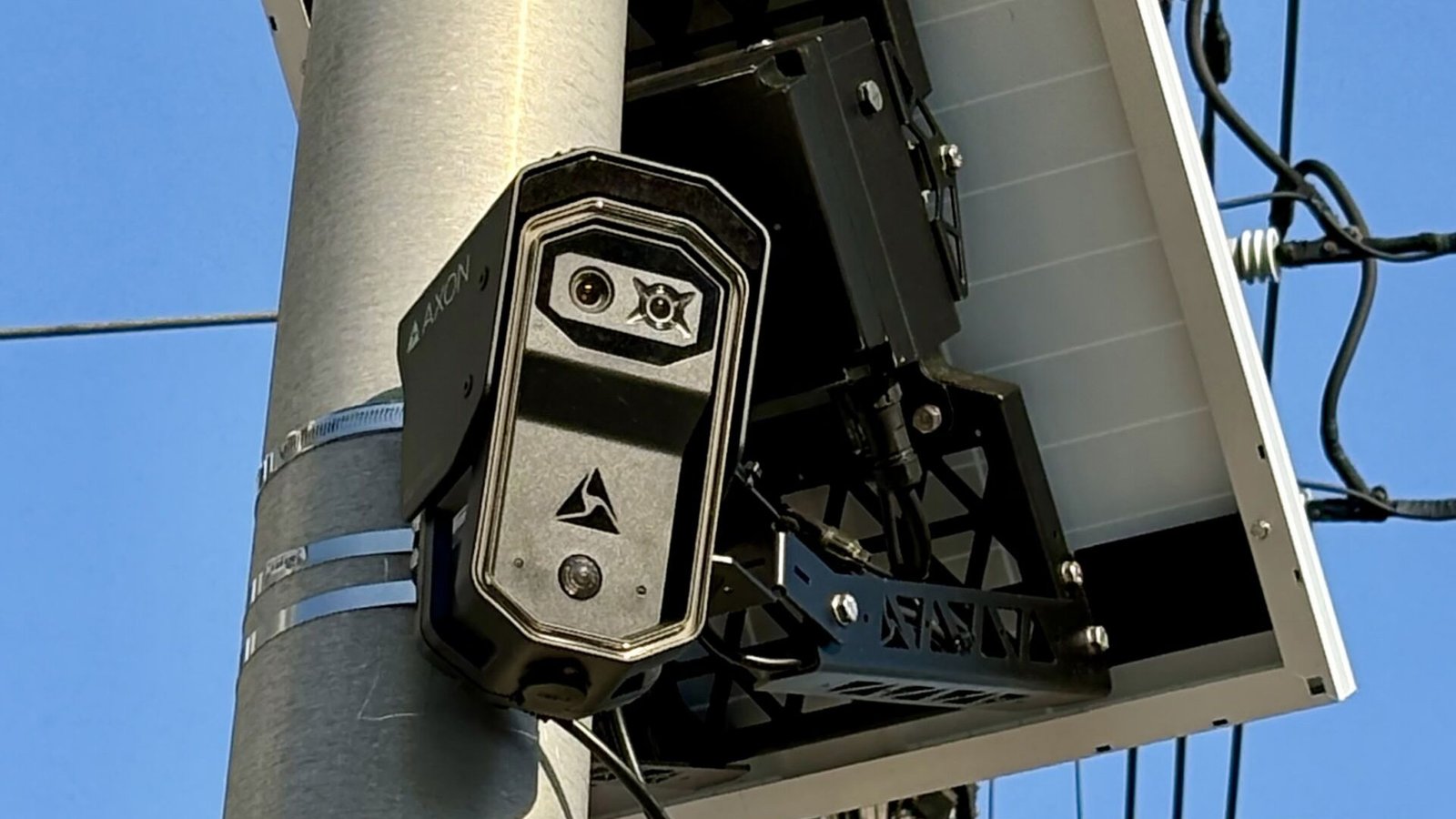
Automated license plate surveillance cameras, key to recent ICE arrests, are coming under increasing scrutiny by lawmakers and privacy advocates who say widespread digital networks are creating hoards of data to track motorists.
Elected leaders in New Jersey and 34 other states have proposed nearly 100 pieces of legislation regarding license-plate readers. Many seek to prohibit states from sharing or selling what may be years’ worth of data that could be used to document vehicles’ movements extensively, according to BillTrack50, which compiles federal and state legislation.
These scanners and cameras can be found on roadsides, traffic lights and police cars. Using multiple photos from various spots, the networks can compile vehicle details, from dents and scratches to speed. The Department of Homeland Security in recent months has made use of a range of electronic surveillance systems, including the readers, to help agents identify and detain people who lack immigration documents.
Cameras around the country
Here’s a look at how some other states are handling license plate readers:
• Connecticut: House Bill 5449, sponsored by Democrats, would limit how long data can be stored for the purpose of investigations based on race, ethnicity, pregnancy status or gender identity.
• Ohio: House Bill 725, sponsored by a Republican, would make it a crime to sell, transfer or share data for commercial use.
• Indiana: Gov. Mike Braun, a Republican, in February signed House Bill 1150, banning homeowners’ associations from installing the systems.
Of particular concern to New Jersey Sen. Linda Greenstein, (D-Middlesex), is the equipment’s potential use in investigations of people seeking legal reproductive health care. A bill she’s sponsoring, S1290, would prohibit New Jersey’s sharing those data with other states.
“In our state reproductive techniques or procedures are legal, and we don’t want to facilitate the work of these other states where it isn’t legal,” Greenstein said. Her bill was released from the Senate Law and Public Safety Committee in February and is awaiting a hearing in the Senate budget committee.
Before and throughout her career, Greenstein has supported legal abortion and reproductive rights and she says her bill aligns with her views. Since the 2022 U.S. Supreme Court landmark Dobbs ruling, which allowed states to restrict abortion services, New Jersey has been put in a difficult position, she said. “We need to defend our laws and make sure things are done our way,” Greenstein said. “We don’t want our law enforcement to be vending or giving information to these states where these techniques are not legal reproductive techniques.”
Assemblyman Brian Bergen, (R-Morris), condemns the data’s being stored for prolonged periods.
“They’re definitely a helpful tool, and I don’t think there’s any expectation of privacy when you’re driving down the road that the police won’t know who you are because you’re in a car with a license plate on it,” Bergen said. “It becomes a problem when information is stored for a lengthy period of time. I do not want a Big Brother government profiling where Brian Bergen drives around the city at times. That is overly intrusive.”

Bergen said he is not opposed to license plate readers for urgent law-enforcement use.
“It’s OK to scan and identify who’s on the road and maybe use that in the immediacy, but to store it and maintain it and track it and put it in databases — that’s just ridiculous. That’s too much,” Bergen said.
In 49 states
The American Civil Liberties Union of New Jersey, a privacy advocate, is “extremely concerned” about the readers, according to staff attorney Dillon Reisman.
“Our attorney general’s policy allows local law enforcement and the whole state to keep automated license plate reader data for up to three years,” Reisman said. “That’s three years in which the entire driving history — the whereabouts of everyone who drives on New Jersey’s roads — can be rolled back, rewound and replayed and surveilled for a long time.”
Reisman called New Jersey’s lengthy storage limit “grossly out of step with standards across the country.”
“Many states have retention limits as short as one month. Some states even have retention limits as short as five minutes,” Reisman said. “I cannot emphasize how absurd it is that we collect it for so long. I mean, would any of us be OK with any officer trailing us for three years? No.”
Atlanta-based Flock Safety, a major AI-surveillance technology company, is forming a vast network across states fueled by law-enforcement agencies, businesses, homeowners’ associations, college campuses and others that contract for the service. Flock has more than 80,000 cameras in 49 states, according to the Center for Human Rights at the University of Washington.
Flock says its equipment is key to preventing crime and providing valuable clues to law enforcement.
In a video on Flock’s website, Josh Thomas, the company’s chief communications officer, says “there’s a common misconception that Flock tracks you wherever you go.” Its equipment captures the rear of vehicles, he says, “not biometric data or faces.” License plates and “visible vehicle characteristics,” he says, are viewable in public. By default, Flock’s equipment erases data after 30 days, though clients can set another retention period.
Flock has said it doesn’t contract with ICE directly, though data captured by its equipment can be shared by local and state law enforcement.
‘Who you spend time with’
Critics say the AI technology, in addition to its use for immigration and reproductive law enforcement, can document people attending rallies and religious services. The ACLU of New Jersey is particularly concerned about its uses against people who cross state lines for gender-affirming care.
“Even if you’re not a member of one of these vulnerable communities, this is something all New Jerseyans should be concerned about,” Reisman said. “Automated license plate reader data, by tracing where you go, can create a very detailed picture of your life: who you spend time with, where you work, where you worship, what health care you seek and where you socialize. All of this information can be accessed for up to three years. Retaining it for a longer period of time only increases the intrusion on someone’s privacy.”
Reisman called for “comprehensive legislation and policies” to prevent “reckless use of surveillance technology” like the plate readers.
“I don’t think any New Jerseyan should rest easy that these systems exist,” Reisman said.
This article was produced through the Statehouse Reporting Project, a collaborative effort by collegiate journalism programs across the country. The lead reporter was Brinda Patel of The College of New Jersey and contributors were Gavin Foster, the University of Connecticut; Luke Shepherd, Franklin College; Sonja Sutcavage and Andrew Otten, the University of Georgia; Jack Bordeleau, the University of Kansas; and Kayla Gleason, Kent State University.



