
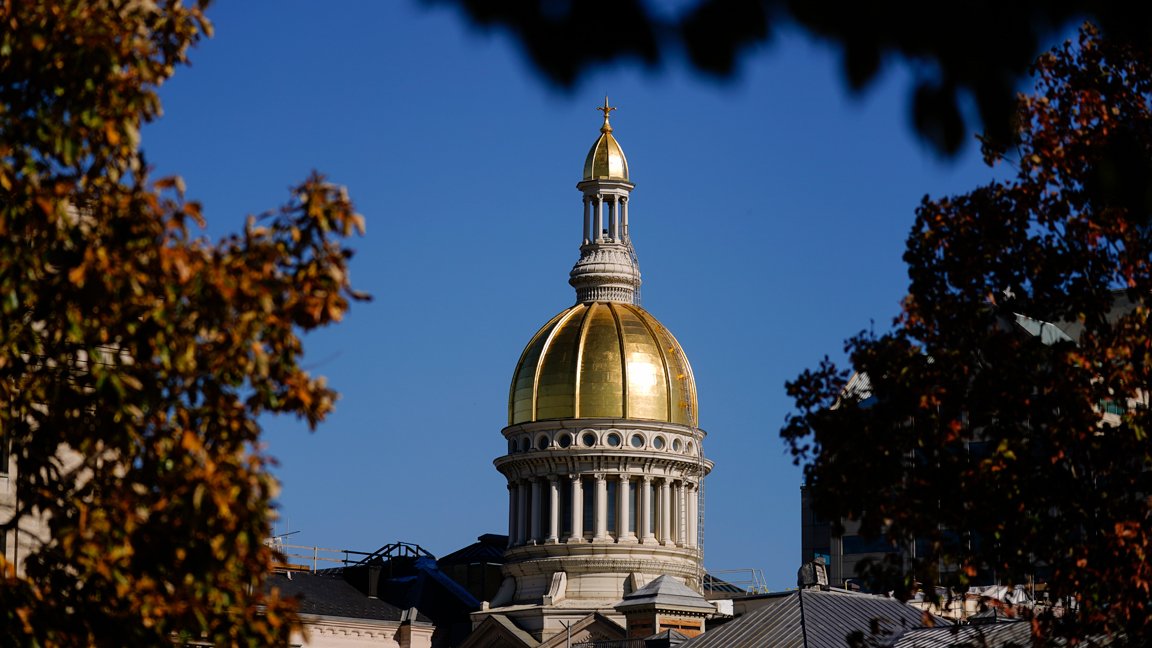
A budgeting report card unveiled by Gov. Mikie Sherrill gives people a new way to track state taxpayer funding for major programs and services, such as health care and schools, direct property tax relief and mass transit.
Not yet appearing in Sherrill’s new online fiscal transparency tool, though, are other allocations funded with taxpayer dollars, primarily through the state government’s annual budget. These are called line items, sponsored by individual lawmakers, and they often benefit only one legislative district, or even a single community.
Nearly all of the hundreds of millions of dollars set aside annually to fund such spending in recent years goes to districts represented by majority Democrats in the Legislature, according to an NJ Spotlight News analysis. In the current state budget, the total was more than 80%.
The spending often is inserted into the budget just days or even hours before the July 1 start of the fiscal year. Typically it is approved with little public explanation or justification.
One example is the $400,000 Democrats tucked into the current state budget for “playground and safety amenities” at a Newark park, according to budget documents. Others are $165,000 earmarked for “tot lot and playground improvements” in Florence, and $50,000 for “recreational improvements” in National Park.
Last year, the individual sponsors of these and hundreds of other similar spending items were not disclosed by Democrats until several weeks after the budget was signed into law on June 30. Almost a year later, it remains publicly unknown who sponsored one item, the diversion of legal settlement money intended to go toward opioid recovery and remediation.
This year, Sherrill, a first-term Democrat, has flagged overspending by state government as a key concern. She is urging lawmakers to help close a wide structural budget gap that she says threatens the state’s financial sustainability. In recent years, the last-minute spending has not been fully offset with new cuts or tax increases, leading to a broader gap.
In March, Sherrill drew notice – and unsettled some in the Legislature – when she put forward a more than $60 billion budget plan that removed much of the spending sponsored by her fellow Democrats in June, when the current state budget came together in Trenton.
In response, some lawmakers are highlighting the spending’s impact in their districts. Others in Trenton compare the legislatively sponsored spending to the federal funding that members of Congress routinely deliver to their New Jersey districts through budget allocations known as earmarks.
Sherrill, though — a former Navy officer and ex-federal prosecutor who was elected to four terms as a congresswoman — raised a key distinction during a recent public radio interview. Congress’ budgeting requires more accountability, she said, and that’s something the “people of New Jersey deserve to see.”
Democrats in charge
Democrats have controlled the Legislature for more than two decades and their clear Assembly and Senate majorities give them a lock on the legislative agenda and the yearly state budget. Democrats hold 82 of 120 Senate and Assembly spots, or nearly 70%.
That margin for the Democrats increased last year in statewide elections, in which Sherrill won the governor’s office with almost 60% of the vote. Democrats, too, dominate New Jersey’s congressional delegation. The state hasn’t elected a Republican to U.S. Senate since Clifford Case in 1972, and Democrats Cory Booker and Andy Kim occupy the seats today. Among the 12-member House delegation, nine are Democrats.
In the state Legislature, partisan-sponsored spending generally does not align with the ratios of Democrats to Republicans, according to an NJ Spotlight News analysis of budget documents over several years.
In the current budget, almost 81% of the more than $580 million in lawmakers’ spending went to Democratic-represented districts. Republican districts received 12%. In other words, for every $6.75 that the Democrats received, the Republicans got $1.
The balance went to districts with split representation, or to entities or projects without a single location or home base.
In some cases, the money went to organizations with broad missions, such as a public college. With those line items excluded, $134 million was the portion of the current budget given to municipal entities, school districts and counties, according to the analysis. Over 96% of that went to districts represented by Democrats, while less than 4% went to GOP-led districts or those with split representation.
Better balance
The spending process worked differently recently when the Department of Community Affairs distributed recreation grants. It used a competitive process, and the result showed a more partisan balance, NJ Spotlight News found.
To qualify, each recipient had compliance requirements, including providing detailed cost breakdowns; certifying that the location was owned by a county, municipality or school district; and listing key project managers or consultants, according to Community Affairs. More than 560 applications were submitted, though they may not have come from every legislative district, a Community Affairs spokeswoman told NJ Spotlight News.
Of the more than 150 Local Recreation Improvement Grants, about 40% went to districts represented by Democrats, and 50% to Republican districts, NJ Spotlight News found.
For years, GOP lawmakers have faulted the majority’s budget practices, arguing that the spending sponsored by lawmakers circumvents state grant programs and encourages political favoritism. Republicans also have raised transparency concerns and flung derogatory labels such as pork and Christmas tree items — the moniker preferred by Trenton insiders — to characterize the handouts.
It was the Democrats’ own party mate, Sherrill, who suggested that the legislatively sponsored spending has contributed to steep fiscal challenges, including a structural budget gap that, unless policymakers change course, is estimated to exceed $3 billion in the fiscal year that begins July 1.

Sherrill, in her March 10 public budget message, told lawmakers she intended to enhance state budget transparency, in part with what she called the New Jersey Report Card, which debuted in late April.
Her own proposed spending plan — the one that stripped the legislatively sponsored spending in place for the current fiscal year — is “the budget we can afford,” she said.
“We’ve given notice that special-interest giveaways are over,” Sherrill said.
The state constitution, though, authorizes lawmakers to draft the annual spending bill that becomes the budget. That’s how legislators, typically in late June, add their own priorities to the governor’s proposal.
It remains to be seen how firmly Democratic legislative leaders will press Sherrill to add new items. A final budget draft from the administration likely will be released this month.
‘Underappreciated’ lawmakers
During a recent interview with NJ Spotlight News, Assembly Speaker Craig Coughlin (D-Middlesex) defended the Legislature’s practice of sponsoring individual spending items. It’s lawmakers, and not the governor, who often are most attuned to their communities’ needs, he said.
“I think people oftentimes underappreciate the role of the Legislature in this process,” Coughlin said.
In passionate remarks during a recent hearing in Trenton, Assembly Budget Committee Chair Eliana Pintor Marin (D-Essex) spoke about the line items by highlighting their impact on communities, particularly in less affluent areas.
“It is important that we step back and call these investments what they actually are,” Pintor Marin said. “They are funding for organizations that serve our most vulnerable residents. They are improvements to parks where our children play, where some may never be able to afford a vacation. They are resources that strengthen neighborhoods and support families in ways that are often not visible on a spreadsheet, but (they) are felt every single day.”
Assemblyman Brian Rumpf (R-Ocean) countered Pintor Marin, questioning whether lawmakers’ spending had only “added to the deficit” that the Sherrill administration is trying to address with spending cuts.
Pintor Marin, a longtime budget committee leader, noted that when her federal counterparts bring federal dollars to their districts to fund local projects, it is “celebrated” back home.
“We shouldn’t lose sight of the fact that doing the same, investing directly in our communities, is part of our responsibility as elected officials, as well,” Pintor Marin said.
Sherrill’s own earmarks
NJ Spotlight News previously reported that Sherrill, who served in Congress from 2019-2025, sought funding for numerous “community projects” through earmarks, as they are known on Capitol Hill.
While Democrats are in the minority in Congress, NJ Spotlight News has detailed how Republicans and Democrats alike routinely secure earmarks.
Congressional earmarks have existed in some fashion since the 18th century, often serving as a form of political currency. For decades, they were doled out in closed-door meetings to build parks, hospital wings and fire stations. Often they went to private contractors, universities or politically connected individuals, too.The term earmark was codified into a formal definition in 2007, according to the Peter G. Peterson Foundation, a nonpartisan budget watchdog group.
In the 1980s, the practice of earmarking expanded — again serving as a way members of Congress could deliver wins to their districts. Corruption and questionable spending followed. During George W. Bush’s presidency, Alaskan lawmakers secured $232 million to build a span from a small town to an island that was home to only a few dozen residents. Alaska’s “Bridge to Nowhere” remains fodder for the earmarking system’s many critics.
Political scandals eventually led to their ban in 2010. Among them was the 2005 guilty plea of California Republican congressman Randy Cunningham, who evaded taxes for years and pocketed at least $2.4 million in bribes from defense contractors for which he had won earmarks. President Donald Trump in 2021 pardoned Cunningham, who died in 2025.
A rebranding in Congress
In 2021, earmarks came back with a new disclosure system.
Gone was the term earmarks — a word some members still view as a near-epithet, given their checkered backstory. In the House, they would be called “community project funding.” In the Senate it was “congressionally directed spending.”
Beyond a rebranding, members now had to file paperwork explaining what they wanted funded, why and for how much. They also had to certify a lack of financial benefit for themselves and family. Certain appropriations bills and projects, in particular for for-profit entities, were off limits.
In an April 2021 letter, for example, sent to the top Republican and Democrat on the powerful House Appropriations Committee, Sherrill asked for funding for the Habitat for Humanity of Morris County.
“The funding would be used for the construction of twenty-five affordable homes and a community room at 42 Bennett Avenue, Randolph 07869,” Sherrill wrote. “I certify that neither I nor my immediate family has any financial interest in this project.” Sherrill secured $3 million for the project, records show. The letter is one of dozens Sherrill signed in her House tenure, like hundreds of other members of Congress.
In the first three budget years of the new earmarking process, New Jersey’s congressional delegation obtained about $840 million for 655 projects, according to an NJ Spotlight News tally. Every New Jersey politician in Congress supports earmarks and has been granted them.
Sherrill secured roughly $42 million in earmarks during that three-year period, in line with what other New Jersey members obtained. Under congressional rules, the state’s U.S. senators are allowed to request more for in-state projects.
Last year, House Republicans canceled all earmarks as part of a spending deal to keep the federal government running — a move that cost New Jersey more than $200 million in expected funding statewide.
“That’s a real loss to people in my district,” Sherrill, frustrated by the cuts, said at the time.
Before she resigned from her House seat in November to become governor, though, Sherrill was able to secure 14 earmarks worth roughly $13 million that will go to police departments, water projects, rail stations and community centers.
In her November resignation letter, Sherrill touted her work over four terms, noting the “funding community projects that support our students, infrastructure, and public safety.”
‘Evidence-based’
Sherrill, the governor since Jan. 20, now finds herself at odds with state lawmakers, including some from her own party who have pitched what they call important local projects to their constituents.
In an interview with WNYC radio host Michael Hill, Sherrill said heard lawmakers argue about the importance of their added spending. She also raised concerns about legislative leaders’ longtime practice.
“We need to make sure that the process works, that there is accountability, that we’re — even if we’re spending money on certain things that sound good — that we’re getting the bang for our buck, that they’re evidence-based, that we’re tracking them,” Sherrill said.
From there, the governor held up as a model the process she followed in Congress to obtain community project funding – the spending that used to be known as earmarks: “It was accountable.”
“We had to make sure that this wasn’t going to a relative,” she said, “or that this was something that the town needed, and show why that was going to make a big impact in our district. “And these are the kind of things that I think people of New Jersey deserve to see.”



